Baby treated with first-ever personalized gene editing treatment


Add Axios as your preferred source to
see more of our stories on Google.
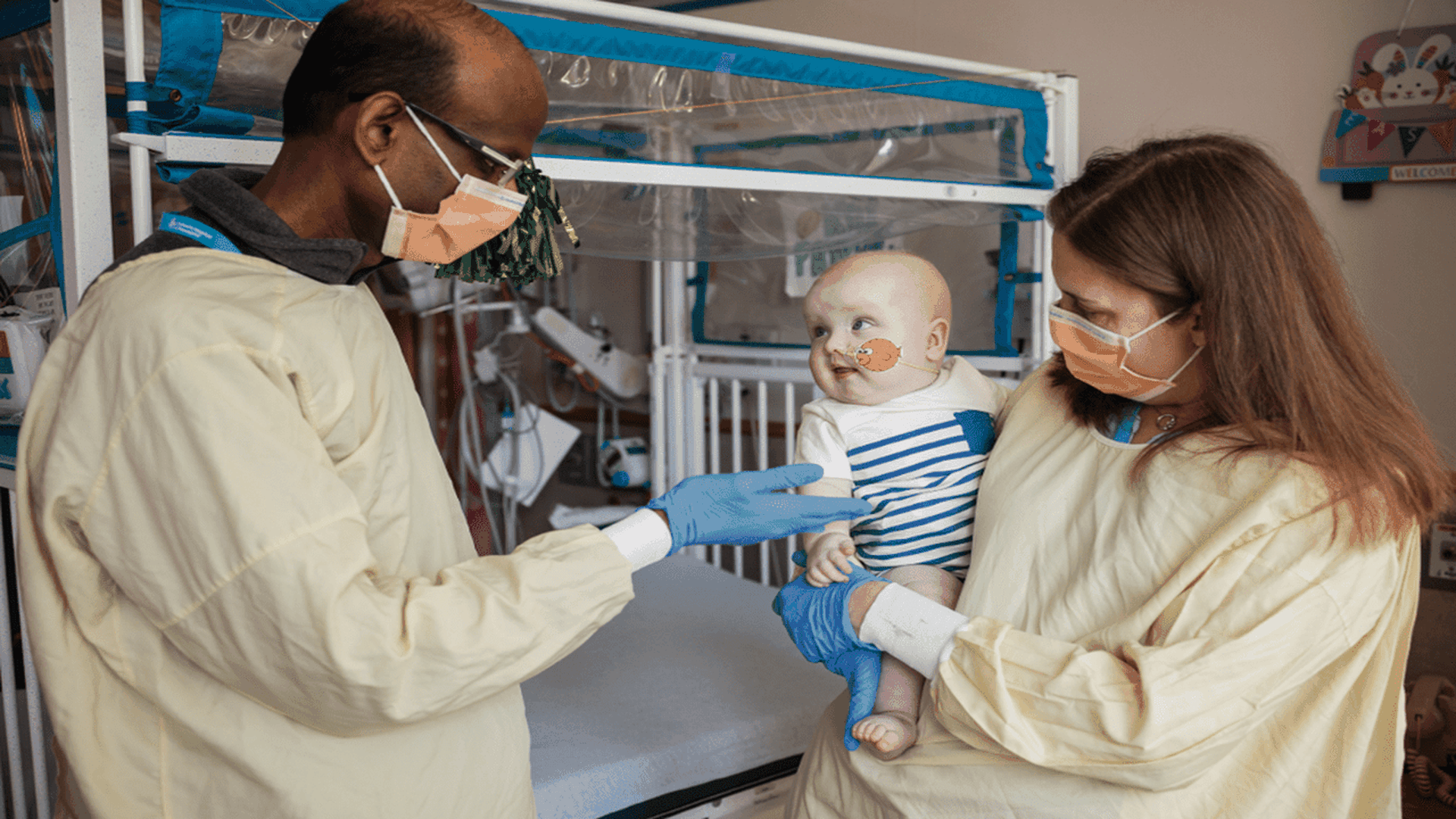
Penn Medicine's Kiran Musunuru (left) and Rebecca Ahrens-Nicklas (right) visiting KJ at Children's Hospital of Philadelphia. Photo: Children's Hospital of Philadelphia via Penn Medicine News
A 9-month-old baby who was born with a rare genetic disorder is the first person to be successfully treated with personalized CRISPR gene editing therapy, scientists in Philadelphia announced on Thursday.
The big picture: This "historic medical breakthrough" could "provide a pathway for gene editing technology to be successfully adapted to treat individuals with rare diseases for whom no medical treatments are available," per a statement from the University of Pennsylvania and the Children's Hospital of Philadelphia.
- While KJ "is just one patient, we hope he is the first of many to benefit from a methodology that can be scaled to fit an individual patient's needs," said a Rebecca Ahrens-Nicklas, an assistant professor of pediatrics and genetics at the Children's Hospital of Philadelphia (CHOP) and the University of Pennsylvania who treated the infant, in a statement.
Driving the news: KJ was born with a rare metabolic disease known as severe carbamoyl phosphate synthetase 1 (CPS1) deficiency, per according from the statement from the hospital and the university's Penn Medicine.
What they did: Researchers "corrected a specific gene mutation in the baby's liver cells that led to the disorder," per a Thursday statement from the National Institutes of Health (NIH), which supported the research, the findings of which were published in The New England Journal of Medicine on Thursday.
- After spending the first several months of his life in the hospital, KJ received the first dose of his bespoke therapy in February.
- He is "now growing well and thriving" after the treatment was safely administered, per the hospital and the university's Penn Medicine.
Context: The research that scientists are hailing as "historic" comes after years of progress in gene editing and decades of federally funded research.
- Gene editing based on CRISPR, which stands for clustered regularly interspaced short palindromic repeat, can precisely correct disease-causing variants in the human genome.
- "CRISPR is an advanced gene editing technology that enables precise changes to DNA inside living cells," according to the NIH.
- "This is the first known case of a personalized CRISPR-based medicine administered to a single patient and was carefully designed to target non-reproductive cells so changes would only affect the patient."
What they're saying: "As a platform, gene editing — built on reusable components and rapid customization — promises a new era of precision medicine for hundreds of rare diseases," said Joni Rutter, director of NIH's National Center for Advancing Translational Sciences, in a statement.
- It's "bringing life-changing therapies to patients when timing matters most: Early, fast, and tailored to the individual," Rutter added.
The bottom line: "This truly is the future for all of these gene and cell therapies," said Arkasubhra Ghosh, who studies gene therapy at Narayana Nethralaya Eye Hospital in Bengaluru, India, per Nature.
- "It's really exciting," added Ghosh, who wasn't involved in the study.
Go deeper: Gene therapy's slow rollout offers a reality check
