Alzheimer's on the rise: Early signs to watch for in adults over 65

Add Axios as your preferred source to
see more of our stories on Google.
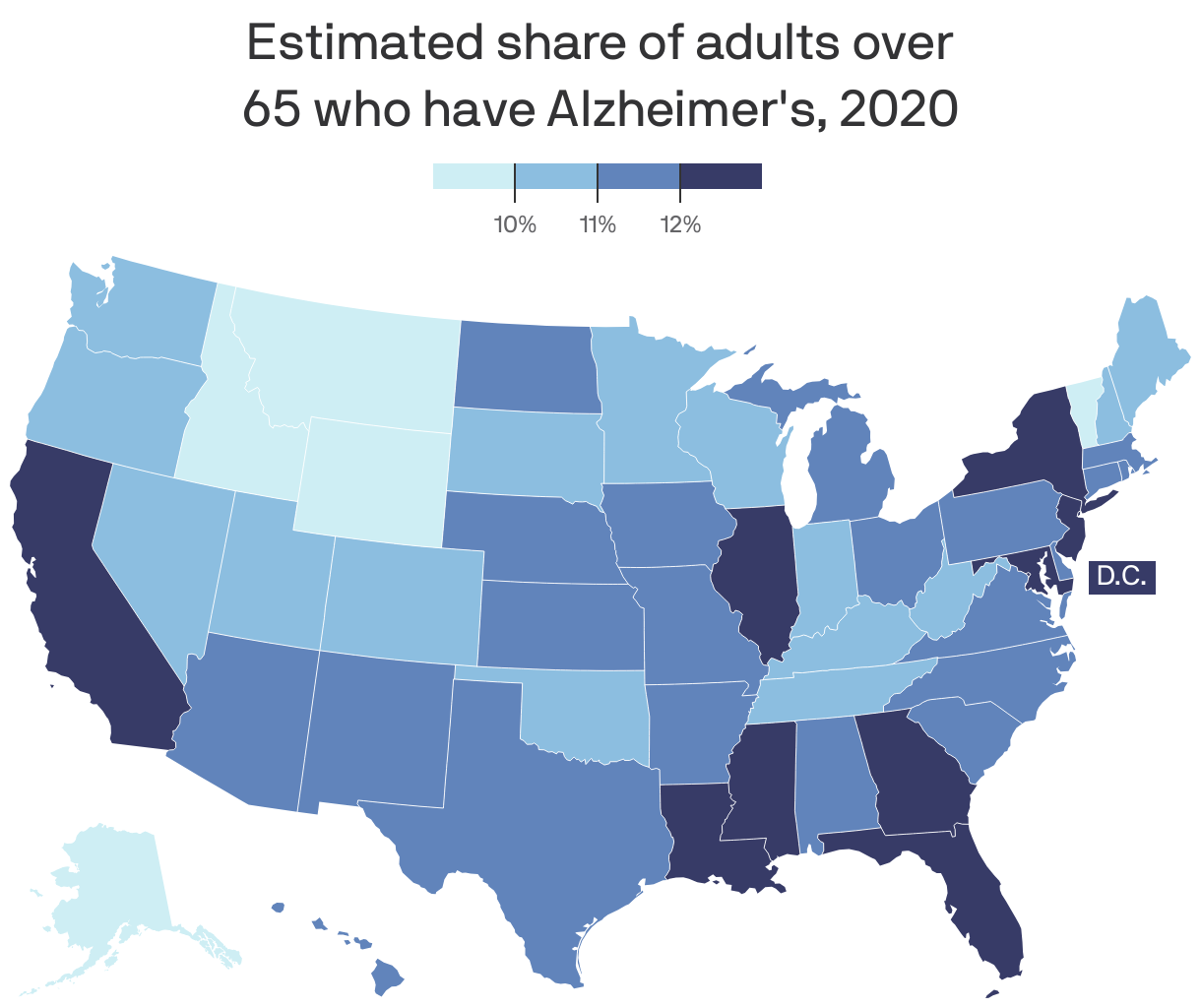
More than 7 million Americans over 65 are now living with Alzheimer's — the highest number ever recorded, per a new Alzheimer's Association report.
Why it matters: That means about one in nine people 65 and older (11%) have dementia believed to be caused by Alzheimer's — but addressing cognitive decline early can help stave off the disease.
By the numbers: 7.2 million adults are estimated to have Alzheimer's nationally, up from 6.9 million last year, per the Alzheimer's Association report.
- Almost two-thirds of Americans with Alzheimer's are women, according to data cited in the report.
- The highest rates of seniors with Alzheimer's are in D.C. (16.8%), Maryland (12.9%), and New York (12.7%), according to the Alzheimer's Association.
- Risk increases with age: 5.1% of people aged 65 - 74 have it; and 33.4% of people 85 and older have it, per the report.
"It doesn't surprise me" that Alzheimer's incidence has increased, because the population is aging and "we're becoming more sophisticated in our options for diagnosing and testing for Alzheimer's disease," Lakelyn Eichenberger, a gerontologist and caregiving advocate at Home Instead, tells Axios.
- With cases climbing and age a key risk factor, early action is critical for managing the disease and accessing new treatments, Eichenberger says.
Warning signs to watch for in high-risk age groups:
- Trouble finding the right word.
- Difficulty judging distances.
- Misplacing things and struggling to retrace steps.
Between the lines: "If you're seeing patterns of these types of signs over an extended period of time," that could signal it's time to see a health care provider about cognitive decline, Eichenberger says.
- If symptoms appear suddenly, however, that could be a sign of a different issue.
- Read about more early signs and symptoms of dementia here.
Be smart: Keeping your brain on its toes, so to speak, can help prevent dementia.
- That means learning new things and staying social.
- For example, doing a word puzzle and talking through clues with a friend checks two boxes for brain health: mental stimulation and social connection, Eichenberger says.
- And don't skimp on sleep. It's a myth that older adults need fewer Zs.
Go deeper: Take a short quiz to assess brain health.
