Newark's perfect storm: What's causing long delays at the airport?

Add Axios as your preferred source to
see more of our stories on Google.
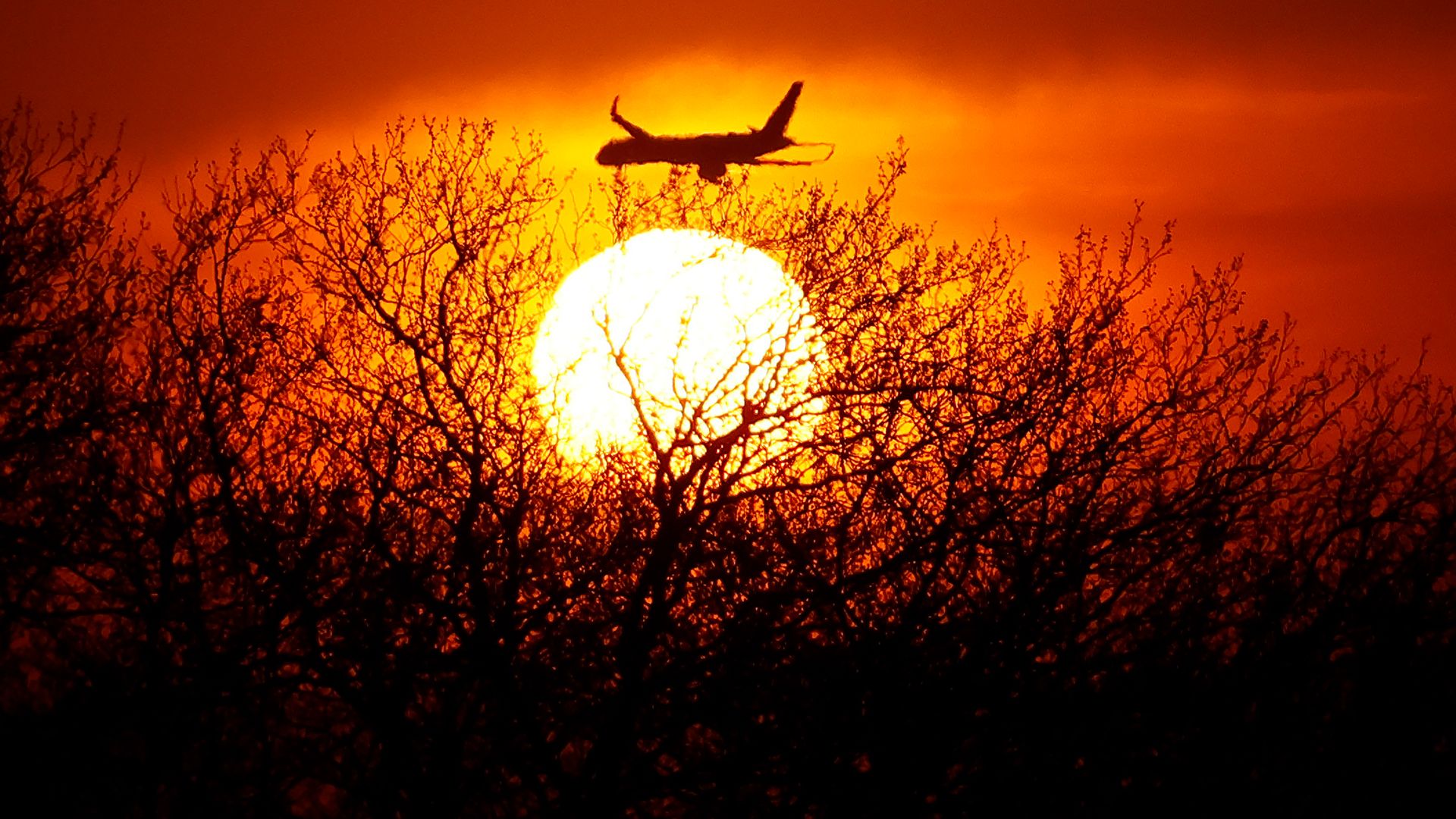
An airplane approaching Newark Liberty International Airport passes over the sun at sunset on April 19 in Jersey City, New Jersey. Photo: Gary Hershorn/Getty Images
A compounding mess at Newark Liberty International Airport in New Jersey led to days of flight delays and cancellations.
The big picture: Several factors collided to fuel more than a week of airport headaches, the most prominent being a shortage of air traffic controllers.
The latest: The FAA imposed a new ground delay program for Newark Tuesday morning and estimated delays averaging 2 hours and 41 minutes. On Monday afternoon, the agency estimated delays averaging nearly four hours for flights heading to Newark.
- The FAA did not respond to Axios' request for comment on the cause of the delays. Tuesday's update pointed to staffing, wind, low cloud ceilings and runway construction.
- There have been 80 flight cancellations and another 80 delays at the airport as of Tuesday morning, according to data from tracking website FlightAware.
- On Monday, there were more than 400 delays and 160 cancellations. United alone delayed over 200 flights.
Catch up quick: On April 28, controllers at a Philadelphia air traffic control center responsible for separating and sequencing aircraft in and out of Newark "temporarily lost radar and communications with the aircraft under their control" and were "unable to see, hear, or talk to them," the National Air Traffic Controllers Association confirmed in a Monday statement to Axios.
- The union — which represents nearly 20,000 controllers, engineers and other aviation safety-related professionals — said that due to the ordeal, controllers took absences under the Federal Employees Compensation Act.
- The statement added that they did "not 'walk off the job'" as some reports said.
- News of the incident comes amid days of delays and cancellations at the airport.
Driving the news: United Airlines announced in a Friday statement that it would be removing 35 round-trip flights per day from its schedule at Newark, a major hub for the airline.
- United CEO Scott Kirby pointed to persistent air traffic controller shortages and technology issues that resulted in diverted, delayed and cancelled flights in his statement. Some controllers took trauma leave after briefly losing their radio and radar feeds, exacerbating the shortages.
- "Keep in mind, this particular air traffic control facility has been chronically understaffed for years and without these controllers, it's now clear – and the FAA tells us – that Newark airport cannot handle the number of planes that are scheduled to operate there in the weeks and months ahead," Kirby said.
"Our antiquated air traffic control system is affecting our workforce," the FAA said in a Monday statement.
- The agency noted that some controllers at the Philadelphia TRACON had "taken time off to recover from the stress of multiple recent outages."
- It added, "While we cannot quickly replace them due to this highly specialized profession, we continue to train controllers who will eventually be assigned to this busy airspace."
Zoom out: Senate Minority Leader Chuck Schumer (D-N.Y.) on Monday called for an inspector general investigation into the issues at Newark, warning the chaos there could "very well be a harbinger if issues like these aren't fixed."
Last week, NBC's Tom Costello reported that a veteran controller told him to avoid the airport at all costs.
- It's a stunning situation at an airport that the Department of Transportation listed in its top 20 busiest based on passengers boarded last year.
Context: The mess was not caused by one issue alone, Axios aviation expert Alex Fitzpatrick notes.
- On top of staffing shortages, technology errors and bad weather, one of the airport's runways remains closed until mid-June for "rehabilitation work."
What they're saying: "The technology that we are using is old," Transportation Secretary Sean Duffy said Friday in a post on X. "That's what is causing the outages and delays we are seeing at Newark."
- He continued, "If we don't act, we will start to see these issues across the national airspace." Duffy added that he will soon unveil a plan for "an all-new air traffic control system."
- Duffy last week announced a new package of actions to boost air traffic controller recruitment and retention, which included incentives to keep controllers from retiring and financial awards for new hires and academy graduates.
State of play: It's not just Newark being plagued by staffing deficits.
- A large slice of U.S. air traffic control facilities are understaffed, per FAA data. Though it's been a long-standing issue, January's mid-air collision near Reagan National Airport sparked elevated awareness of the shortages.
Go deeper: Musk wants retired air traffic controllers to resume work, but it's not so easy
Editor's note: This story has been updated with a statement from the the Federal Aviation Administration.
