Stephen Miller: Most Americans would pay more for U.S.-made dolls

Add Axios as your preferred source to
see more of our stories on Google.
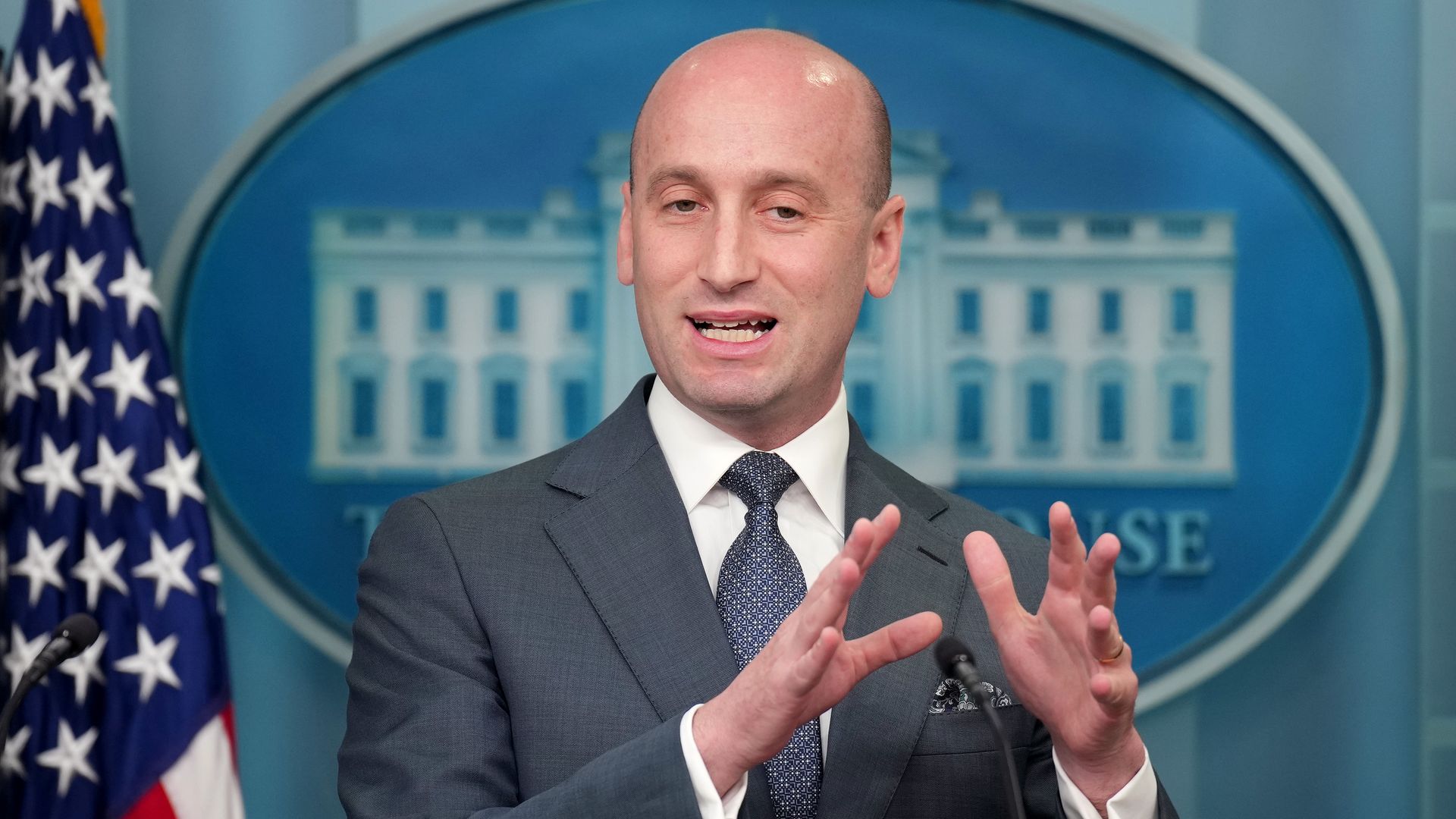
White House Deputy Chief of Staff Stephen Miller speaks in the Brady Press Briefing Room at the White House on May 1. Photo: Andrew Harnik/Getty Images
The doll debate continues: After President Trump acknowledged that toy shortages were a possible tariff side effect, Deputy Chief of Staff Stephen Miller argued that "almost every American consumer" agrees they'd pay more for an American-made doll.
The big picture: Miller on Thursday emphasized the administration's persistent argument that tariffs would force manufacturers to produce more goods in the U.S. — but domestic retailers fear the trade war with China will leave prices higher and shelves empty.
Driving the news: Asked about the president's acknowledgement that dolls might cost more under the trade war with China, Miller contended that Trump was making the point that most American consumers would choose an American-made toy over a Chinese-manufactured one.
- Presented with "the doll from China that might have ... lead paint in it that is not as well-constructed" and "a doll made in America that has a higher environmental and regulatory standard and that is made to a higher degree of quality," he said, "you probably would be willing to pay more for a better-made American product."
- But he added that tax and regulation cuts means it "will be cheaper than ever to make and manufacture in America."
Catch up quick: Miller's and Trump's comments come among concerns the 2025 holiday shopping season will be significantly disrupted as imports are expected to plunge and prices are primed to rise.
- Trump, speaking to reporters Wednesday, acknowledged that "Somebody said, 'oh, the shelves are gonna be open.'" He continued, "Well, maybe the children will have two dolls instead of 30 dolls, and maybe the two dolls will cost a couple of bucks more."
- Treasury Secretary Scott Bessent echoed that sentiment in March, saying that "access to cheap goods is not the essence of the American dream."
- Factories in China produce nearly 80% of all toys sold in the U.S., per the New York Times.
The American-made divide
By the numbers: Polls suggest that there are divides in consumer sentiment regarding where a product is made.
- According to polling earlier this year from the Ipsos Consumer Tracker, a majority (56%) do say they like buying American, even if it costs more — but Republicans are around twice as likely to agree with that statement as Democrats.
- Around 64% of respondents said they agreed American-made products were better quality.
A 2022 survey from Retail Brew and The Harris Poll of 1,986 US adults found that nearly half (48%) said they'd be willing to pay around 10%–20% more for an American-made good.
- 17% said they'd be willing to pay around 30% more.
Afina, a company that makes shower heads, recently put the choice to the test. They offered a secret landing page with two identical products, one labeled "Made in Asia" for $129, and another that was "Made in the USA" priced at $239.
- Forbes notes that the higher price was based on a manufacturing cost three times as high in the U.S. as it is in China and Vietnam.
- In the end, while site visitors added two dozen USA-made products to their cart, there were no final purchases. There were, however, over 580 purchases of the Asian-made product.
What we're watching: The administration recently signaled a softer stance on China, as CEOs privately warned him his trade policy could disrupt supply chains and raise prices.
- "We're doing very well with respect to a potential trade deal with China," White House press secretary Karoline Leavitt told reporters last week.
- Miller on Thursday, asked about the end goal of the levies on China, said Bessent is "in the process of developing a plan that will answer" such questions.
- But he added, "Tariffs will bring significant revenue into this country that will allow us to pursue our dramatic plan of tax cuts and reforms."
Go deeper: Bessent: No supply chain shocks ahead from tariffs
