Oklahoma religious charter school case could hinge on Chief Justice Roberts

Add Axios as your preferred source to
see more of our stories on Google.
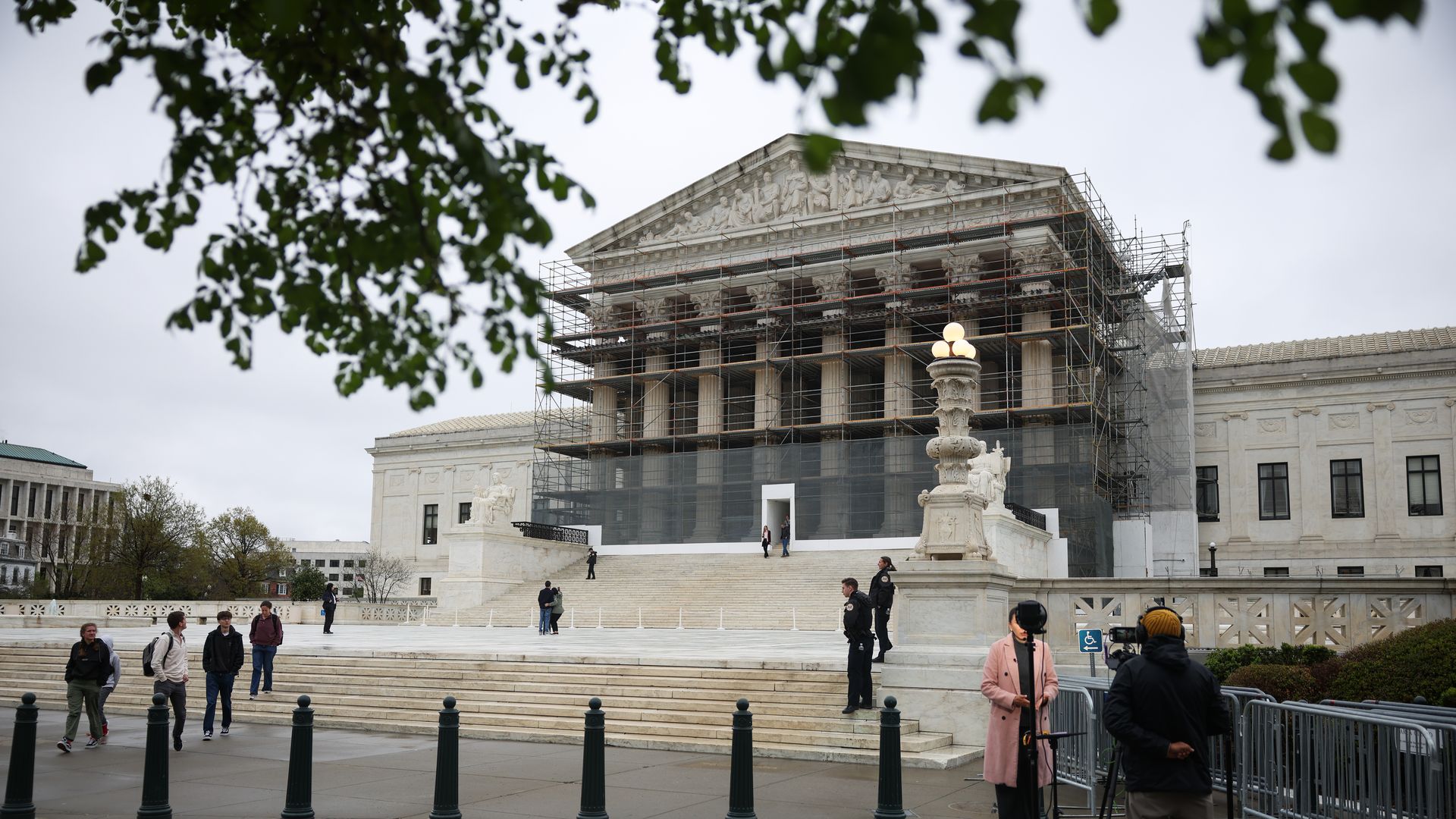
The U.S. Supreme Court is seen on April 7 in Washington, D.C. Photo: Kayla Bartkowski/Getty Images
The Supreme Court's conservative majority Wednesday indicated it would be open to allowing the country's first religious charter school, with some hesitancy from Chief Justice John Roberts.
Why it matters: The Oklahoma bid, which centers on a proposed Catholic virtual school, challenges the U.S. doctrine of separating church and state.
- The ruling, expected over the summer, will have ramifications for charter school systems in place in nearly every state.
- Charter schools are publicly funded but operate independently of the traditional public school system. They are tuition-free for students.
Zoom in: The court on Wednesday seemed mostly split among ideological lines, but Chief Justice John Roberts expressed some skepticism. He could be the deciding vote, as Justice Amy Coney Barrett recused herself from the case.
- The conservative justices questioned why a religious charter school is distinct from other religious groups that receive public funding. Gregory Garre, an attorney representing the Oklahoma attorney general, who is challenging the charter school's creation, said the state directly establishing the school makes it distinct from funding a nonprofit.
- The liberal justices questioned how religious charter schools could favor certain religions over others.
Driving the news: Oklahoma's statewide Virtual Charter School Board voted 3-2 to approve the St. Isidore of Seville Virtual Charter School in 2023.
- Oklahoma Attorney General Gentner Drummond (R) said the school violated both the Oklahoma and U.S. constitutions. In June, Oklahoma's Supreme Court ruled the same.
Context: The school, proposed by the Catholic Archdiocese of Oklahoma, plans to incorporate Catholic teachings into its instruction.
- The Oklahoma Charter Schools Act stipulates that charter schools must be nonsectarian in their programs and operations.
- "A sponsor may not authorize a charter school or program that is affiliated with a nonpublic sectarian school or religious institution," the law said.
Zoom out: The Supreme Court has recently been sympathetic to expanding public funds to religious schools, notably in 2020 Montana and 2022 Maine cases.
- Both of those cases involved private schools, but the mostly conservative court has also been inclined toward expanding religious freedoms at public schools.
- Earlier this month, the court seemed likely to back religious opt-outs for LGBTQ-themed books in schools.
What we're watching: Coney Barrett recused herself from the Oklahoma case without providing a reason. This means the case could deadlock at 4-4.
- She previously taught at Notre Dame, and the Notre Dame Law School's Religious Liberty Clinic represents the potential charter school.
State of play: Public charter legislation has been passed in 45 states and Washington, D.C. as of fall 2021, per the National Center for Education Statistics.
- Montana, Nebraska, North Dakota, South Dakota and Vermont are the exceptions.
Go deeper: Oklahoma Supreme Court rules religious public charter school unconstitutional
Editor's note: This story has been updated with details from oral arguments.
