Big Ten faculties ask their administrations to sign a joint defense pact against Trump

Add Axios as your preferred source to
see more of our stories on Google.
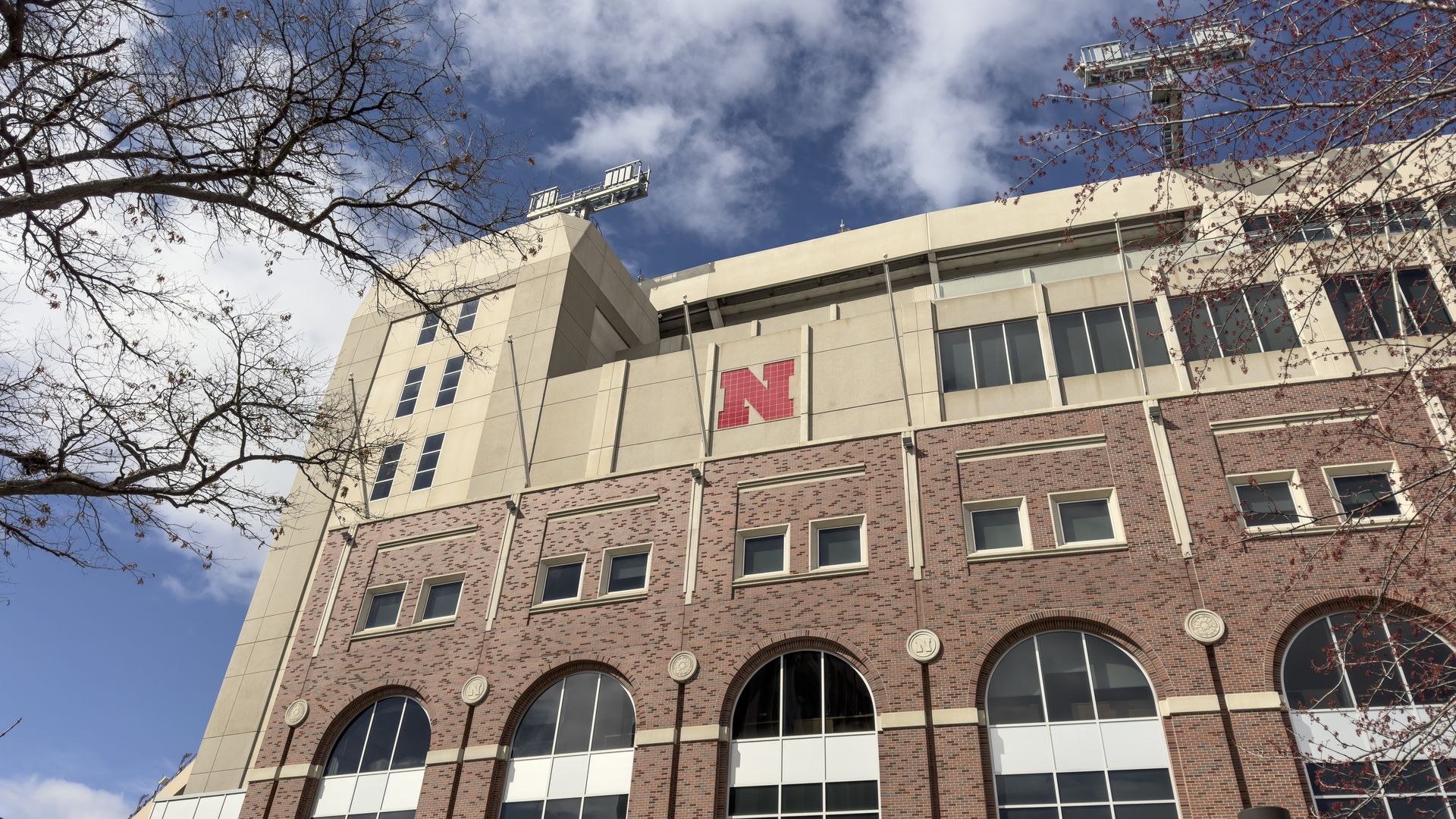
A general view of the exterior of Memorial Stadium on the campus of the University of Nebraska-Lincoln in March 2024 in Lincoln, Nebraska. Photo: David Madison/Getty Images
Faculties at several Big Ten universities have asked their administrations to consider a joint defense pact in the face of threats to higher education institutions from the Trump administration, multiple outlets reported.
Why it matters: The potential pact would mark an escalation in resistance from universities to President Trump's push for them to follow his agenda, which has so far largely targeted private, elite schools.
- The Big Ten, a college athletic conference with 18 member schools, is made up of 16 public universities and two private universities, Northwestern University and the University of Southern California (USC).
- Northwestern has been a target of a funding freeze amid an ongoing civil rights investigation related in part to one of its legal clinics representing a pro-Palestinian activist.
- Several other Big Ten schools — including USC, Rutgers, Michigan and Indiana — are also under investigation for alleged Title VI violations "relating to antisemitic harassment and discrimination," per a March letter from the Department of Education's Office for Civil Rights.
State of play: Described as a "NATO-like agreement," the pact would allow the Big Ten institutions to share attorneys and financial resources if the Trump administration targets one of its members, per the Washington Post.
- Faculty and university senates at the University of Minnesota, Indiana University, University of Nebraska at Lincoln, University of Michigan, Michigan State University, Rutgers University and University of Washington have signed resolutions asking their leadership to adopt such an agreement.
The latest: The Big Ten Academic Alliance's Board of Directors said in a recent statement it was not involved in the recent resolutions and that they "do not represent the position of the Big Ten Academic Alliance."
Zoom in: Faculty senates at the Ohio State University, the University of Wisconsin-Madison and the University of Illinois Urbana-Champaign are expected to consider similar resolutions in the coming weeks.
- Any final decision to activate the proposal will come from university administrations.
What they're saying: Several schools, including the University of Washington and the University of Michigan, are working with the Association of American Universities, the Association of Public and Land-Grant Universities and the American Council on Education to respond to the administration's threats.
- "We also understand the urgency and need for universities to jointly demonstrate their critical role in the United States' leadership in science, research and education," Victor Balta, a spokesperson for the University of Washington, said in a statement.
- "We value faculty engagement and recognize non-binding resolutions as an important way for the faculty senate to weigh in on issues impacting our community," Kay Jarvis, a spokesperson for the University of Michigan, said in a statement.
A University of Minnesota spokesperson said via email the college's shared governance groups "are important advisors and regularly engage in substantive discussion of issues impacting our community," including offering non-binding resolutions for consideration.
- "Concurrently, the University of Minnesota administration is directly engaged with peer organizations such as the Association of American Universities, the Association of Public and Land-Grant Universities, and the Big Ten Academic Alliance," the spokesperson added.
- "These groups are supporting advocacy strategies for research universities like ours, regularly communicating with federal and state delegations, and actively challenging the legality of some federal directives."
- Spokespeople for other Big Ten university administrations did not immediately respond to Axios' requests for comment.
Context: The Trump administration has increased its attacks on higher education via threats to federal funding, purportedly because of antisemitism and diversity, equity and inclusion policies.
- Harvard has pushed back by denying the demands and suing the administration. But Columbia University previously agreed to meet some of the demands and regained its funding.
- Funding for Cornell, Brown and Princeton is also in limbo.
- On Tuesday, 200 college leaders signed a letter against Trump's education overreach.
Go deeper: Education Department cuts threaten summer learning programs
Editor's note: This story has been updated with statements from additional universities and the Big Ten Academic Alliance's board.
