Trump administration sued over effort to dismantle federal unions

Add Axios as your preferred source to
see more of our stories on Google.
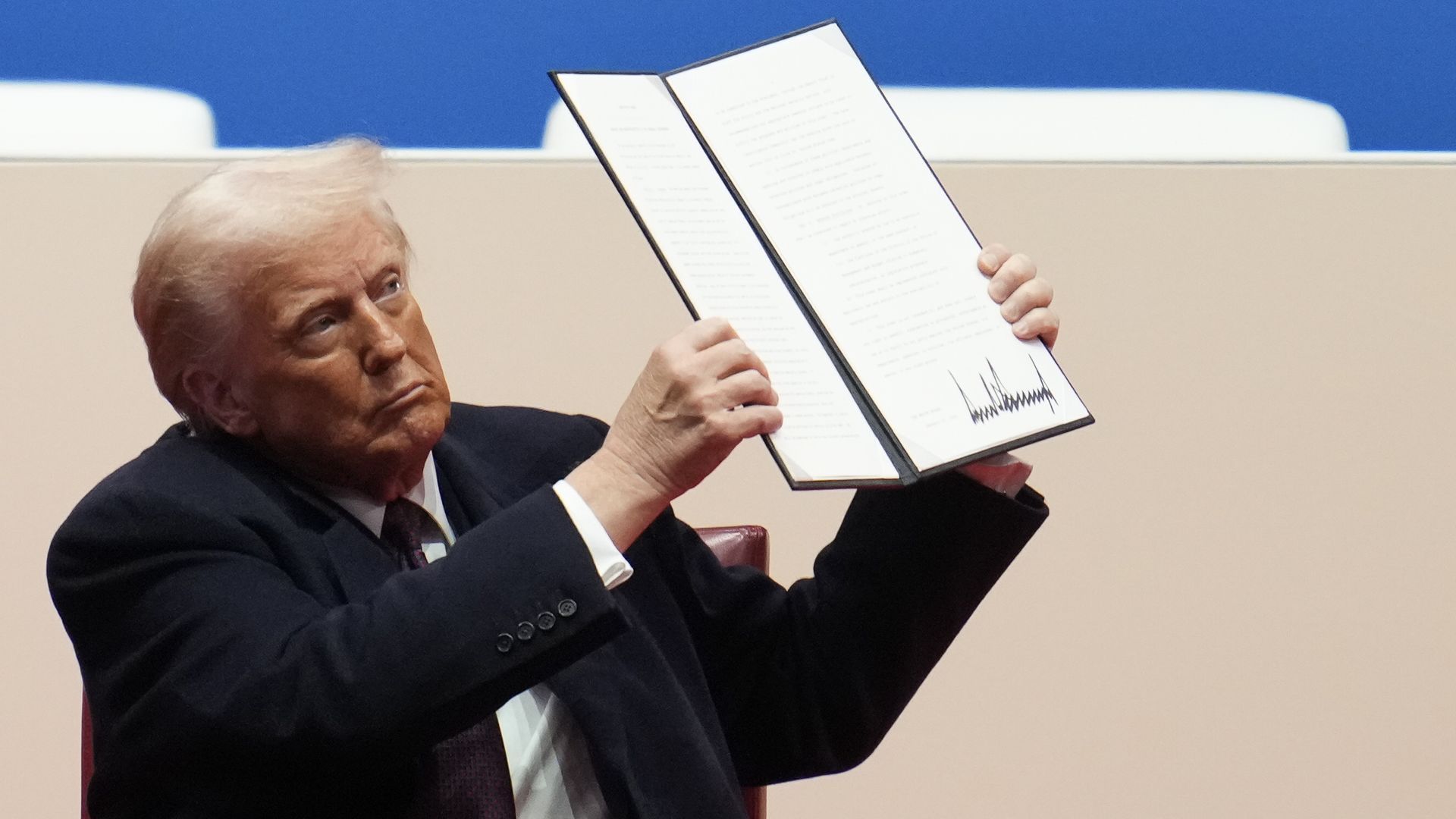
Photo: Christopher Furlong/Getty Images
The National Treasury Employees union filed suit against the Trump administration in federal court in Washington, D.C., on Monday, over the White House order eliminating collective bargaining rights for two-thirds of the federal workforce.
Why it matters: The executive order threatens the very existence of these unions, which use collective bargaining to negotiate for better pay, benefits and fair treatment.
- The order would strip protections for civil service employees, who are already under unprecedented threat from Trump's federal workforce purge.
The big picture: These unions have been on the front lines of what is effectively "the resistance" in Trump's second term, filing suit after suit challenging the administration's actions — many successful thus far.
- Unions representing public employees have seen a surge in new members this year as the White House has been cutting employees and rescinding benefits like remote work, the New York Times reported.
By the numbers: NTEU represents federal workers across 37 agencies including the IRS, which employed more than 100,000 people in January — though that number has now diminished.
- Other public sector unions are expected to sue over the executive order.
What they're saying: "The Executive Order plainly punishes NTEU for its legal challenges to this administration's actions, cancelling, as relevant here, twelve of NTEU's collective bargaining relationships, including NTEU's largest and longest one at the IRS," the lawsuit states.
- "We're seeing now why collective bargaining rights are so important," said Sharon Block, a labor professor at Harvard University. "It's giving [unions] a chance at a voice during this unbelievable moment when everything is being taken away from them."
Between the lines: In issuing the order, the White House acknowledged that this was a way to retaliate and rein in the power of unions to challenge its actions.
- "Certain Federal unions have declared war on President Trump's agenda," says a White House announcement.
- "President Trump is taking action to ensure that agencies vital to national security can execute their missions without delay and protect the American people," a White House spokesperson said in an email. "The President needs a responsive and accountable civil service to protect our national security."
Zoom in: Issued last week, the EO purports to end collective bargaining with federal unions for the Department of Defense, Department of Veterans Affairs, the EPA, State Department, FCC and more.
- Under the 1978 law that established these rights, the president can exempt certain employees if national security is at stake. That's the authority Trump relies on here.
- But experts say it's not meant to be used this broadly.
The law "gives the President limited authority to exempt particularly sensitive categories of workers, which presidents since Jimmy Carter have done," says David Super, who focuses his research on administrative law at Georgetown University Law Center.
- "But it does not allow him to reverse the central purpose of the statute. This executive order therefore exceeds his powers."
What to watch: The White House has already filed a lawsuit in federal court in Texas, a friendly jurisdiction, asking for permission to carry out the EO.
- Perhaps more significantly, the federal Office of Personnel Management has already issued guidelines telling agencies that they no longer have to negotiate with unions.
- The guidance also eases certain protections for workers that make it easier to fire federal workers.
Crucially, OPM says agencies no longer have to deduct union dues from paychecks — which would cripple these unions at a time when they need funds to keep fighting in court.
Editor's note: This story was updated with a statement from the White House.
