Trump's "restoring truth" order could return toppled Confederate monuments


Add Axios as your preferred source to
see more of our stories on Google.
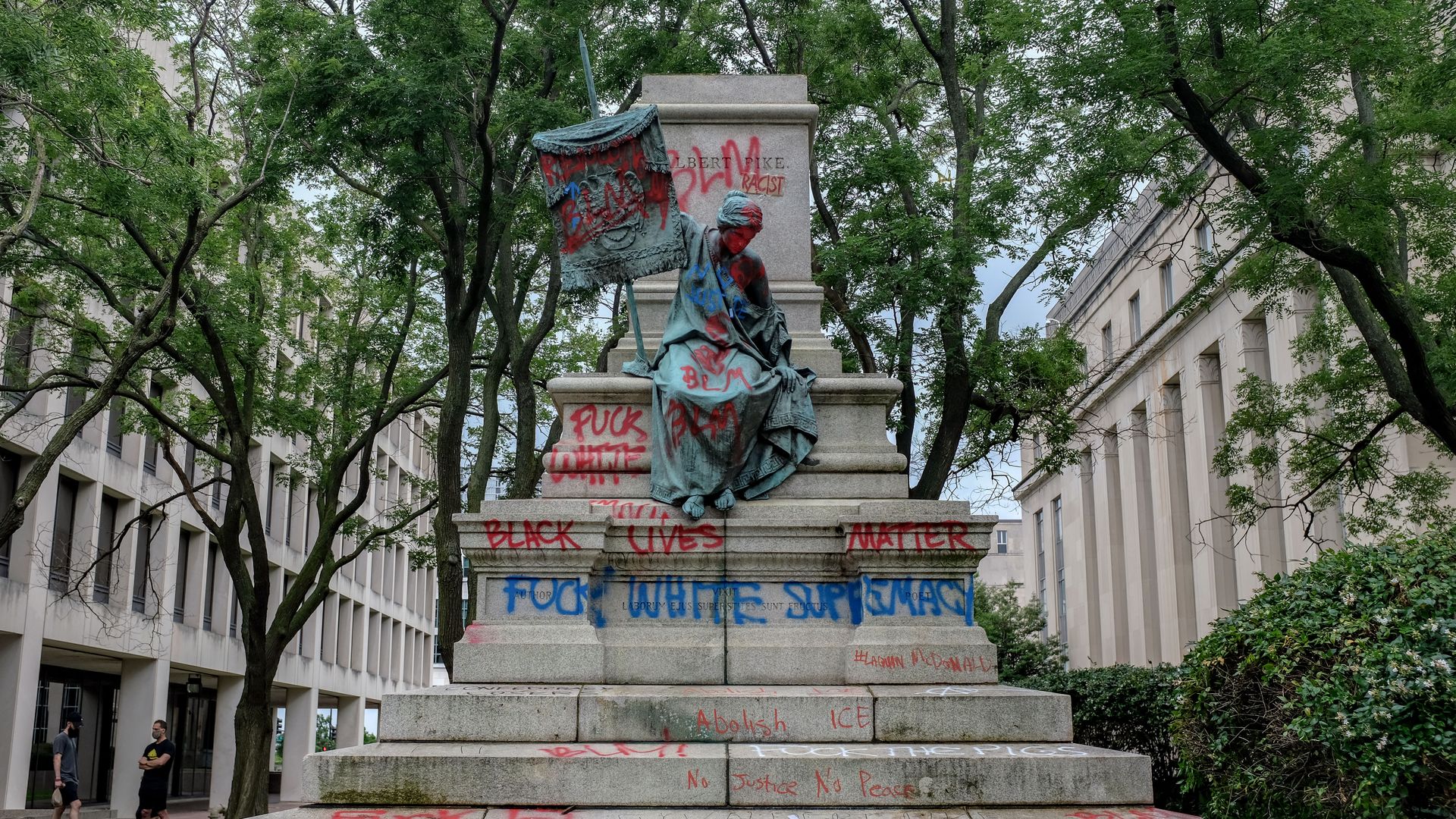
A partially destroyed monument to Confederate general Albert Pike in Washington D.C.'s Judiciary Square, targeted by protesters in June 2020. Photo: Alex Wroblewski/Getty Images
President Trump has ordered a federal review of monuments toppled in the wake of George Floyd's murder, targeting what he calls a "concerted and widespread effort to rewrite our Nation's history."
Why it matters: The Trump administration is leaving no stone unturned in its push to erase the legacy of 2020's racial reckoning, including by restoring monuments to Confederate leaders who fought to preserve slavery.
Zoom in: Trump signed an executive order Thursday taking aim at what he called a "revisionist movement" that has infiltrated the Smithsonian Institution and other federal sites dedicated to America's history.
- Besides purging "improper ideology" from Smithsonian facilities, Trump directed the Department of the Interior to determine whether "public monuments, memorials, statues, markers, or similar properties" in its jurisdiction have been removed or changed "to perpetuate a false reconstruction of American history."
- The order directs the agency to reinstate those monuments and ensure they do not contain descriptions that "inappropriately disparage Americans past or living."
The big picture: Trump has long opposed the removal of Confederate monuments, famously wading into the debate after the 2017 white nationalist rally in Charlottesville, in which protesters gathered to protect a statue of Confederate general Robert E. Lee.
- GOP backlash to the 2020 racial reckoning led to new state laws limiting the discussion of slavery in public schools, and conservatives fighting to restore Confederate monuments and names on schools, military installations and other government facilities.
- Many of the monuments were erected decades ago as part of the "Lost Cause" myth, which falsely recast the Civil War as a noble regional fight for "states' rights" as opposed to the preservation of slavery.
- At least 167 Confederate symbols were removed or renamed after the 2020 protests, but in 2022 there were still more than 2,000 Confederate memorials throughout the U.S. and its territories, according a Southern Poverty Law Center (SPLC) report.
Yes, but: The direct impact of Trump's order will be limited, given that few toppled Confederate monuments were ever on federal land, Jesse Holland, a historian and author of "The Invisibles and Black Men Built the Capitol," tells Axios.
- "States putting them back up will be doing it because they want to — not because they were told to," Holland said.
- Still, the explicit policy endorsement by the Trump administration could be a powerful catalyst.
What they're saying: "We will not allow this administration to restore monuments that stand for intimidation, oppression and violence," Margaret Huang, SPLC president and CEO, said in a statement.
- Huang did not specify how the group would fight any name restorations, but condemned the executive order as a deliberate attempt to glorify racism under the guise of patriotism.
The backstory: The Lost Cause myth was developed by white southerners to portray the Civil War as a noble effort to protect the southern way of life while downplaying the horrors of enslavement.
- White mobs after Reconstruction terrorized Black communities with lynchings and violence to reverse new electoral and business gains by emancipated Black Americans.
- The federal government removed Union troops from southern states as southerners erected monuments to former Confederates and slaveholders to romanticize their exploits during the Civil War.
- Historians say the Lost Cause reinforced white supremacy in public spaces and was used to scare Black Americans from fighting segregation or seeking racial equality.
The bottom line: Holland says this is a cultural retreat — one designed to erase the reckoning of 2020 and re-center white grievance as patriotic nostalgia.
- "It's not about restoring history — it's about restoring inequity," he said. "This isn't a reset. It's a whitewashing of American history all over again."
