Overcrowding plagues detention units amid Trump's immigration blitz

Add Axios as your preferred source to
see more of our stories on Google.
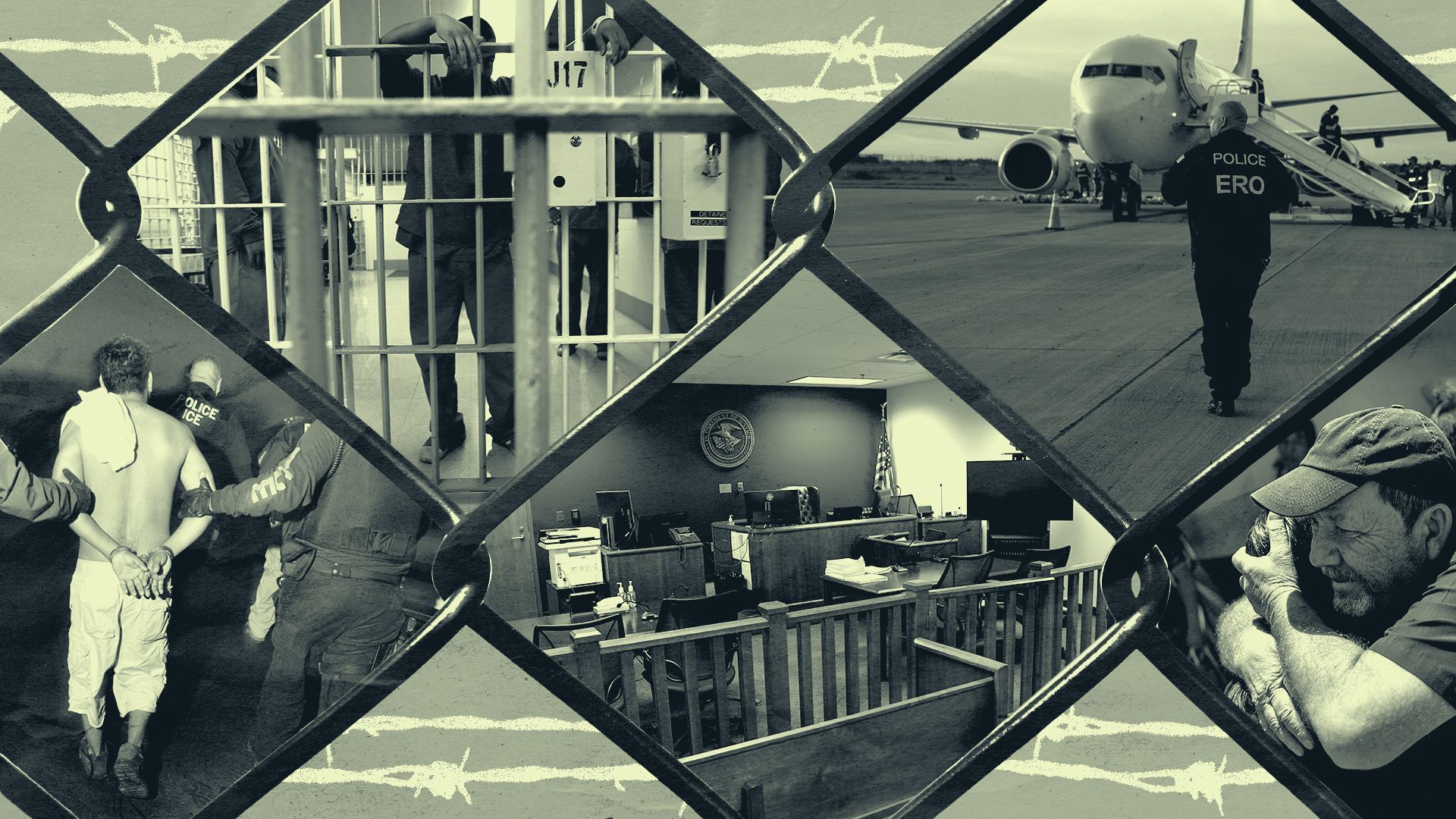
Photo illustration: Allie Carl/Axios. Photos via Getty Images
Days without a shower. Sleeping on floors. Two hundred people confined in a space meant for 85.
- Some immigration detention units are so crowded that non-citizens arrested in President Trump's crackdown are living in inhumane conditions, attorneys for detainees tell Axios.
Why it matters: The Trump administration's goal of deporting "millions" of people has led officials to jam more than 46,000 detainees into a system designed to hold no more than about 40,000, according to Immigration and Customs Enforcement (ICE) records.
The crowding is just one sign of a system under stress:
- Officials are scrambling to arrange more detention space across the U.S. and abroad.
- They're sending detainees they've deemed as dangerous on controversial — and legally questionable — flights to foreign prisons without giving them court hearings.
- And they're monitoring other unauthorized immigrants who've been arrested and released after agreeing to return for their court dates.
Zoom in: At a time when the Department of Homeland Security is desperate for billions more to build an infrastructure that could come close to handling the surge, conditions in the system's detention facilities are deteriorating.
- "Oftentimes conditions aren't great, but this seems definitely out of the norm, this type of extended overcrowding," said Paul Chavez, director of the litigation program at Americans for Immigrant Justice.
- He said that at a detention center in Miami, about 200 people were being held in a room meant for 85 at one point. One client was held in a room meant for 50 people that was holding 90.
- "If you have a building that's meant for 600 people, and now you have twice that in there, it'll inevitably lead to issues," Chavez said.
Detainees often are hesitant to speak out about conditions in detention, particularly if they're trying to get an immigration court to allow them to stay in the U.S.
- But conditions in detention have been so poor that some immigrants prefer deportation to spending more time in the facilities, Chavez said.
- "A lot of people are just signing orders to be removed, because the conditions are so horrible," he said.
State of play: At a temporary holding facility in Baltimore where detainees are supposed to be kept for no more than 12 hours, many are being held for days, two immigration attorneys tell Axios.
- Conditions in the G.H. Fallon Federal Building's holding space — which has no beds — have worsened during the administration's blitz, the attorneys say.
- Katie Hyde, an attorney for a woman who was held there in February, said her client "was treated worse than an animal" in the five days she was there.
- "No shower, no change of clothes, no toothbrush or toothpaste or hair tie," Hyde said. "She was made to sleep on the floor with no mattress or blankets."
Hyde said her client, who didn't want to be identified because of fear of retaliation, told her at least one other woman felt "afraid to ask for toilet paper," Hyde said.
- The Baltimore facility isn't included in ICE's detention occupancy report — one of the signs that the actual number of detainees being held in the system could far exceed the 46,000 total released publicly.
- The General Services Administration, which runs the facility, declined to comment and directed questions to ICE.
- ICE's main office didn't respond to a request for comment about the Baltimore facility. Nestor Yglesias, an ICE spokesperson in its Miami office, said in a statement that "some ICE facilities are experiencing temporary overcrowding due to recent increases in detention populations."
- "We are actively implementing measures to manage capacity while maintaining compliance with federal standards and our commitment to humane treatment," Yglesias said.
The Baltimore facility appears to have been struggling to care for detainees for some time. Attorney Sabrina Surgil represents a man in his 50s who was kept there for about 36 hours in November, during the Biden administration.
- The detainee doesn't remember much about the conditions there, Surgil said, because he was refused his insulin and went into diabetic shock before being flown to Florida.
Surgil's client has been in the Krome North Processing Detention Center in Miami since November. He told Surgil that conditions were fair when he arrived but that the number of detainees there ballooned after Trump took office.
- "In the general population at Krome, it's horrible. He said he has buddies in there who are sleeping on the floor, sleeping by toilets," she said. Her client is in a medical unit in the facility.
- Krome can hold roughly 600 people. ICE's detention management report, last updated March 7, listed Krome as holding 606. But attorneys with Chavez's organization, who have clients in the facility, believe the population is much more than that.
Yglesias, the ICE spokesperson, said the agency is doing several things to alleviate crowding, including transferring detainees and "expedited case processing where appropriate."
- "We remain committed to providing necessary medical care, access to legal resources and safe living conditions for all individuals in our custody," he said.
- ICE doesn't provide current numbers of those in detention for "operational and security concerns," he said.
