Dangerous weekend tornado outbreak puts 100 million at risk

Add Axios as your preferred source to
see more of our stories on Google.
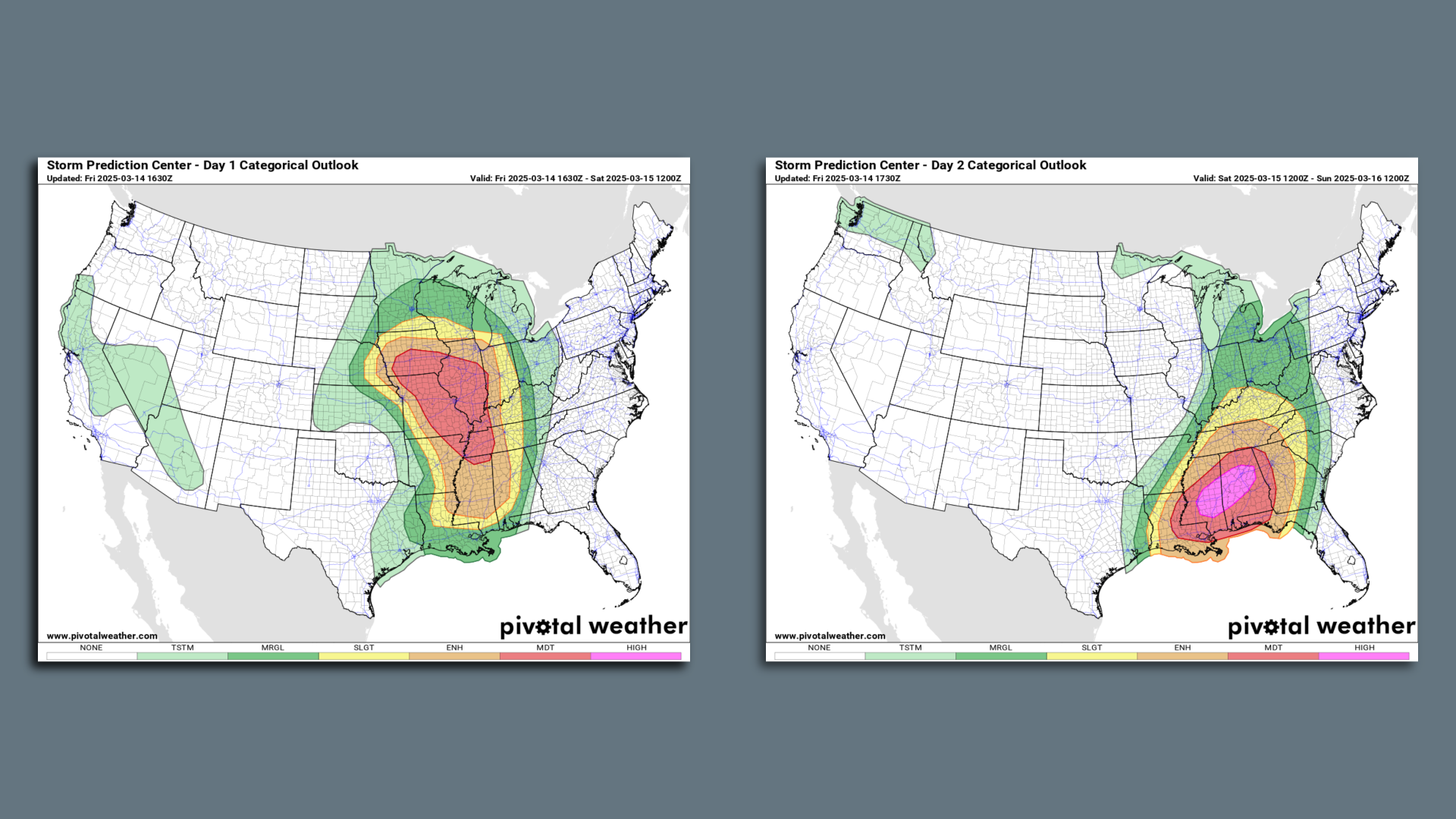
Side-by-side maps for Friday (left) and Saturday (right) showing the Storm Prediction Center's threat levels for a severe weather outbreak. Image: Pivotal Weather
A powerful storm system is set to bring multiple rounds of dangerous severe thunderstorms, with numerous strong tornadoes possible, from the Midwest to the Southeast beginning Friday.
Why it matters: "Today may end up as one of the more prolific severe weather outbreaks in recent memory" in the region, the National Weather Service forecast office in St. Louis said in a forecast discussion Friday.
Threat level: About 100 million people live in areas under threat from straight-line wind damage, hail and tornadoes through the weekend.
- The greatest threat for storms on Friday centers on the Midwest, where a squall line containing straight-line winds and embedded tornadoes is forecast to congeal later in the day and sweep across parts of Missouri east to Indiana.
- A large area of strong winds will occur even outside of severe storms, raising the likelihood of widespread power outages.
- Cities under a "moderate risk" of severe thunderstorms on Friday, which is a Level 4 of 5 on the Storm Prediction Center's threat scale, include Memphis, St. Louis, Des Moines and Springfield, Ill.
The greater threat for powerful tornadoes will occur on Saturday, when an especially volatile setup takes shape across the Deep South and Southeast.
- The Storm Prediction Center has taken the nearly-unheard of step of issuing a "high risk" severe thunderstorm outlook for the next day, indicating increasing confidence in a large-scale tornado outbreak.
Zoom in: The SPC is using strong language to describe the tornado threat in Louisiana, Mississippi and Alabama in particular on Saturday.
- "Numerous significant tornadoes, some of which should be long-track and potentially violent, are expected on Saturday afternoon and evening," forecasters wrote Friday afternoon.
- The tornado threat will continue into the overnight hours on Saturday into early Sunday.
- Overnight tornadoes are particularly deadly because people have a harder time receiving warnings and getting to shelter, particularly in states with high proportions of mobile homes.
Cities in the high risk zone Saturday include Birmingham, Jackson, Miss., Tuscaloosa, Ala. and Hattiesburg, Miss.
- New Orleans and Baton Rouge, La. are in the moderate risk zone for Saturday.
- Alabama Governor Kay Ivey (R) issued a state of emergency for the entire state beginning on Friday afternoon.
- "The state of Alabama is at risk for potentially dangerous, severe weather throughout this weekend, so it is critical that everyone stays very aware of their local forecasts," Ivey said.
The NWS forecast office in Birmingham released a statement on X noting the rare combination of ingredients that could make this event so significant, summarizing it as: "This will be a very scary situation for many."
Context: Climate change is altering the environment in which severe thunderstorms and tornadoes form. Studies show that while some ingredients, such as humidity and atmospheric instability, are likely to increase with a warming climate, others may do the opposite.
- Climate change is anticipated to decrease the amount of wind shear available to severe thunderstorms, which could deprive them of a key ingredient for tornado formation.
Yes, but: When the right mix of ingredients are present, climate change may lead to larger severe weather outbreaks, albeit fewer in number overall per year.
The intrigue: The Southeast has been particularly hard-hit by tornado outbreaks in recent years beginning during March.
- Some researchers have noted a shift of so-called "Tornado Alley" to the southeast and earlier in the year, away from some of the Plains states and Midwest, over time.
- However, tornado alley itself has long been considered somewhat of a misnomer in the meteorology community, with multiple areas favored for tornado outbreaks. Tornadoes can and have occurred in any state.
Between the lines: This severe weather outbreak will test NOAA's ability to handle a large-scale, potentially deadly weather event in the wake of laying off about 800 meteorologists and other staff in late February.
- These layoffs reduced staffing at some local weather forecast offices to threadbare levels, causing some to reduce their services.
- Some meteorologists are also having to put in more frequent overtime shifts.
- Recent court rulings may bring at least some of those fired federal workers back on the job at least temporarily.
Further staff reductions of about 1,000 NOAA workers are planned, though it is not clear if those would focus on the NWS or NOAA's other missions.
The bottom line: This severe weather outbreak could be a high-end, potentially historic event, resulting in multiple powerful, long-lasting tornadoes, particularly in the Southeast on Saturday and Saturday night.
Go deeper:
Scoop: NOAA monthly media calls on climate change suspended
NOAA cuts could ground some Hurricane Hunter flights
2nd judge orders agencies to reinstate thousands of fired federal workers
