Israel agrees to U.S. plan for Gaza ceasefire extension and claims Hamas refuses

Add Axios as your preferred source to
see more of our stories on Google.
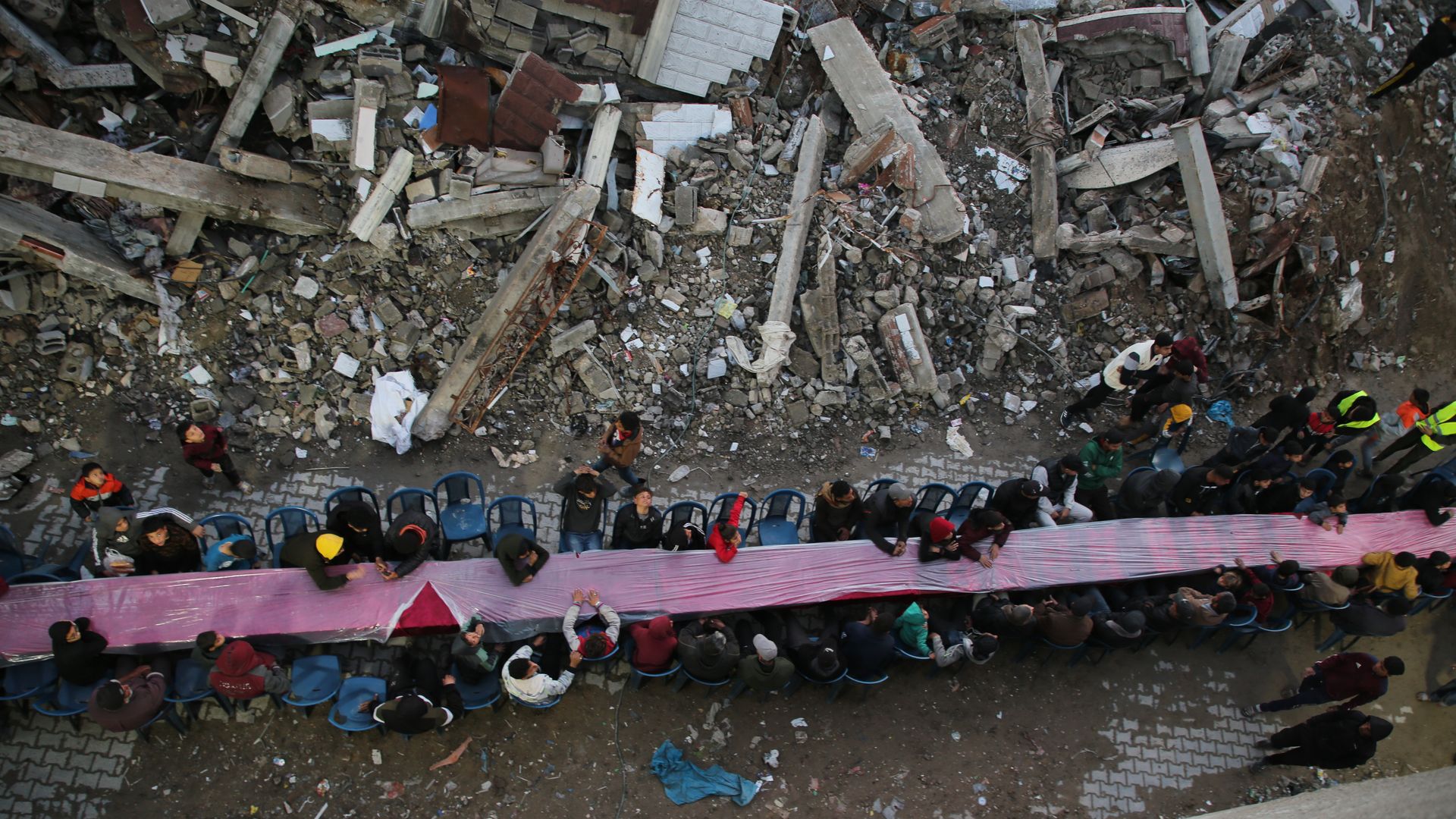
Palestinians gather for their first iftar of the holy month of Ramadan among the rubble in the Al-Shujaiyya neighborhood of northern Gaza on Mar. 01, 2025. Photo: Hamza Z. H. Qraiqea/Anadolu via Getty Images
Israel has agreed to a new U.S. proposal to extend the first phase of the ceasefire in Gaza in exchange for the release of about half of the remaining hostages — both living and dead — but Hamas has so far refused to accept it, the Prime Minister's Office claimed in a statement. Hamas has in recent days said the original agreement needs to be implemented.
Why it matters: The Israeli statement was released just after the first phase of the hostage-release and ceasefire in Gaza deal ended on Saturday.
- According to the deal, the ceasefire would continue as long as negotiations on the second phase of the deal were taking place. But there are currently no active negotiations and the fighting in Gaza could resume as soon as Sunday.
Driving the news: On Thursday and Friday, Israeli negotiators held talks in Cairo with Egyptian and Qatari mediators on extending the first phase of the deal.
- Israeli officials and sources with direct knowledge said no progress was made in the talks.
- On Saturday, Israeli Prime Minister Benjamin Netanyahu convened a meeting with senior ministers and the negotiations team leaders to discuss the next steps for the agreement.
- 59 hostages are still held by Hamas in Gaza. Israeli and U.S. officials believe 22 of them are still alive, including one American. 37 of the hostages are believed to be dead.
During the meeting, the Israeli leaders decided to officially adopt a proposal presented by White House envoy Steve Witkoff for a temporary ceasefire for the period of the holy Muslim month of Ramadan and the Jewish holiday of Passover, Netanyahu's office said.
- According to the statement from the Prime Minister's Office, Witkoff presented the new proposal to extend the ceasefire "after he reached the conclusion that at this stage there was no possibility of bridging the gaps between the parties to end the war, and that additional time was needed for talks on a permanent ceasefire."
- Israel claimed Hamas has "so far stuck to its refusal to accept" the proposal.
Over the past few days, Hamas told Qatari and Egyptian mediators that it opposes extending the ceasefire in return for the release of more hostages, Israeli officials said.
- Hamas said publicly in several statements, including on Saturday, that it wouldn't agree to an extension of the ceasefire without a guarantee that negotiations on the second phase of the deal would begin.
- Hamas also said the original Gaza deal must be implemented to its letter, including that negotiations on a permanent ceasefire start without the release of additional hostages.
Behind the scenes: A senior U.S. official said Witkoff presented his proposal earlier his week after four meetings with the Israeli Minister of Strategic Affairs Ron Dermer and phone calls with the Prime Minister of Qatar and the head of the Egyptian intelligence service.
- According to the U.S. proposal, the ceasefire in Gaza would be extended for an additional 42 days.
- On the first day of the extended ceasefire, half of the living hostages and half of the dead hostages still held by Hamas would be released, Netanyahu's office said.
- A U.S. official said the plan would be for 10 living hostages to be released on the first day of the extended ceasefire. The bodies of 18 dead hostages would be returned to Israel as well.
- The U.S. proposal stipulates that during the additional 42 days of the ceasefire, negotiations will be held on a permanent ceasefire.
- If an agreement is reached on a permanent ceasefire, the remaining living and dead hostages would be released, the Prime Minister's Office said.
What to watch: Netanyahu's office claimed Hamas violated the agreement and denied that Israel did the same, despite having so far refused to enter into negotiations on the second phase of the deal.
- "According to the agreement, Israel can return to fighting after the day 42 if it thinks that the negotiations are ineffective" the statement from the prime minister's office said, hinting that Israel could resume the war, if Hamas does not agree to the U.S. proposal.
