Israel says Hamas returned "anonymous" body in "violation" of deal

Add Axios as your preferred source to
see more of our stories on Google.
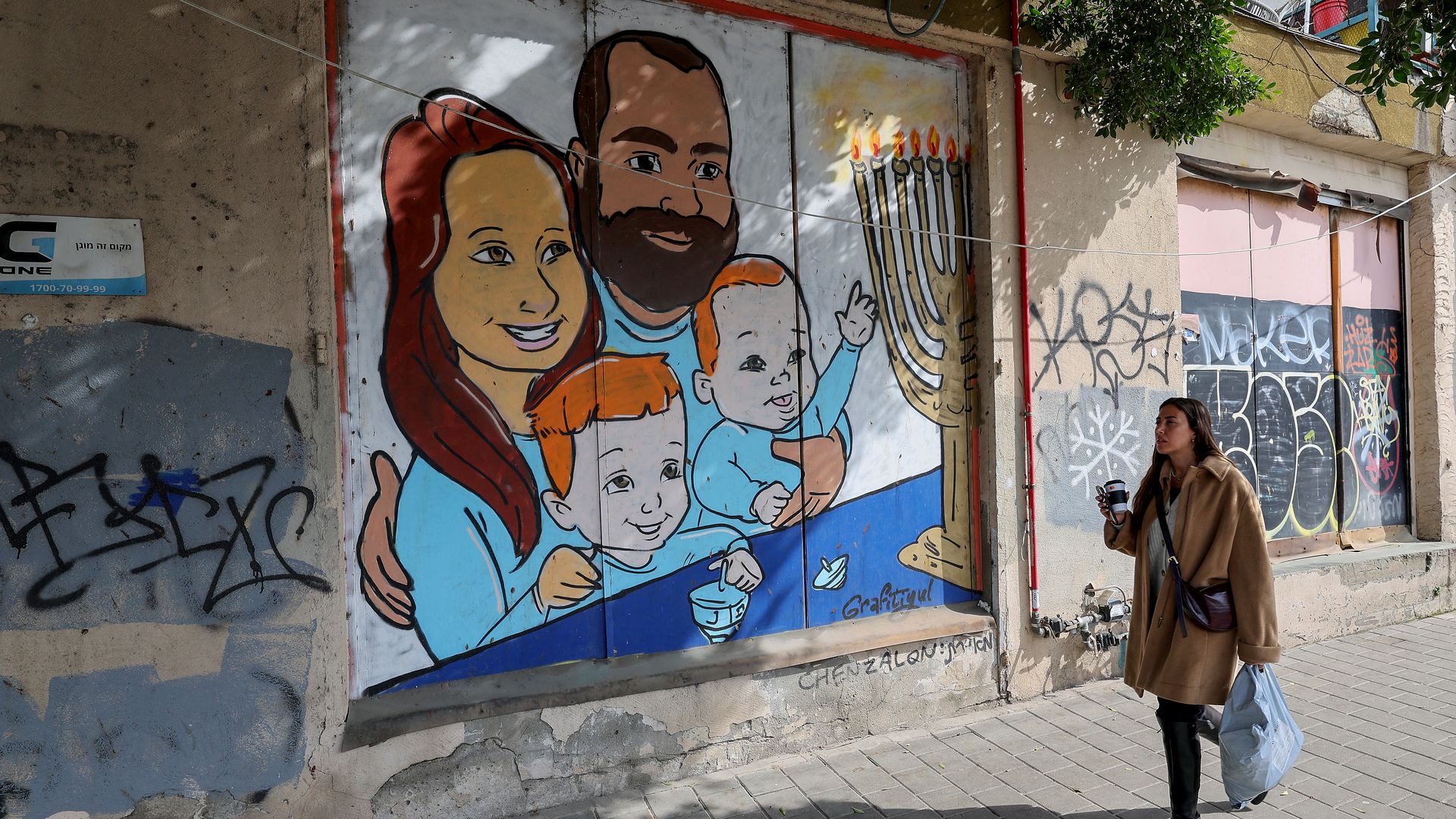
A mural depicting the Bibas family in Tel Aviv. Photo: Jack Guez/AFP via Getty
Hamas transferred the bodies of Israeli hostages to Israel on Thursday as part of the Gaza ceasefire deal, the first time since the Oct. 7 attack that Hamas has returned the remains of dead hostages to Israel.
The latest: Hamas said it transferred the bodies of the Bibas family. Shiri Bibas was 33 years old when she was kidnapped from her home with her two children, 4-year-old Ariel and 9-month-old Kfir. However, the Israel Defense Forces said the body believed to be Shiri Bibas was an "anonymous, unidentified body" and the DNA didn't match that of any of the hostages.
- "This is a grave violation of the agreement by Hamas who committed to return four bodies of hostages. We demand that Hamas returns Shiri Bibas' body and all other hostages," the IDF said in a statement.
- The IDF said it had identified the bodies of Oded Lifshitz, who was 84 when he was kidnapped from his home, and the Bibas children.
- The IDF said the pathological examinations and intelligence gathered by Israel suggests that the Bibas family children were murdered in captivity in November 2023.
- An Israeli official said in a briefing with reporters that Israel shared the intelligence about the killing of the family with the U.S.
State of play: The first phase of the hostage and ceasefire deal was considered back on track following Hamas' release of the bodies after nearly breaking down.
- Israeli strategic affairs minister Ron Dermer is expected to meet White House envoy Steve Witkoff in the U.S. on Thursday to begin talks on the second phase, which will be even more complicated, an Israeli official and a source familiar said.
- The second phase talks were due to focus on the endgame of the war in Gaza, which poses thornier political and strategic questions than the initial ceasefire agreement.
- Netanyahu appointed Dermer to lead these talks, pushing aside the Israeli intelligence chiefs who led negotiations on the first phase. Dermer's office did not respond to a request for comment.
- The second phase was discussed in general terms at an Israeli security cabinet meeting earlier this week. An Israeli official said Netanyahu did not want to go into a detailed discussion for fear of leaks.
Background: Hamas, which returned the bodies earlier Thursday, had claimed the Bibas family was killed in an Israeli air strike early in the war. The Israel Defense Forces have not confirmed that.
- Their father Yarden Bibas was released alive two weeks ago.
- Lifshitz, a peace activists who drove Palestinians from Gaza to hospitals in Israel, died during his time in Hamas captivity.
- In return for the bodies, Israel released women and minors who were arrested by the IDF in Gaza during the war but who did not take part in the Oct. 7 attack.
- Four more bodies were expected to be delivered next Thursday as part of the first phase of the hostage and ceasefire deal.
What they are saying: Hamas delivered the bodies to the Red Cross in a military "ceremony" that included anti-Israeli slogans.
- UN human right commissioner Volker Turk condemned the display.
- "Under international law, any handover of the remains of deceased must comply with the prohibition of cruel, inhuman or degrading treatment, ensuring respect for the dignity of the deceased and their families," he said in a statement.
What's next: Witkoff is expected to speak by phone on Thursday with Qatari Prime Minister Mohammed bin Abdul Rahman al-Thani about the second phase of the deal, which is due to begin on March 1.
- Netanyahu made it clear in a cabinet meeting this week that Israel's positions regarding the second phase of the deal will be based on the war goals defined by the cabinet, officials said.
- Israel demands that Hamas not continue to control Gaza, that Gaza be demilitarized of heavy weapons, and that senior Hamas military and political leaders in Gaza leave the strip and go into exile, the officials added.
- An Israeli official said that in light of the fact that there are less than two weeks left until the end of the first phase of the deal and in light of the very wide gaps between Israel and Hamas regarding the second phase, an attempt will be made to find an interim solution.
- The Israeli official said that Israel and the U.S. will try to reach understandings with Hamas on extending the first phase of the deal, in which more hostages will be released in exchange for an extension of the ceasefire, while negotiations on the second phase continue.
The other side: A Hamas official told AFP on Wednesday that the militant group is prepared to release all of the remaining hostages "in one batch" if the second phase of the deal is agreed and enters implementation.
Editor's note: This article has been updated with comment from the Israel Defense Forces.
