DOGE's moves threaten fragile payments system

Add Axios as your preferred source to
see more of our stories on Google.
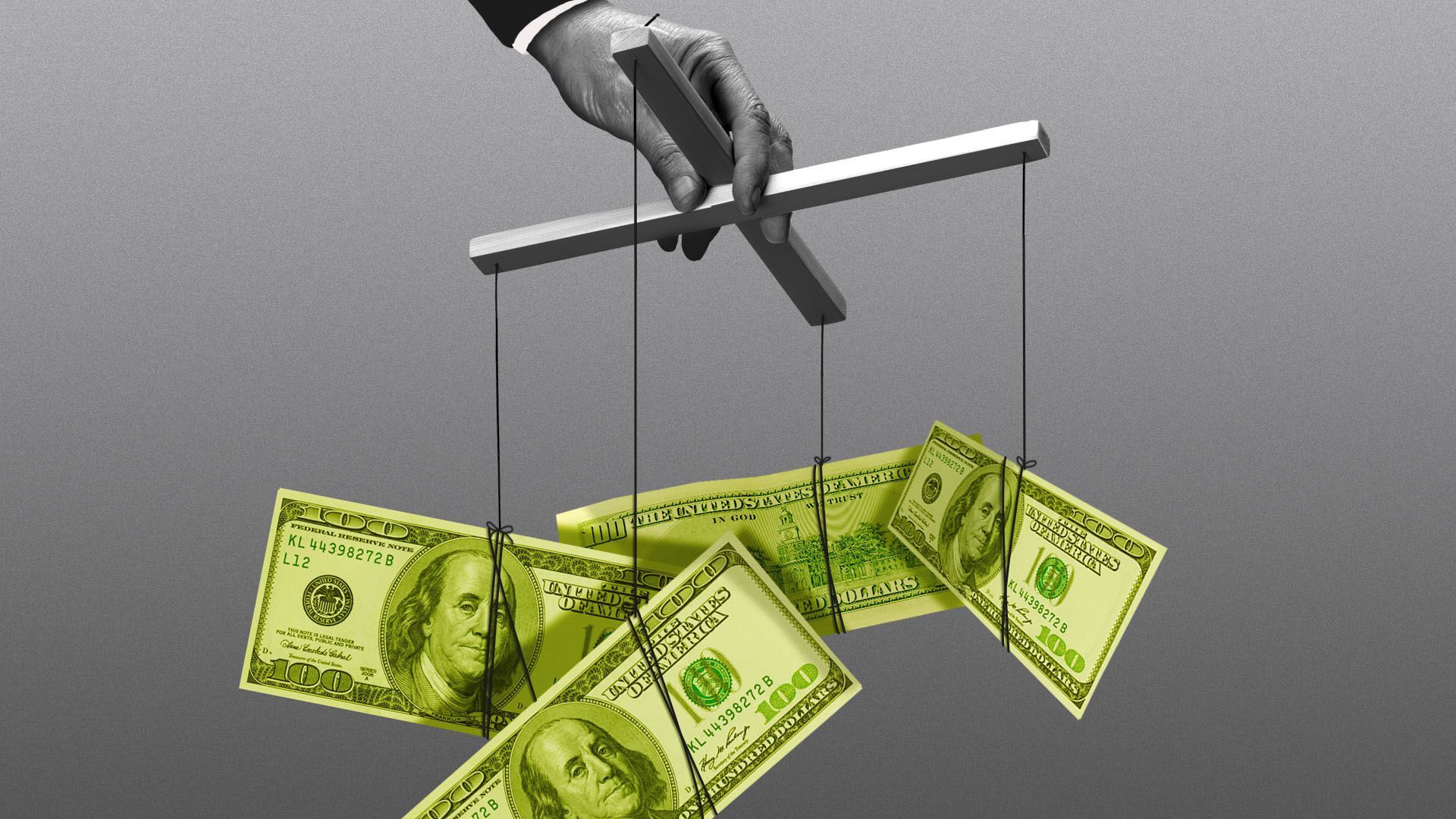
Illustration: Sarah Grillo/Axios
As a series of recent books has detailed, successive U.S. administrations this century have shown an unprecedented willingness to use payments systems against foreign adversaries. Now, the Trump administration may be taking certain pages from the playbook domestically.
Why it matters: At stake is the security and trustworthiness of the largest and most important payments system in the world, one that was already fraying around the edges even before President Trump took office.
- Experts say there's no precedent for what Elon Musk's DOGE is doing with regard to federal payments.
Driving the news: When it reversed an $80 million payment that FEMA made to New York City in early February, the U.S. government used a known weakness in the Automated Clearing House (ACH), one of the most common forms of payment in America.
- Whether the U.S. government's ACH reversal was legal will be for a court to decide. New York City Comptroller Brad Lander, for one, is adamant the government seized the money held in a Citibank account "with no legal authority," per a press conference last week.
- Legal or not, however, the reversal undoubtedly happened, which means it's now a proven tool in DOGE's arsenal when it comes to rescinding any spending the White House considers wasteful or unlawful.
- ACH's security issues are well documented. According to the AFP Payments Fraud Dashboard, 33% of all organizations experienced ACH debit fraud in 2024, rising to 41% of large organizations with more than 100 payments accounts and revenue of at least $1 billion.
- The White House did not respond to requests for comment.
How it works: ACH, a payments system born in the 1970s, was designed as a way for banks to transfer money between each other. It was built on a basis of mutual trust that every participating institution will adhere to rules codified by Nacha, the operator.
- Today, it's the system that allows credit card companies to debit a different amount from your account every month or, for that matter, allows fraudsters to pay their bills with other people's money.
- Because mistakes can be made, ACH transactions are reversible in cases where there was a clear clerical error, like when the wrong account was credited, for instance, or a single transaction was inadvertently duplicated.
- When the government reverses an ACH transaction, says Yesha Yadav of Vanderbilt Law School, it has to notify the Treasury's Bureau of the Fiscal Service as to why it is seeking reversal, and has to certify the grounds on which it is doing so. (DOGE has also penetrated the government's internal payments system. More on that below.)
- Whether the requisite notifications took place in this case is unclear. DOGE and FEMA did not reply to requests for comment. Nacha said it could not provide any information on what happened.
Zoom in: Different banks process ACH reversals in different ways, but large ones like Citibank often let the money leave the account automatically, even in some cases where there isn't enough money in the account.
- As Lander has explained in interviews, the Citibank account targeted by DOGE only had $1 million in it as of the Feb. 11 reversal, but was attached to a large overdraft facility. When $80.5 million was withdrawn from the account, Citibank automatically created a $79.5 million overdraft on a pre-existing line of credit. (The $15,000 overdraft fee was refunded by the bank.)
- "I think it is dubious, in practice, to view an overdraft as readily available liquidity" for Nacha purposes, Yadav says. Still, that's what happened, and Citibank is indemnified by the government under 31 CFR § 210.6(f), the law governing federal ACH reversals.
- Citibank declined to make a public statement on the matter.
Says Yadav: "ACH is being used by federal government to police other agencies and enforce compliance with central aims, without us knowing if a clear statutory basis has been given or even if the Nacha rules are being followed."
- "This feels like a first."
ACH is one of many payments systems that DOGE now has access to, and it's not even the main one that gives Musk's cost-cutting team the ability to block congressionally mandated expenditures like the FEMA transfer to New York City.
Context: From the earliest days of this administration, Trump has signaled a desire to challenge Congress' constitutionally enshrined power of the purse.
- The easiest and most effective way to do so is to control the purse strings — to commandeer payment systems to prevent money from going where Congress has said it must go.
The big picture: DOGE has sought to use Treasury's payments system to prevent disbursements to USAID, per the New York Times. The career civil servant charged with maintaining the system's integrity, David Lebryk, resigned under pressure in January.
- Replacing him with a political appointee, as Treasury has reportedly done, "raises serious concerns, including the risk that payments will be illegally stopped," per the Center on Budget and Policy Priorities.
What they're saying: "Musk's DOGE is weaponizing the U.S. government's payment, information, and physical infrastructure," write Henry Farrell and Abraham Newman, political scientists specializing in the payments system, "carrying out an end run around the political structures that are supposed to restrain unilateral executive action."
- Once DOGE can access both Treasury's system and ACH, that "creates one way to leverage pretty comprehensive control over the payments system," Yadav tells Axios.
