Scoop: Why Trump targets AP

Add Axios as your preferred source to
see more of our stories on Google.
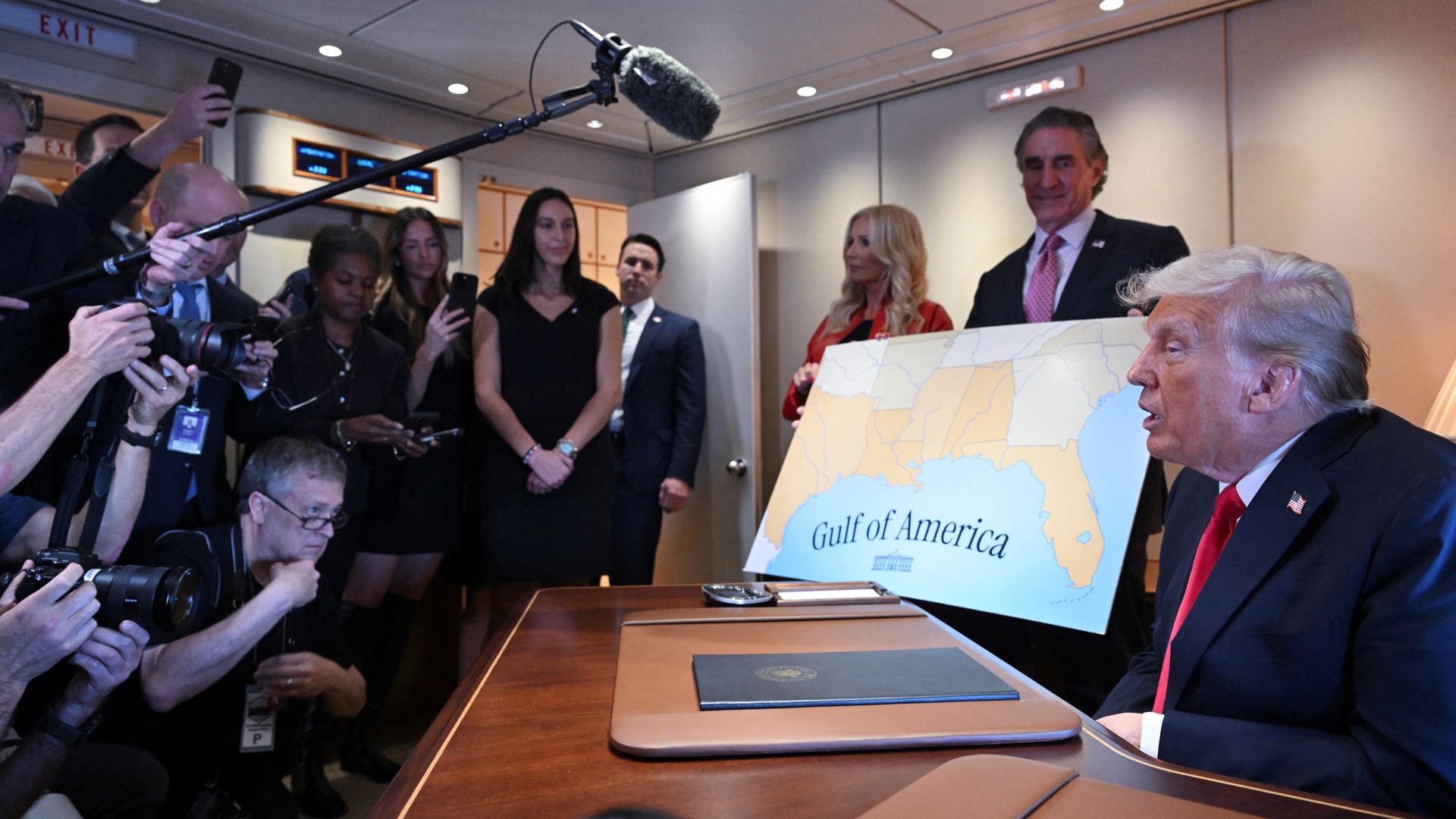
President Trump signs a proclamation for Gulf of America Day, aboard Air Force One on Feb. 9. Photo: Roberto Schmidt/AFP via Getty Images
One of the big reasons President Trump is limiting AP reporters' White House access is to protest what aides see as years of liberal word choices that the wire service's influential stylebook spread across mainstream media, according to top White House officials.
Why it matters: The trigger was the announcement by The Associated Press that it would continue using the 400-year-old "Gulf of Mexico" rather than switch to "Gulf of America," as declared by Trump in a Day 1 executive order. But it turns out that broader underlying grievances made AP a target.
The big picture: By spotlighting AP, Trump is amplifying Republican and conservative criticisms that the AP Stylebook, a first reference for most U.S. news organizations, shapes political dialogue by favoring liberal words and phrases concerning gender, immigration, race and law enforcement.
- "This isn't just about the Gulf of America," White House deputy chief of staff Taylor Budowich told Axios. "This is about AP weaponizing language through their stylebook to push a partisan worldview in contrast with the traditional and deeply held beliefs of many Americans and many people around the world."
- The dispute with AP is part of Trump's broader effort to discredit legacy media outlets and the public's trust in the press — already at a record low.
The other side: AP — which has long been considered the gold standard of neutrality — rejects any accusation of bias. Lauren Easton, vice president of corporate communications, told Axios that AP "is a global, fact-based, nonpartisan news organization with thousands of customers around the world who span the political spectrum."
- "If AP journalism wasn't factual and nonpartisan, this wouldn't be the case," she said.
- Easton said AP provides "guidance on issues brought to us by members and customers, and it is up to them what they choose to use. Again, this is guidance. It's not surprising that political parties, organizations or even individuals may disagree with some entries. The Stylebook doesn't align with any particular agenda."
State of play: After barring AP reporters from covering several events with Trump last week, the White House said Friday that because the wire service "continues to ignore the lawful geographic name change of the Gulf of America," AP slots in the Oval Office on Air Force One "will now be opened up" to other reporters.
- An AP reporter and photographer were blocked Friday from boarding Air Force One for Trump's weekend trip to Florida.
- The White House said AP journalists "will retain their credentials to the White House complex."
The backstory: AP said in its Jan. 23 "style guidance," released proactively to guide members and customers, that Trump "has signed an executive order to rename the Gulf of Mexico to the Gulf of America. The body of water has shared borders between the U.S. and Mexico. Trump's order only carries authority within the United States. Mexico, as well as other countries and international bodies, do not have to recognize the name change."
- "The Gulf of Mexico has carried that name for more than 400 years," the guidance continues. "The Associated Press will refer to it by its original name while acknowledging the new name Trump has chosen. As a global news agency that disseminates news around the world, the AP must ensure that place names and geography are easily recognizable to all audiences."
- AP said in the same announcement that it'll follow Trump's executive order returning the name of Alaska's Mount McKinley, which had been changed to Denali in 2015. AP's logic: The peak is solely within the U.S., and "Trump has the authority to change federal geographical names."
Behind the scenes: Five days after AP issued its guidance concerning the gulf name change, White House press secretary Karoline Leavitt held her first briefing, and foreshadowed the fight the White House would pick with legacy media.
- "Karoline said she would not lie and that she would call out media organizations who do lie," a Trump adviser said, speaking on condition of anonymity. "And we knew the AP would keep calling the Gulf of America the Gulf of Mexico, and that's misinformation."
To attract maximum attention to his change, Trump signed an order in front of reporters on Air Force One as he flew over the Gulf en route to the Super Bowl on Feb. 9, declaring the "first ever Gulf of America Day."
- Two days later, the White House blocked an AP reporter from an Oval Office event.
Zoom out: Trump allies — including Mike Cernovich, a leading MAGA influencer on X — began attracting the attention of the president's advisers by highlighting longstanding complaints about some of the AP stylebook's thousands of entries. Other less-well-known accounts criticized guidance about immigration and transgender issues that White House advisers have seen. Among the AP guidance conservatives find objectionable:
- Warning against "all views" in transgender coverage: AP's "Transgender Coverage Topical Guide" says to avoid "false balance — giving a platform to unqualified claims or sources in the guise of balancing a story by including all views."
- Using the phrase "gender-affirming care": AP says the term, commonly used by advocates and physicians, refers to "a swath of mental and medical treatments (such as counseling, hormones or surgery) that help bring a person's gender expression (such as voice, appearance or anatomy) in line with their gender identity."
- Capitalizing Black but not white for race: AP's stylebook advises that "Black" should be used for racial descriptions while the lowercase "black" is considered just a color. AP says "white people's skin color plays into systemic inequalities and injustices, and we want our journalism to robustly explore those problems. But capitalizing the term white, as is done by white supremacists, risks subtly conveying legitimacy to such beliefs." AP notes that white people "generally do not share the same history and culture, or the experience of being discriminated against because of skin color."
- Describing immigrants: The Stylebook frowns on the term "illegal immigrant" and says to "use illegal only to refer to an action, not a person: illegal immigration, but not illegal immigrant." AP doesn't recommend "undocumented immigrant," and says acceptable "variations include living in or entering a country illegally or without legal permission. For people: immigrants lacking permanent legal status."
What they're saying: Terry Schilling, a conservative critic of "transgenderism" (a word AP recommends against), called the style guidance "Orwellian newspeak. It's 1984."
- Ashley Brundage, a transgender activist with GLAAD, defended AP for trying to use "inclusive language," and said that "if Republicans are good with name changes for the Gulf of Mexico, then they should be OK for any name changes" for transgender people.
The Axios position: We've taken a different approach than many media companies, based on serving primarily a U.S. audience. The government, plus Apple Maps and Google Maps, call it the Gulf of America. For clarity, we call it the "Gulf of America (renamed by the U.S. from Gulf of Mexico)."
- "At the same time," Axios said in a statement Friday, "the government should never dictate how any news organization makes editorial decisions. The AP and all news organizations should be free to report as they see fit. This is a bedrock of a free press and durable democracy."
