America might have reached "peak truck"

Add Axios as your preferred source to
see more of our stories on Google.
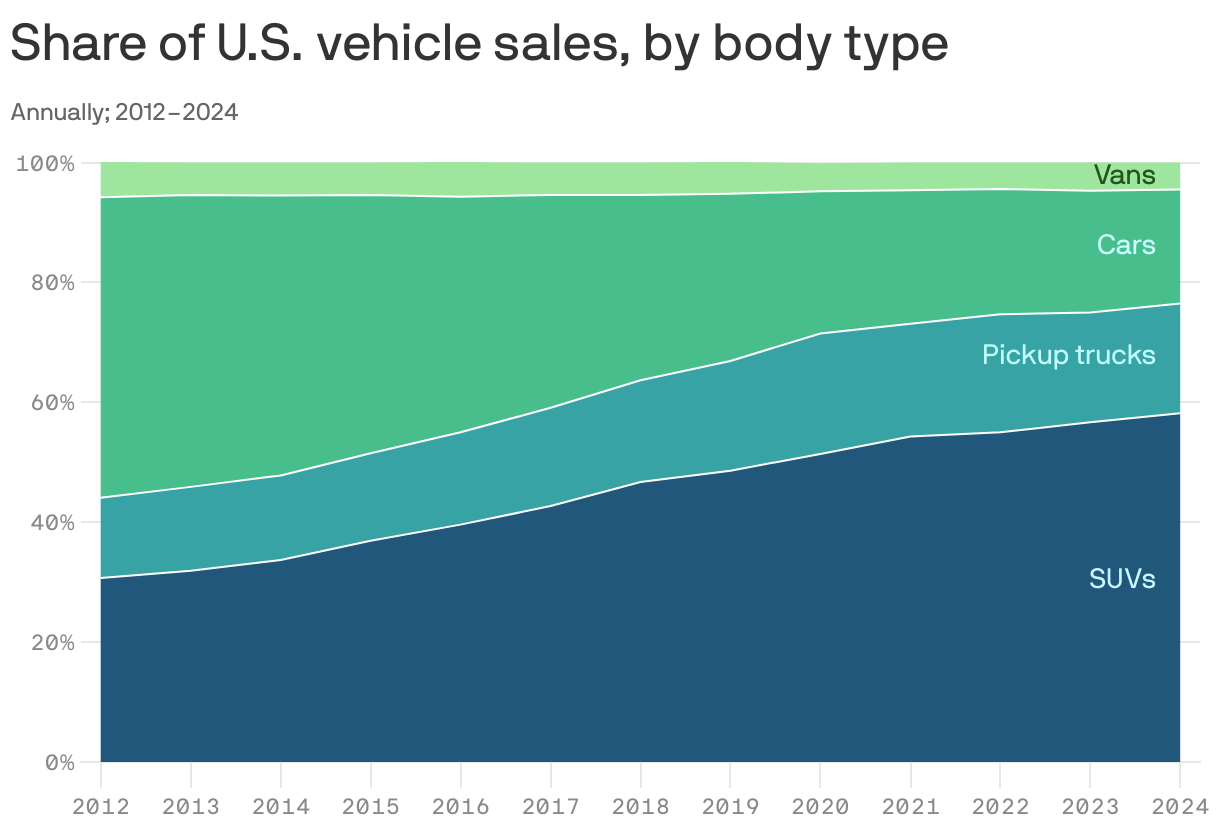
Sales of pickup trucks and SUVs might have peaked in the United States — not because Americans don't want them, but because many people can no longer afford them.
Why it matters: Affordability is a growing concern, not just for car buyers, but also for stressed-out automakers facing heightened economic uncertainty and potential supply chain disruptions since President Trump took office.
The big picture: Big, fancy trucks and SUVs are the profit engines for automakers, generating cash to funnel into new technologies like electric, automated and connected vehicles.
- A market shift back to more affordable sedans would squeeze profits and hit General Motors, Ford and Jeep parent Stellantis the hardest because the American car is essentially obsolete.
- U.S. automakers gave up on the segment years ago, ceding it to the likes of Toyota and Honda, while they refocused on higher-margin models and advanced technologies.
Driving the news: A recent market outlook report from Dave Cantin Group and Kaiser Associates, specialists in dealership mergers, caused a stir by declaring "Peak Truck" as a trend to watch in 2025.
- Their latest survey of consumer sentiment showed the number of people who believe their next vehicle will be a truck or SUV fell 3% compared to a year ago, while the number intending to buy a car rose 3%.
- A surge in inflation last month, and continued high interest rates, added to the mounting evidence that car buyers are feeling pinched.
- Pickup truck sales are also closely tied to housing. When housing is slow, tradespeople don't replace their vehicles as quickly.
- "This isn't just an automotive story, it's an American consumer story," said Dave Cantin.
Reality check: America hasn't given up its love affair with trucks and SUVs.
- But sales data shows some buyers are trading down to smaller, less-expensive models, says Erin Keating, executive analyst at Cox Automotive.
- One example: Full-size pickup sales have softened, but cheaper mid-size trucks like the Ford Ranger and Maverick are in high demand.
- Also popular: Compact and subcompact SUVs like the Toyota RAV4 and Chevrolet Trax.
By the numbers: Even trading down, truck prices still far exceed other options.
- The average price of a new truck in January was $59,684, while SUVs sold for an average of $47,667, according to Cox Automotive.
- Cars, meanwhile, sold for an average of $39,233.
Between the lines: More than the sticker price, however, buyers care about their monthly outlay for a car.
- Larger down payments and leasing are ways to lower monthly payments — currently an average of $755, per Cox.
- But other car-related expenses add up, too. Maintenance costs rose 44% between December 2018 and December 2024, while insurance was up 52% and gasoline was 30% higher in that time frame, according to federal data.
What to watch: The auto industry is forecasting a solid year, but executives concede they haven't factored in higher tariffs or policy flip-flops on electric vehicles under the Trump administration.
- For now, manufacturers are adopting a wait-and-see attitude, but the uncertainty makes strategic planning difficult, Brian Gordon, chief business and strategy officer at DCG, tells Axios.
- "It's a story in progress."
Disclosure: Cox Automotive and Axios are both owned by Cox Enterprises.
