Money becomes more precarious

Add Axios as your preferred source to
see more of our stories on Google.
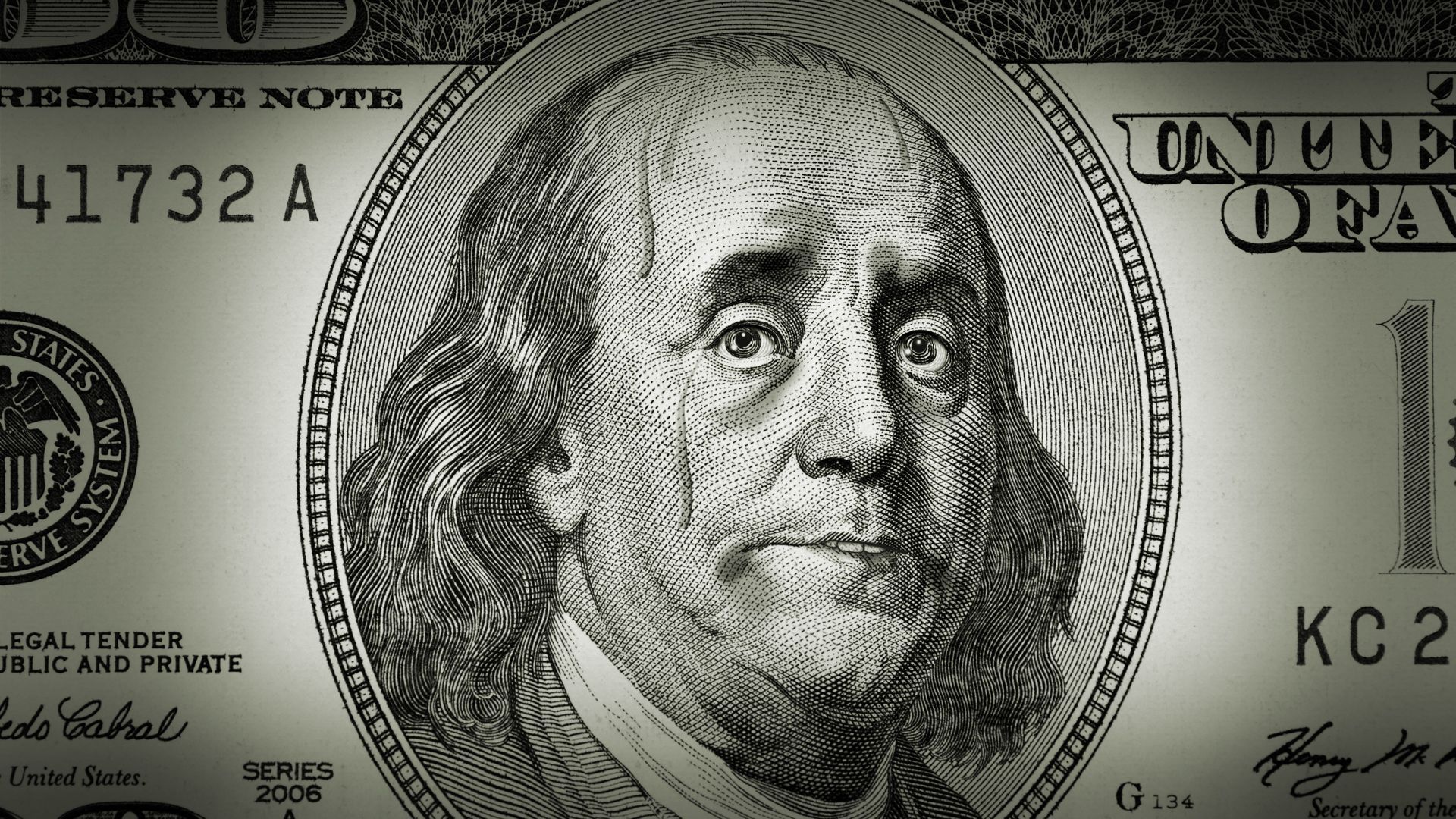
Illustration: Sarah Grillo/Axios
Money is the bedrock of our capitalist system, but recent moves from the Trump administration have made that foundation feel a bit squishier.
Why it matters: When the public loses faith in money objects, that unmoors us and can make things feel dangerously uncertain.
Driving the news: When New York City Comptroller Brad Lander checked one of the city's 26 bank accounts on Wednesday, he noticed $80.5 million had disappeared, clawed back by its sender, FEMA, seemingly on the orders of Elon Musk. (Musk alleged the money was earmarked to pay for hotel stays for migrants, which he said violated President Trump's executive orders.)
- On Feb. 4 the money was in the account. By Feb. 12 it was gone.
- The money was paid into the account via ACH transfer, a protocol that allows transactions to be reversed within five business days for one of three specific reasons: It was a duplicate transaction, it was sent to the wrong account by mistake, or there was an incorrect payment amount that needs to be corrected and resent.
- Lander is adamant none of those conditions applied in this case. Musk seized the money "with no legal authority," he said in a press conference.
- DOGE and FEMA did not reply to requests for comment.
Between the lines: People talk of and think of "the money" in their bank account. The number they see when they check their balance is money.
- That is thanks to many decades of rigorous bank supervision and regulation, as well as federal deposit insurance.
- A bank deposit that can purportedly disappear at any time on someone's orders, or one that can turn worthless upon the failure of the bank, isn't money. It's something much more ephemeral than that.
Zoom in: The Wall Street Journal reported that the Trump administration may be thinking about folding the FDIC, the agency that oversees most U.S. deposit insurance, into the Treasury.
- While there is no suggestion that deposit insurance might be abolished, the FDIC has become so conterminous with the concept that (unfounded) worries were quickly raised on social media about the safety of money in banks.
What's next: Trump has also ordered the Treasury to stop producing pennies, which are the most common form of money in existence. (Over 1.6 trillion pennies have been produced since 1793.)
- While there are lots of good reasons for the penny to be abolished, the ability to carve up cash purchases into slices of one hundredth of a dollar does give many Americans a feeling of fine-grained control over their money. In surveys, most Americans generally want to keep the penny.
Zoom out: At stake is a concept known as moneyness, which is essentially the ability of something to be money.
- "It is not always clear cut whether something should be considered a money object or not," David Orrell wrote in 2015. Orrell is a theoretician who describes money as "a powerfully psychoactive substance, which resonates in strong but unpredictable ways with human psychology."
The bottom line: Money might be a socially negotiated abstraction, but it also needs a real-world instantiation in order to exist and be useful.
- That tension has historically been carefully managed by the government, but Trump and Musk seem to have other priorities.
