Ford CEO: Trump is creating "costs and chaos" for automakers

Add Axios as your preferred source to
see more of our stories on Google.
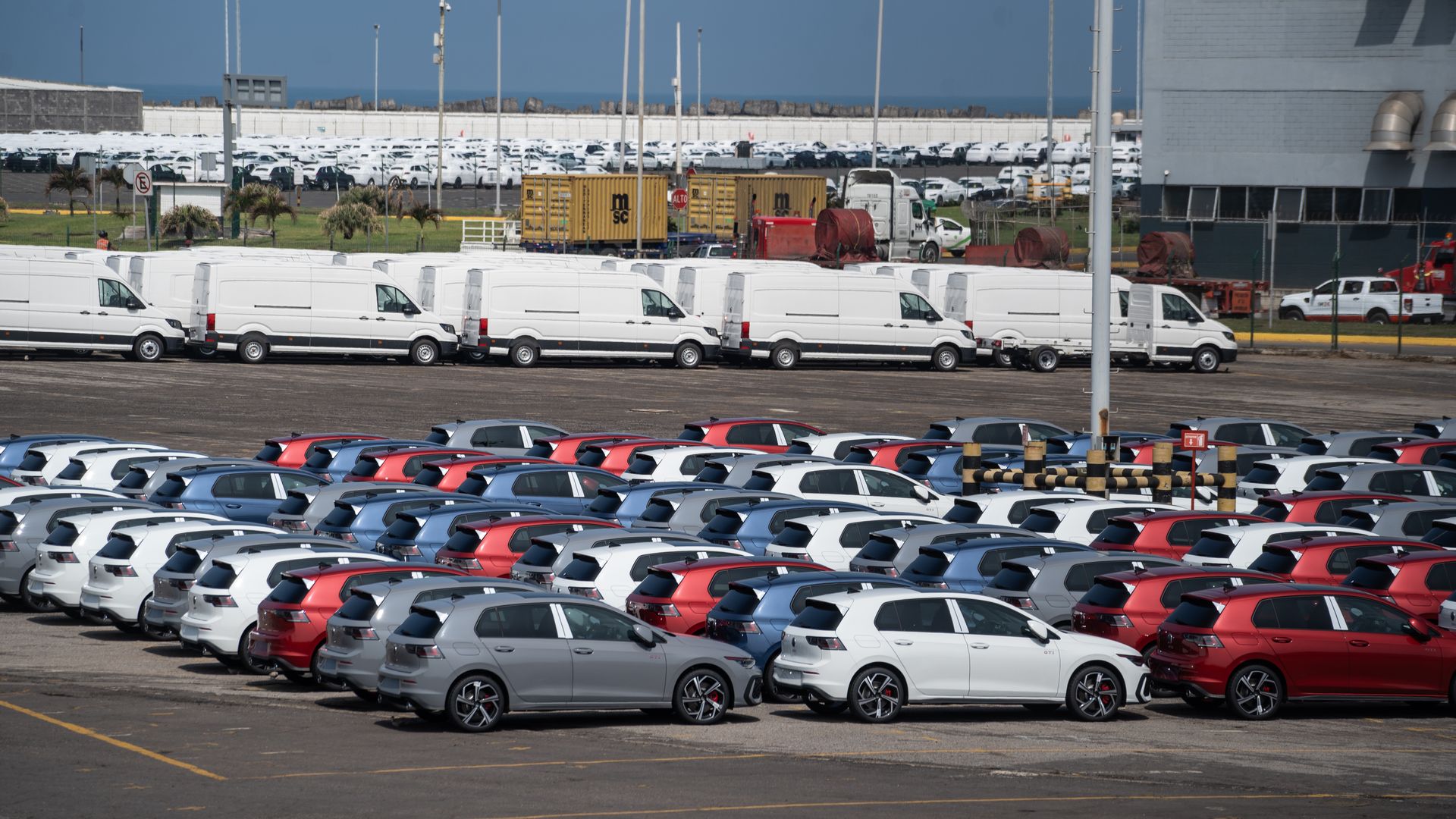
Cars waiting for export at a port in Mexico. Photo: Victoria Razo/Bloomberg via Getty Images
President Trump's early tariff moves have one thing in common: No matter the target, they all threaten to "blow a hole" in the auto industry, Ford CEO Jim Farley said Tuesday.
Why it matters: Whether the tariffs are national (Canada, Mexico) or material (steel, aluminum), the industry fears the same effect — millions of cars a year coming in from Asia and Europe with a sudden cost advantage.
The big picture: Thus far, no matter what Trump does with trade, it seems to hurt the auto industry more often than anyone else.
- Tariffs on Mexico and Canada? Most U.S. automakers sell cars with parts that cross those borders a half-dozen times or more during the assembly process, each time potentially incurring a levy.
- Tariffs on steel and aluminum? It's literally what the cars are made of.
What they're saying: "So far what we're seeing is a lot of costs and a lot of chaos," Farley said at a Wolfe Research conference on Tuesday.
- "Let's be real honest long-term: a 25% tariff across the Mexico and Canadian border will blow a hole in the U.S. industry that we have never seen," Farley said.
- "And frankly it gives free rein to South Korean and Japanese and European companies that are bringing one-and-a-half to two million vehicles into the U.S. that wouldn't be subject to those Mexican and Canadian tariffs."
- Farley also said he was headed to D.C. Wednesday to make his case.
- "It's the second time I've been there in three weeks. They need to understand that there's a lot of policy uncertainty here, but in the meantime, we're scrambling to manage the company as professionals and we're in a global race."
Zoom in: GM executives, speaking at the same conference, said they'd been taking steps to mitigate some of the tariffs, like reducing inventory sitting in international plants — but those steps could only go so far.
- "We think we can mitigate 30 to 50% of tariffs without deploying capital," CEO Mary Barra told investors.
Between the lines: Additional tariffs on steel and aluminum would create "a triple-whammy for the auto industry," which was already bracing for tariffs on goods from Mexico, Canada and China, said Patrick L. Anderson, CEO of Michigan-based Anderson Economic Group.
- Overall, tariffs could "hammer" the economies of Michigan, Ohio, Indiana and Ontario, Anderson said, and also hurt Tennessee, South Carolina, Alabama and Texas.
Yes, but: All this tariff talk could just be a negotiating ploy, and there's also a chance Trump will spare the auto industry or its key trading partners.
- During his first term in office, Trump imposed tariffs of 25% on steel and 10% on aluminum, but later granted exemptions to several countries, including Australia, Brazil, Canada and Mexico.
The intrigue: Tariffs are the problem the industry didn't need, while trying to transition to electric vehicles and compete with a slew of new Chinese competitors.
- Automakers need to lower their costs, and tariffs only make it harder.
The bottom line: Ford's CEO is still waiting for Trump to enact policies that will help, not hurt, the auto industry.
- "We're expecting and hoping there will be a pony in here for the auto industry. Right now, we're doing a lot of shoveling," Farley said.
