Trump's ICE frees hundreds of immigrants under "catch and release"

Add Axios as your preferred source to
see more of our stories on Google.
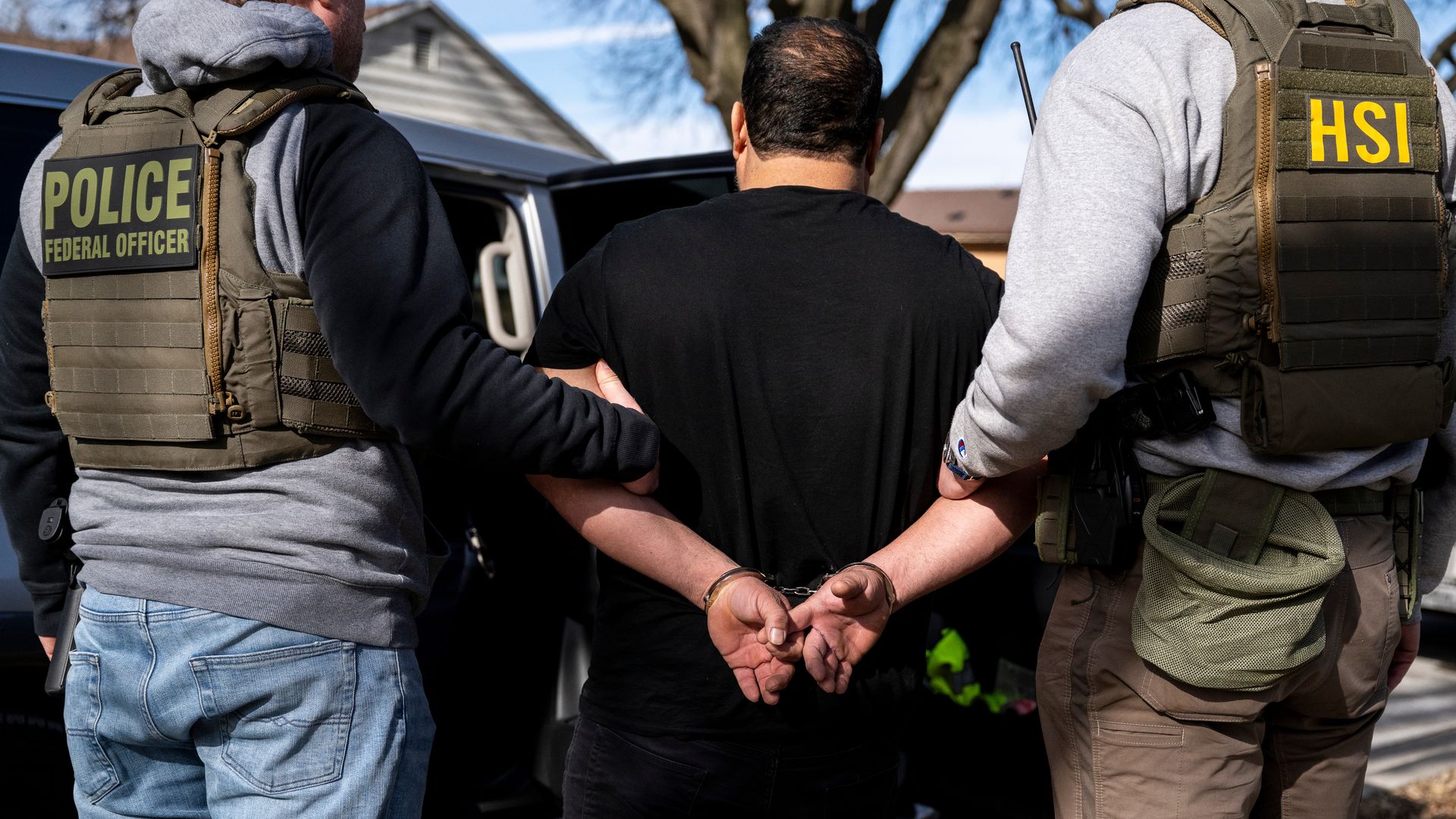
U.S. Immigration and Customs Enforcement (ICE) agents with a detainee in Lyons, Ill., on Jan. 26. Photo: Christopher Dilts/Bloomberg via Getty Images
Donald Trump's administration has used the "catch and release" program to free 461 undocumented immigrants from custody since he took office, partly because of limited detention space in U.S. immigration facilities, Axios has learned.
Why it matters: During his campaign Trump repeatedly criticized the Biden administration's use of "catch and release," and last month he set plans to end the practice.
- But for now it remains part of Trump's immigration enforcement strategy, as he pushes agents to round up immigrants for mass deportations at a time when detention facilities are nearly full.
- Under "catch and release," nonviolent undocumented immigrants who've been arrested by U.S. agents are freed after agreeing to return for their cases to be heard by an immigration court.
- The immigrants usually are given wristbands or ankle monitors, or are told to check in by telephone, to allow authorities to keep track of them until their court dates.
Zoom in: The released immigrants make up less than 6% of the roughly 8,000 undocumented people arrested since Jan. 21, Tricia McLaughlin, assistant secretary for public affairs at the Department of Homeland Security, said in an emailed statement to Axios.
- "They do not have final deportation orders and are likely contesting their immigration status," she said.
- McLaughlin said several factors can determine whether an arrested immigrant is released. They include a lack of detention space for women detainees, whether a detainee is likely to be deported anytime soon, and humanitarian considerations.
Immigration and Customs Enforcement (ICE) agents have been arresting a "significant number" of "criminal" immigrants who "require greater detention capacity," McLaughlin said.
- She added that ICE is looking to Congress for more funding to expand partnerships with local law enforcement and is working to review case files more quickly to deport those with "executable final orders of removal."
Zoom out: Immigration detention facilities in the U.S. hold about 41,500 people per day, on average. Trump has vowed to deport "millions" of unauthorized immigrants, and his administration wants to double the immigration system's detention capacity .
- The administration expects to build new facilities, but more immediately is rushing to line up detention agreements with sheriff's offices and beyond the U.S. mainland.
- Trump signed an executive order expanding migrant detention units at the U.S. naval base at Guantanamo Bay, Cuba. The Pentagon has sent hundreds of service members to the base to support the effort to house detained immigrants linked to crimes.
- On Tuesday, 10 Venezuelan nationals who officials said are members of the Tren de Aragua gang were sent to Guantanamo Bay on a military plane.
Another large military flight — carrying carrying men, women and families back to their native India — left the U.S. on Wednesday. DHS did not give a specific breakdown of those returned to India but said that such large flights typically carry 100 people.
- The Trump administration also has an agreement with Venezuela to accept its citizens deported from the U.S. And El Salvador recently agreed to accept criminals and detainees of any nationality — including Americans, which has raised legal concerns.
- Trump's border czar, Tom Homan, asked for more bed rentals from leaders at the National Sheriffs' Association meeting during its convention in Washington last weekend.
- The sheriffs asked Homan to make it easier for them to partner with ICE under formal agreements, which require additional training for local departments. The sheriffs also asked for more clarity on procedures for holding people ICE wants to detain.
