Raising tariffs would hit working-class Americans harder

Add Axios as your preferred source to
see more of our stories on Google.
President Trump ran on the Oprah promise of "you get a tax cut" for lots of different people: tipped service workers, retirees, overtime workers.
Why it matters: His first tax pitch out the gate — broad tariff increases on America's top trading partners — will likely raise the cost of living for those folks instead.
Where it stands: The U.S. struck deals Monday to pause looming tariffs on Canada and Mexico for 30 days.
- But the threat of tariffs remains a core Trump tactic, and eventually something is likely to stick around.
How it works: Tariffs are a tax typically paid by importers, but they don't generally eat those costs. Companies pass them on to consumers in the form of higher prices.
- In a new analysis out Tuesday, the Conference Board projects that the combined impact of Trump's tariff proposals would increase inflation by 0.6 percentage points over a one-year period.
- That's not near the sky-high inflation of 2022, but people, particularly middle-income earners, will feel those cost increases, says Dana Peterson, the group's chief economist.
Between the lines: A lot of the tariffed items aren't discretionary, or stuff people can just do without, such as food, energy, clothing and auto parts.
- Lower- and middle-income folks spend more of their money on these items and will feel those cost increases more than wealthy people, who spend a smaller percentage of their money on goods. The same thing happened with inflation.
Follow the money: Tariffs can cause prices to rise even on goods that aren't directly affected by the increases, says Wendy Edelberg, a senior fellow in economic studies at the Brookings Institution.
- If the price of, say, Canadian whisky goes up, then that can give other booze retailers an excuse to "take price" on competitive products. "There are going to be some companies that make out like bandits," she says.
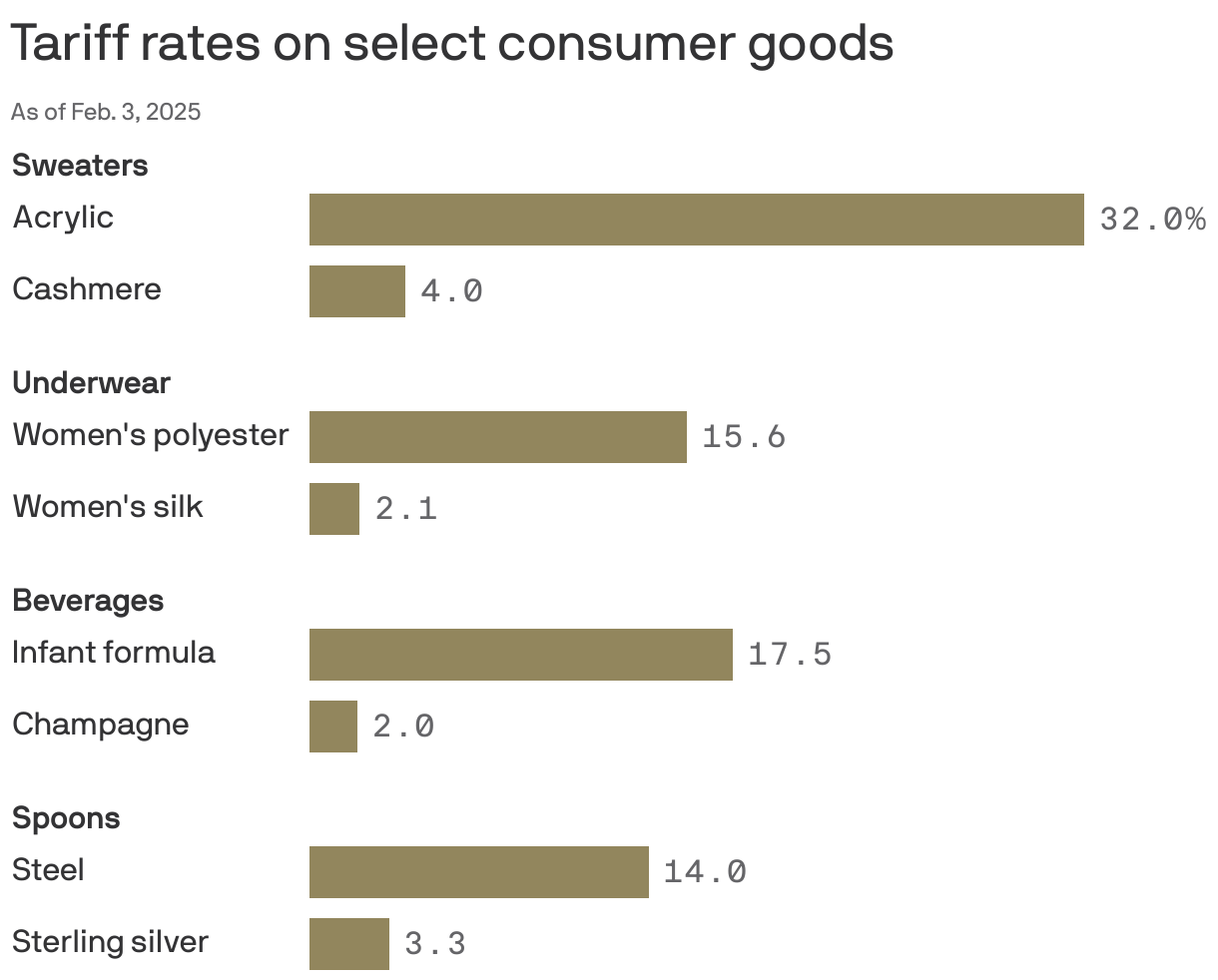
Zoom out: Even as it stands now, the U.S. tariff system is skewed in favor of the wealthy. Cheaper items face higher tariff rates than luxury goods, as outlined in a report last year from the Progressive Policy Institute.
- There's a 4% tariff on imported cashmere sweaters, and a 32% tariff on acrylic sweaters, per the institute's analysis.
- That's because U.S. companies that make less-expensive products lobby for higher tariffs to keep out cheaper goods from overseas, while firms that sell luxury goods are less worried about price competition.
The big picture: The theory behind higher tariffs is that the increases will force more manufacturing to happen at home, creating more jobs for Americans.
- In practice that's hard to pull off, Edelberg points out. Manufacturers often need raw materials from other countries and the costs of those inputs would rise in a trade war scenario.
- "It's entirely possible you could see lower, not higher, employment in the manufacturing sector," she says.
The bottom line: Trump said he'd bring costs down, but tariffs don't do that.
