OpenAI's Operator agent clicks, types and buys for you

Add Axios as your preferred source to
see more of our stories on Google.
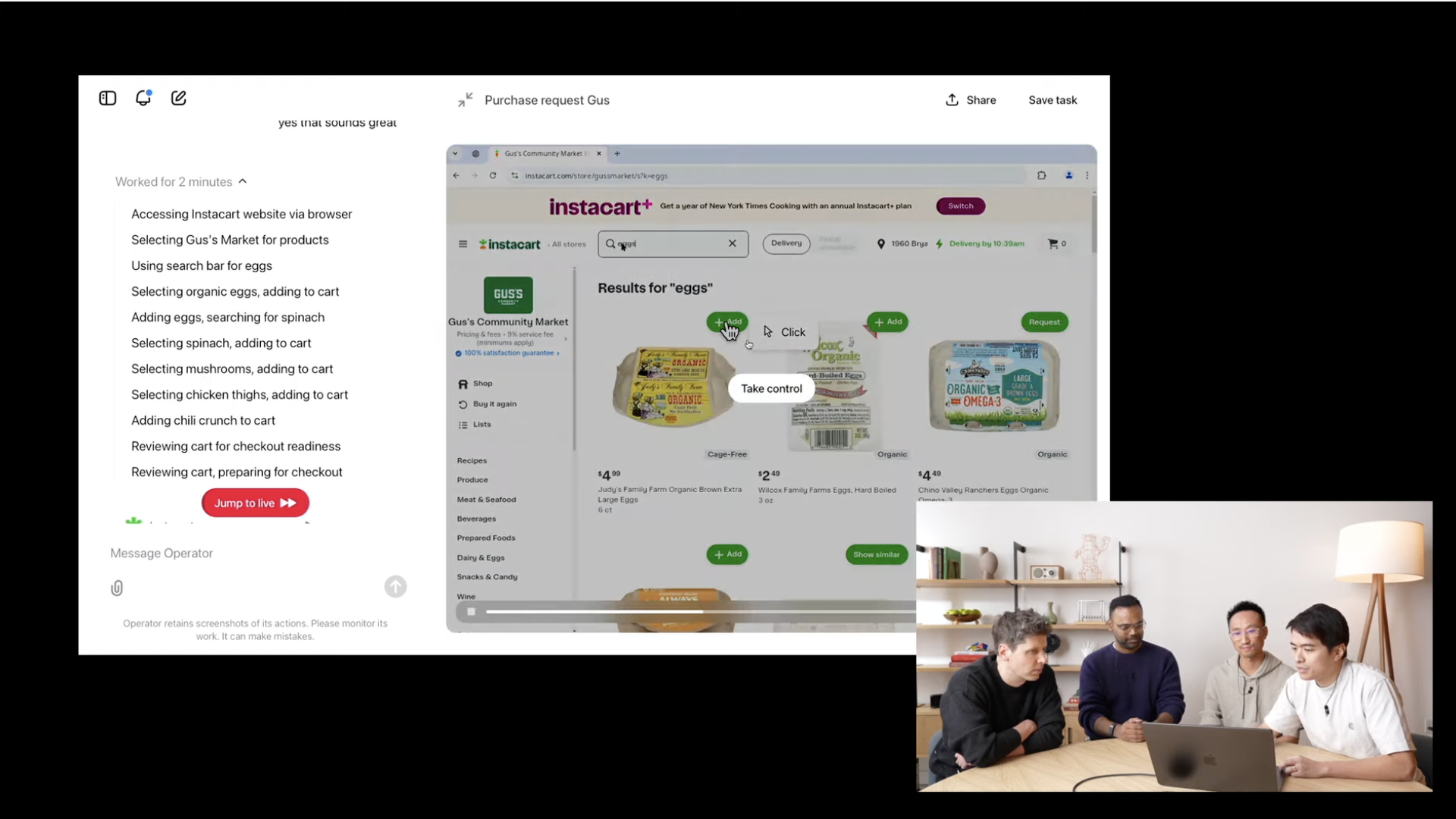
Video: OpenAI
OpenAI released a "research preview" of its first agent Thursday — Operator, a tool that can do web tasks for you.
Why it matters: With 2025 shaping up to be the year of the AI agent, AI firms are racing to free AI from the chat box and set it loose in the world. For now, that world is going to be the web browser.
The big picture: AI optimists' manifestos promise the new tech will save lives, reimagine education and make us more productive, but this new release only showed us slightly easier ways to buy concert tickets and order grocery deliveries.
- All the demos involved tasks that are currently easy to do without an AI agent — and even without AI.
How it works: Users can tell Operator to fill out forms, order products, make reservations and more. It opens its own browser and starts clicking and typing while you watch.
- In a blog post introducing the product, the company said Operator will "help people save time on everyday tasks while opening up new engagement opportunities for businesses."
- In Thursday's demo, CEO Sam Altman and three colleagues prompted the AI to make dinner reservations, buy tickets and order from Instacart.
- After typing the request, the four men simply watched as Operator did its thing.
In real life, you might use that time to do something else.
- But the time you save — especially when you consider how much time you may have to spend supervising the agent to fill in passwords or make sure it doesn't run wild with your credit card — is pretty minimal.
- Operator is only available for now to $200/month Pro subscribers in the U.S. OpenAI says it will roll out more widely in coming weeks and months.
State of play: Other AI companies have released similar tools designed to complete tasks on your behalf, but theirs were more focused on productivity.
- Anthropic released its "computer use" feature in October that collects data from the web and adds it to spreadsheets, among other features.
- In December, Google released Project Mariner, a tool that automatically completes tasks in Chrome.
Between the lines: OpenAI views Operator as the first baby steps toward loosing its AI on the world beyond ChatGPT's window.
- "Teaching the model how to use the same basic interface we use on a daily basis ... unlocks a whole new range of software to use that was previously inaccessible," OpenAI's Reiichiro Nakano explained in the demo.
- "That's what the core research project is about. It's about removing one more bottleneck on our path toward AGI and letting our agent move around and act in the digital world."
Threat level: There's always a tradeoff between security and convenience.
- OpenAI says it's releasing Operator slowly for safety, despite the "rigorous safety measures" already outlined in its System Card.
- We already let browsers store passwords and other personal information, but letting agents act on our behalf introduces all sorts of new risks.
- IT teams might not be prepared to secure agents if employees use them, per Axios cybersecurity reporter Sam Sabin.
Fun fact: Open AI wasn't the only company to release an AI agent assistant Thursday.
- AI startup Perplexity launched Perplexity Assistant for Android. The company claims the tool can also help you buy things without going to a retailer's website, although TechCrunch found this feature to be "slow and error-prone."
Flashback: Remember Google Duplex? It was a tool Google announced in 2018 to help make dinner reservations and other appointments over the phone.
- The company discontinued it in 2022.
Disclosure: Axios has limited beta usage of Operator for certain web tasks.
