Taboo economics no more


Add Axios as your preferred source to
see more of our stories on Google.
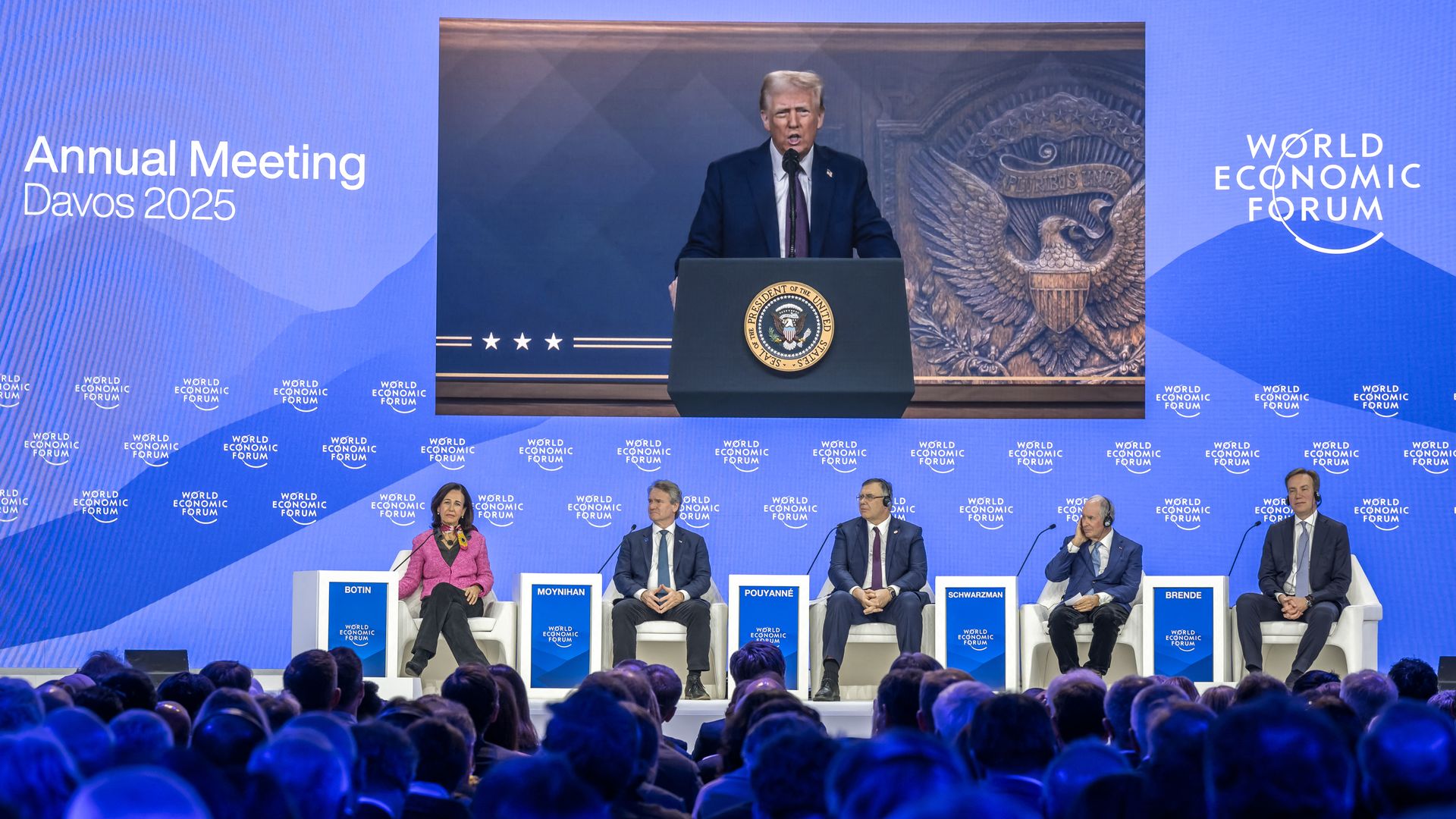
Trump speaks to the World Economic Forum today. Photo: Fabrice Coffrini/AFP via Getty
Economic orthodoxy is out. Rule-busting and experimentation are in. That's a key takeaway from this week's gathering of top executives and world leaders at the World Economic Forum in Davos, Switzerland.
Why it matters: Economic mini-experiments are happening in nations big and small as government officials embrace tariffs, protectionism, anti-immigration and other policies.
- The goal is to invigorate economic growth after tried-and-true policies have failed, despite warnings from mainstream economists that such approaches will damage the economy.
- However, the conventional wisdom around the economic benefits of free trade and a more interconnected world became that for a reason — and risks abound.
Driving the news: "My message to business is simple: Come make your product in America, and we will give you the lowest tax rate on Earth. But if you don't make the product here, you will have to pay a tariff," President Trump told the gathering in a virtual appearance — a reminder that the world's largest economy is led by a figure who rejects the mainstream economic view that tariffs are harmful.
What they're saying: Top executives may not love the prospect of big tariffs but say they believe the set of policy changes on the way will be good for the economy on net.
- "Lower regulatory burden will result in higher profit margins, will then allow us to manage the tariff burden differently," Bank of America CEO Brian Moynihan said in an interview with Axios on Thursday, so long as tariffs are used "in moderation."
- "We absorbed the tariffs put in during the first Trump administration and they never came off. Ten years later, we're talking about outsized economic growth relative to trend and relative to the rest of the world," Moynihan said.
- Or as JPMorgan CEO Jamie Dimon put it to CNBC on Wednesday when asked about tariffs, "If it's a little inflationary but it's good for national security, so be it. I mean, get over it."
The intrigue: For the second year in a row, Argentine President Javier Milei gave a special address at Davos criticizing mainstream economic thought.
- "I say to all global leaders, it is time to break free of the script," Milei said. "The truth is that there is something badly mistaken about the ideas that have been promoted through forums such as this one."
- "It is essential to break these ideological chains if we want to usher in a new golden age," he added, borrowing a phrase from Trump's inaugural address.
What to watch: European leaders face a harsh reality about their economy: Take a new approach, or fall even further behind after its yearslong slog.
- Officials in Germany are debating whether to upend a longtime debt rule enshrined in their constitution to jumpstart the stagnant economy.
- Speaking in Davos, German Chancellor Olaf Scholz pushed to expand borrowing to invest in infrastructure — an idea that helped tank the government last year.
- The nation's top central banker backed the idea, telling a German newspaper that the longstanding debt rule has worked well. "But now we live in a world of tectonic change and we have to address that. ... We have to start thinking outside the box."
When nations raise economic barriers as tools of foreign policy, it could lead to a meaningful economic cost, a report out Thursday from WEF and consultancy Oliver Wyman finds.
State of play: The report examines the likely consequences if world leaders continue their march toward greater use of sanctions, export controls, tariffs and other tools of statecraft that create bigger economic barriers between nations.
- In particular, it looks at the risk of falling into an increasingly bifurcated world, with separate financial systems for China and Russia versus the West.
By the numbers: Financial system fragmentation — dividing the world into fully separate blocs — would reduce global GDP by up to 5%, or $5.7 trillion a year, the report finds.
- The hit would be disproportionately felt in smaller emerging economies, which could see GDP losses of up to 11%.
Between the lines: In the United States, the use of sanctions as a geopolitical tool has ramped up steadily for two decades, across administrations. Trump imposed tariffs in his first term in office that the Biden administration kept in place.
- The last many years have been, in effect, a one-way ratchet toward a world with more barriers to the flow of money, goods and people.
- This has made countries with which the U.S. has hostile relationships more eager to develop financial networks of their own, even at a cost of efficiency.
The bottom line: "We're not saying that these type of economic statecraft tools shouldn't be used," Daniel Tannebaum, an author of the report and partner at Oliver Wyman, tells Axios, "but that they should be used smartly and to ensure no unintended consequences to the global economy."
