Autonomous trucking company sues over 1970s safety rules

Add Axios as your preferred source to
see more of our stories on Google.
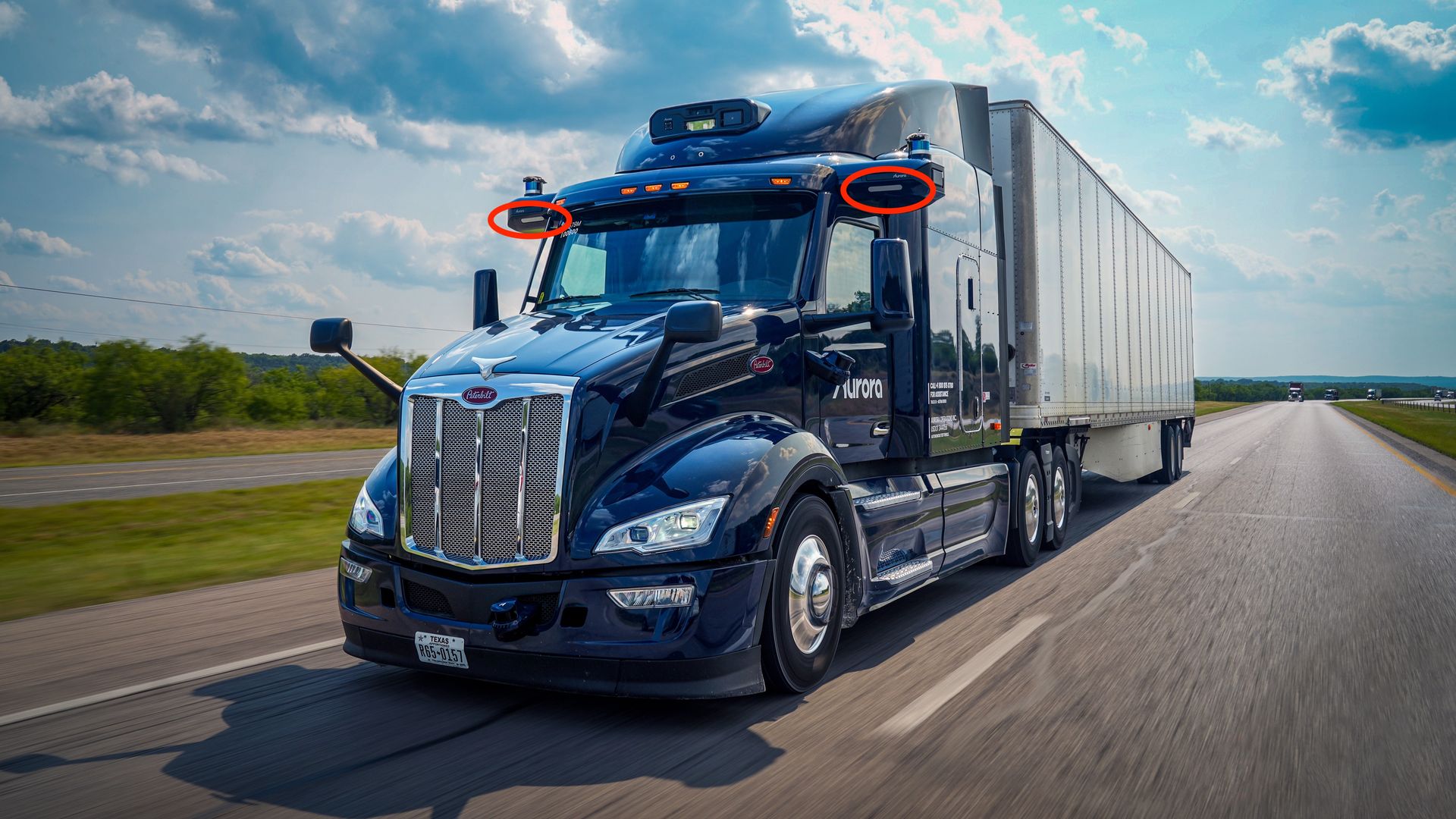
Circled lights on the cab of an autonomous Aurora truck would illuminate as bright flashing beacons similar to roadside construction vehicle to warn drivers if a driverless truck is stopped on the side of the highway. Photo courtesy of Aurora Innovation.
Autonomous trucking companies are at odds with federal safety officials over the best way to warn other motorists when a self-driving truck has stopped on the highway shoulder, and now one of them is taking the fight to court.
Why it matters: The closer autonomous vehicles get to reality, the more obvious the outdated regulatory gaps that must be resolved to ensure everyone on the road remains safe.
- If there's no driver in a semi-truck, for example, existing protocols for handling roadside hazards — which require someone to place warning devices around the vehicle — don't really apply.
Driving the news: Aurora Innovation, which plans to have driverless semi-trucks rolling in Texas by April, is suing the U.S. Department of Transportation, claiming it "arbitrarily" rejected the industry's idea for an alternative solution.
- The complaint was filed Friday in the D.C. Circuit Court of Appeals.
- Aurora argued that the agency's decision "stifles safety innovation and would impede the development of the autonomous trucking industry for no valid or lawful reason."
Catch up quick: Aurora and Waymo, another AV developer, applied in January 2023 for an exemption to existing rules that require truck drivers to exit their vehicle and place reflective triangles or flares on the roadway when stopped on the shoulder of a highway.
- The companies sought permission for driverless trucks to instead use ultra-bright, cab-mounted warning beacons similar to those used by highway construction vehicles.
- Their request was backed by a large coalition of trucking companies and AV developers, but was opposed by the Owner-Operator Independent Drivers Association.
- On Dec. 26, the Federal Motor Carrier Safety Administration, the DOT agency that oversees trucking safety, rejected the request.
- In its decision, FMCSA said the companies hadn't showed that a national, industry-wide exemption for AV trucks would provide an equivalent level of safety in such situations.
That explanation irked Aurora's head of federal policy, Melissa Wade, who told Axios that the government has no data about the efficacy of the current rules, which were enacted in 1972 and have never been updated.
- "There's no data to support that they're even remotely safe," she said. "We know it's dangerous to be on the side of the road."
- Aurora's own testing — which compared motorists' reactions to both hazard warning systems — showed that the cab-mounted beacons were as safe or safer than having a driver get out of the cab and place reflective triangles in the roadway.
- Wade said she was frustrated that federal safety officials didn't attempt to collaborate with the industry on a workable solution in the two years FMCSA had its application.
- The FMCSA did not immediately respond to Axios' request for comment.
Between the lines: The decision won't prevent Aurora from launching its driverless trucks as planned in April, the company says.
- It can find other ways to comply with existing regulations — such as ensuring a human driver closely follows the driverless truck to ensure that in the case it needs to pull over, they can place the warning triangles around it as required.
- But in a new blog post, Aurora President Ossa Fisher argues that it's time to modernize road safety regulations for the autonomous driving era.
The big picture: The federal government has largely been hands-off when it comes to regulating autonomous vehicles, which means AV developers are forging ahead without much guidance.
- Legislation that could dramatically increase the number of AVs on the road has been stalled in Congress for years amid disputes over issues like safety and liability.
- Last month, in the waning days of the Biden Administration, the National Highway Traffic Safety Administration proposed a voluntary national framework for autonomous vehicles, which could stimulate some movement.
- Tesla CEO Elon Musk is urging the incoming Trump administration to make it easier to deploy cars with no steering wheels or pedals, a necessary rule change to deploy a large fleet of Tesla robotaxis.
The bottom line: Whether it's driverless trucks or robotaxis, transportation companies want the government to update regulations that they claim are holding back the industry.
