What's good for a union isn't always what's good for workers

Add Axios as your preferred source to
see more of our stories on Google.
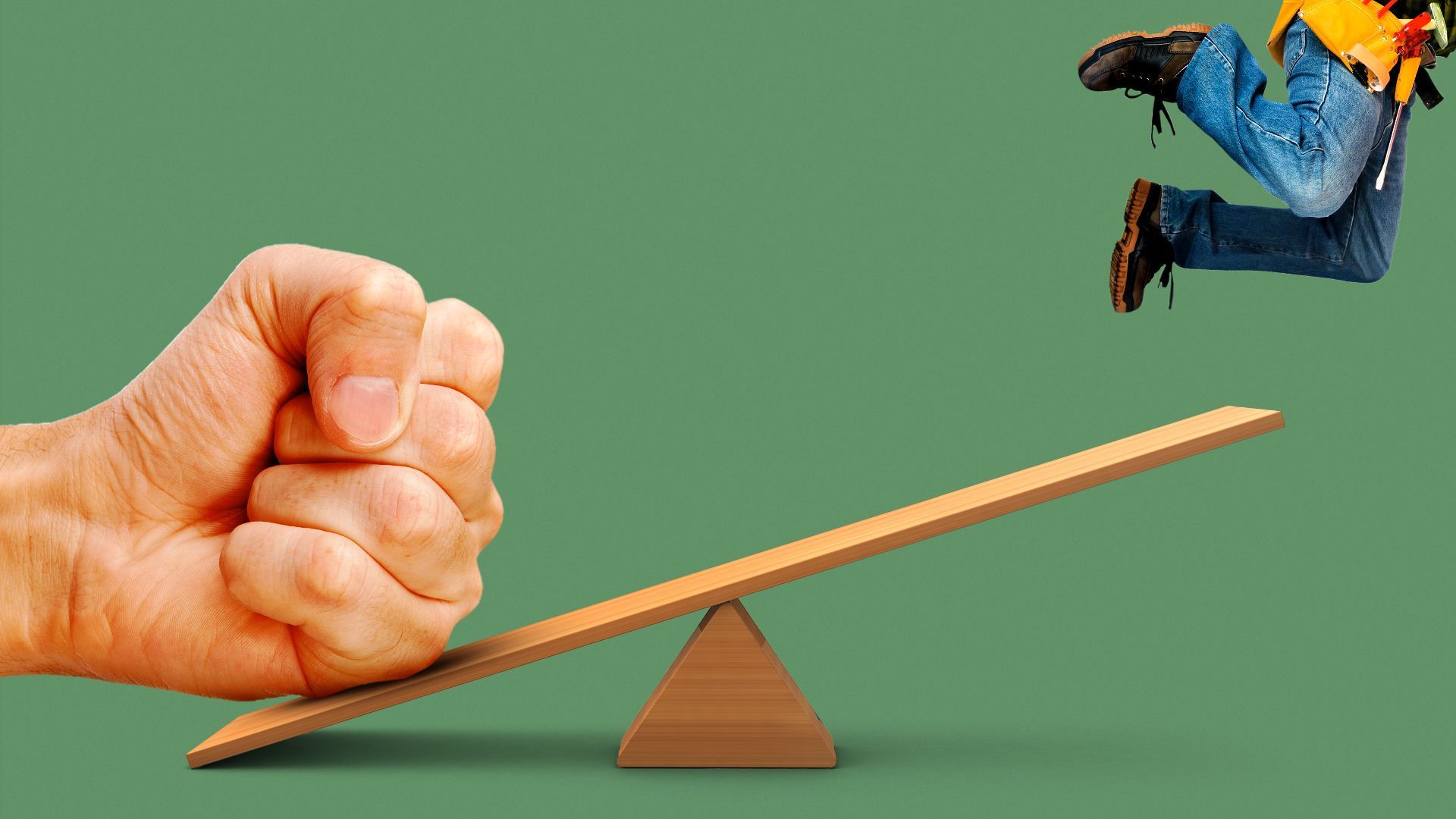
Illustration: Aïda Amer/Axios
President Biden blocked Japan's Nippon Steel from buying U.S. Steel last week, earning the approval of the United Steelworkers union, which desperately wanted the deal crushed.
- But steel workers themselves may be less than enthused.
Why it matters: It's not at all clear that the president's pro-union move will actually wind up benefiting rank-and-file members of U.S. Steel or other workers in the Pennsylvania region where the storied company is based.
Catch up quick: U.S. Steel has warned that without a deal it would be forced to close some operations in Pennsylvania, where it employs close to 4,000 people.
- Most threatened, as Axios' Dan Primack has reported, is believed to be Mon Valley Works, a steel processing plant with more than 3,000 workers. U.S. Steel also said it might relocate its Pittsburgh headquarters.
- Industry observers have said the company's future is rocky without outside investment. That would deliver a huge blow to the Pennsylvania economy, hurting the voters that Biden had been wooing in blocking the deal.
- President-elect Trump was opposed to the deal and has an evolving relationship with organized labor himself, raising questions around if or how he might step in to help the workers. (He's also changed his mind on deals with national security complications before, like TikTok.)
Zoom in: While the union's top brass vehemently fought Nippon, it's not totally clear rank-and-file members lined up behind them.
- Many said they supported the deal, seeing it as a "lifeline" for a dying industry, as the Washington Post recently reported.
- Hundreds of workers staged a protest last month demanding the government let the deal go through.
Between the lines: Ostensibly, the deal was blocked due to national security concerns.
- Almost no observers or experts buy that argument, and some of Biden's closest advisers reportedly wanted the deal to happen.
- "President Biden claiming Japan's investment in an American steel company is a threat to national security is a pathetic and craven cave to special interests that will make America less prosperous and safe," Jason Furman, who chaired the Council of Economic Advisers in the Obama administration, posted on X last week. "I'm sorry to see him betraying our allies while abusing the law."
Japan is typically seen as a very low-risk investor country, says Alexis Early, a partner at Jenner & Block who specializes in CFIUS cases.
- If there were national security concerns over, say, the availability of steel for U.S. defense needs, CFIUS would typically try to mitigate that risk by requiring the foreign buyer to enter into a "supply assurance agreement," she says.
- The decision in this case leaves us "scratching our heads," she says, calling it a "brouhaha car-wreck" that's spooking low-risk foreign investors. The risk is some may decide to pull back. "That could hurt workers beyond the steel industry," she says.
Reality check: There are many unknowns ahead for U.S. Steel, amid lawsuits and the possibility that another buyer could jump in.
- So it's too soon to definitively say this will or won't hurt workers.
- The company's been steadily shedding workers for years from nearly 50,000 in 2008 to around 23,000 last year. At the height of its power, in the 20th century, U.S. Steel employed hundreds of thousands of workers.
What to watch: If layoffs do happen, then clearly this wasn't good for the rank and file, says Lee Adler, a lecturer at Cornell University's School of Industrial and Labor Relations.
- Or for the Democratic Party, since Biden and union leadership will catch the blame, he says. "This is a cauldron."
