Scoop: U.S. raises concerns about attacks on minorities with new Syrian government

Add Axios as your preferred source to
see more of our stories on Google.
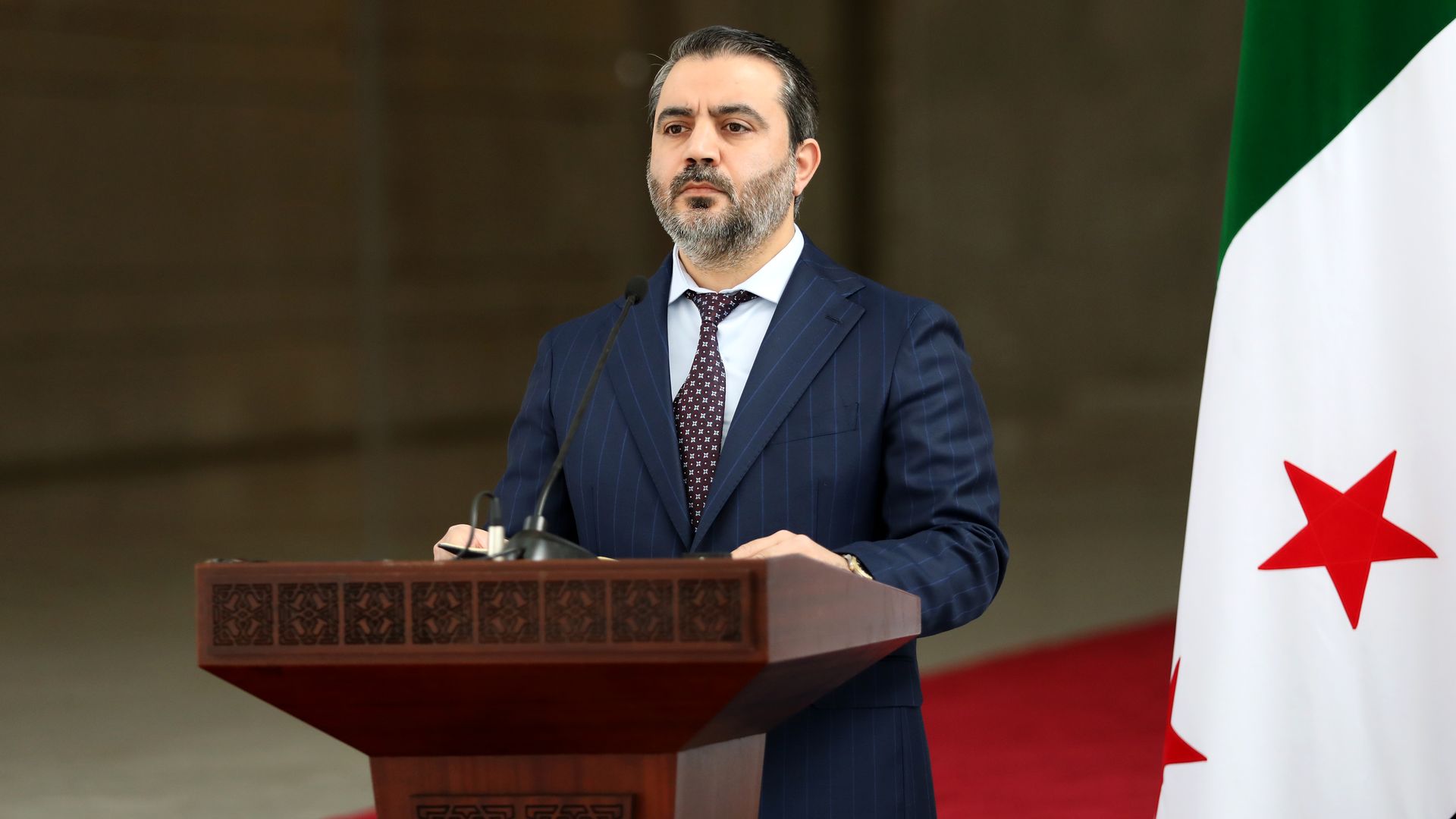
Syria's newly appointed Foreign Minister Asaad Hassan al-Shibani. Photo: Ali Haj Suleiman/Getty Images
The U.S. expressed concern to the new foreign minister of the transitional administration in Syria, Asaad Hassan al-Shibani, about reports of violent attacks by militant groups around the country in recent days, U.S. officials said.
The big picture: The Assad regime's fall after five decades in power and 13 years of civil war left behind many armed groups, and many more grievances. The U.S. is concerned that violent reprisals by militants affiliated with the victorious rebels — targeting minority groups or members of the ousted regime — will undermine efforts to stabilize the country.
Catch up quick: Al-Shibani is the right-hand man to Ahmed al-Sharaa, who is both the de facto ruler of Syria and the leader of the opposition group Hayat Tahrir al-Sham (HTS), the strongest armed group in Syria today.
- HTS is a Sunni Islamist organization that was affiliated in the past with al-Qaeda.
- Al-Sharaa, previously known as Abu Mohammad al-Jolani, has assured U.S. and Western leaders that he and HTS are now more moderate, and he appealed for sanctions imposed on Syria under Bashar al-Assad to be revoked.
- Last week, U.S. diplomats met al-Sharaa for the first time and told him a $10 million bounty on his head had been canceled.
Driving the news: Armed clashes between militants affiliated with the Assad regime and policemen affiliated with the new administration took place last week in the city of Tartus. Fourteen policemen and several militants were killed, according to the Syrian Interior Ministry.
- Tartus and the wider coastal region are predominantly Alawite. The minority Islamic sect makes up around 10% of Syria's population, but much of the now-ousted ruling elite, including the Assad family.
- Some Alawites and members of the Kurdish and Druze minority groups have expressed concerns they will become targets.
Several videos circulating on social media purport to show armed militants — allegedly affiliated with HTS or the security forces of the new government— beating, cursing and humiliating Alawite men while arresting them, or otherwise making threats toward Alawites.
- Axios obtained several such videos, including some showing graphic violence, but has not been able to confirm their authenticity.
- A U.S. official told Axios the State Department is aware of such videos and has been looking into reports of such incidents.
Behind the scenes: On Sunday, State Department envoy Daniel Rubinstein visited Damascus and met al-Shibani, two U.S. officials tell Axios.
- Rubinstein told al-Shibani the U.S. is concerned about the reports of violence, retribution and intimidation against minorities, and that such attacks must stop.
- Al-Shibani said the transitional administration opposes such violence and claimed it was mostly done by other armed groups, not HTS.
- A U.S. official told Axios that al-Sharaa and the transitional administration are trying to get things under control by demobilizing militias and integrating them under a new and united Syrian army.
- The official stressed the new Syrian administration needs to get the situation under control because if these violent incidents continue it could increase internal tensions and allow elements affiliated with the Assad regime or even ISIS to inflame a new conflict in the country.
State of play: Al-Sharaa has made several recent appointments to key positions in the transitional government, many of whom were close confidantes drawn from his administration in the HTS-controlled city of Idlib.
- One of the conditions the U.S. and Arab countries have laid out for the new Syrian government to get international recognition was that the government be inclusive.
- Al-Sharaa was asked about this during an interview with Al Arabiya on Sunday and claimed he made the appointments just for the immediate term to get the country functioning again as soon as possible.
- While al-Sharaa stressed he wants to start a national dialogue as soon as possible to form a new government in March, he also made clear that it needs to be a technocratic government, which is not based on political parties or sectarian quotas.
What to watch: Al-Sharaa surprised many when he said the process of drafting a new constitution could last up to three years and that elections could be held only four years from now.
- U.S. envoy Rubinstein asked the new Syrian foreign minister for more details of those plans during their meeting on Sunday, a U.S. official said.
What they're saying: A State Department spokesperson said the U.S. is in an ongoing dialogue with HTS. The spokesperson said he can't discuss private diplomatic conversations in public, but stressed the discussions so far have been "productive" and have covered both domestic and international issues.
- "We believe HTS should respect the human rights and fundamental freedoms of all Syrians, including members of minority groups and women. We will be continuing to watch and see that actions match words," the spokesperson said.
