What to know about the Azerbaijan Airlines plane crash

Add Axios as your preferred source to
see more of our stories on Google.
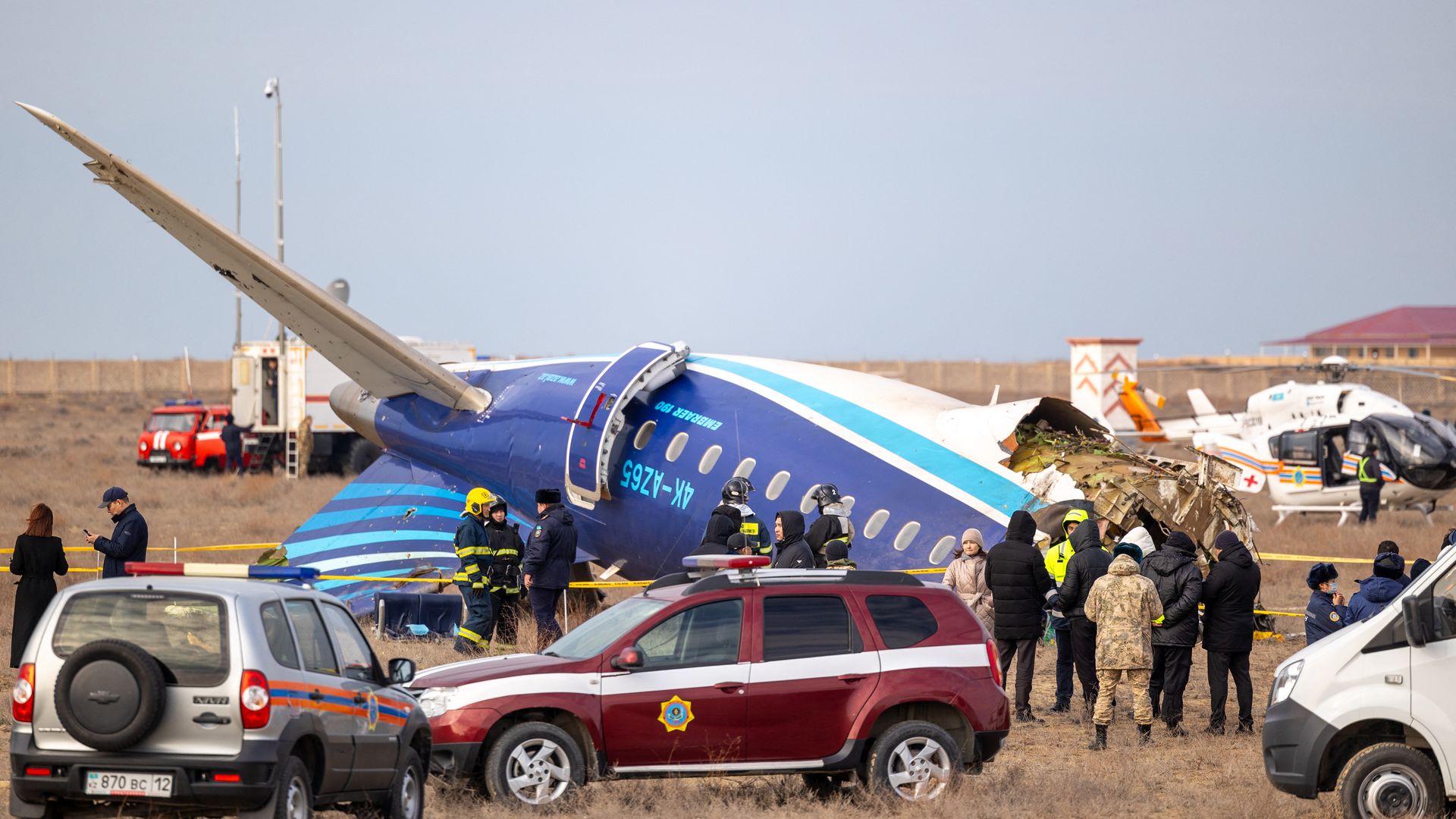
Emergency specialists work at the crash site of an Azerbaijan Airlines passenger jet near the western Kazakh city of Aktau on Dec. 25. Photo: Issa Tazhenbayev/AFP via Getty Images
Authorities in Kazakhstan are investigating the cause of an Azerbaijan Airlines plane crash in the country, which killed 38 people and injured 29 others on Christmas Day.
The big picture: Flight J2-8243 was diverted while en route from Baku, Azerbaijan's capital, to Grozny in southern Russia.
- Images of the incident shared online show the Embraer 190 aircraft catching fire and splitting apart as it crash-landed near the Kazakh city of Aktau.
- The Kremlin warned against "hypotheses," but aviation security analysts say it's "reminiscent" of Malaysia Airlines Flight MH17, which was shot down by a Russian surface-to-air missile system over rebel-held eastern Ukraine in 2014, per AFP.
The latest: Azerbaijani President Ilham Aliyev confirmed Sunday that Russian leader Vladimir Putin had apologized for the crash, but said the country "must acknowledge its guilt" over the tragedy.
State of play: Azerbaijan held a national day of mourning for the victims on Thursday, as Kazakh officials told the media that investigators had found the plane's black box at the crash site.
- A Kazakh official told reporters Thursday that an onboard cylinder containing oxygen exploded moments before the crash.
- A survivor told Russian media he remembered the pilot twice trying to land in dense fog over Grozny and then "the third time, something exploded, some of the aircraft skin had blown out."
Situation report: Chechnya, where Grozny is located, is one of several areas where Russian air defense systems have targeted Ukrainian drones, officials said.
- Chechen media reported Wednesday that Russian forces were repelling drone attacks in the region.
What they're saying: "We have seen some early indications that would certainly point to the possibility that this jet was brought down by Russian air defense systems," National Security Council spokesperson John Kirby said on Friday.
- The U.S. has offered its support to the Kazakhstan- and Azerbaijan-led investigation, Kirby said.
- Azerbaijan Airlines corroborated that the plane experienced "physical and technical external interference," per an early investigation, CNN reported.
Between the lines: "Azerbaijan Airlines flight was likely shot down by a Russian military air-defense system," said Osprey Flight Solutions, an aviation security firm based in the U.K., in an alert to clients that was shared with the media, which cited Kyiv's statement also accusing Russia's military of being behind the crash.
- Other factors included "circumstances around the airspace security environment in southwest Russia," said Osprey, which has provided analysis for carriers still flying into Russia after Western airlines suspended flights due to the Russian invasion of Ukraine.
- Justin Crump, of risk advisory firm Sibylline, told the BBC: "It looks very much like the detonation of [a Russian] air defense missile to the rear and to the left of the aircraft, if you look at the pattern of shrapnel that we see."
Zoom in: Osprey CEO Andrew Nicholson wrote that the firm had issued over 200 alerts on drone attacks and air defense systems in Russia during the war.
- If confirmed, it could prove to be a case of mistaken identity involving Russian units that have not been properly trained and fired "negligently against Ukraine's use of drones," the official said.
What they're saying: "It would be wrong to put forward any hypotheses before the investigation's conclusions," Kremlin spokesperson Dmitry Peskov said in a statement carried by state media.
- "We, of course, will not do this, and no one should do this. We need to wait until the investigation is completed."
Go deeper: Dutch court convicts three for Malaysian Airlines MH17 plane crash
Editor's note: This article was updated to include comment from Azerbaijani President Ilham Aliyev. Axios' April Rubin contributed reporting.
