House Democrats land on "hell no" on GOP spending deal

Add Axios as your preferred source to
see more of our stories on Google.
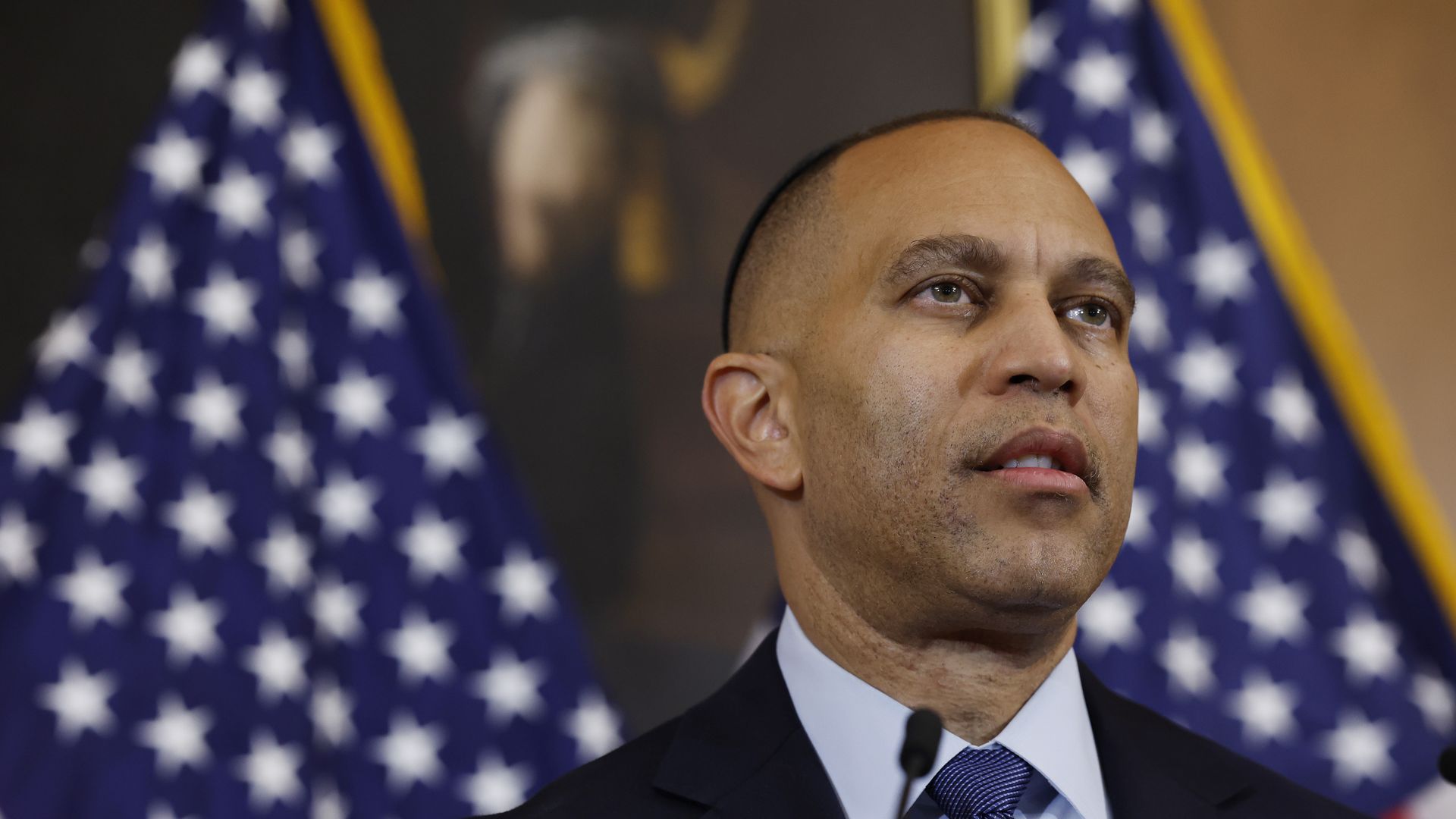
House Minority Leader Hakeem Jeffries arrives at Capitol Hill news conference on Dec. 19, 2024. Photo: Chip Somodevilla/Getty Images)
House Democrats on Thursday coalesced around an operative phrase to describe their fervent opposition to Speaker Mike Johnson's (R-La.) revised spending proposal: "Hell no."
Why it matters: It's a term House Minority Leader Hakeem Jeffries (D-N.Y.) used in a closed-door meeting of his caucus to describe his position, according to four sources who were present for his remarks.
- Jeffries initially termed the bill "laughable" when walking into the meeting.
- Johnson plans to initially hold a vote Thursday under a process that requires a two-thirds majority for passage, meaning the measure would need considerable Democratic support.
What we're hearing: "Sounds like everyone is a Hell No," one House Democrat who was in the closed-door caucus meeting Thursday told Axios.
- Rep. Steve Cohen (D-Tenn.), coming out of the room, said he is "beyond" a hell no, telling Axios: "I'm an f- no."
- There was "not a single soul" in the meeting who spoke in favor of the bill, one senior House Democrat who was present told Axios.
- Democrats plan to formally whip against the bill, according to multiple lawmakers.
Zoom out: Democrats were incensed after President-elect Trump torpedoed their deal with Johnson on a nearly 1,550-page bill to fund the government until March.
- That was the driver of much of their opposition to Johnson's new plan, which strips out several key provisions negotiated by the two parties and includes a two-year debt limit extension that Trump demanded.
- "The big stench is just the complete moving of the goalposts ... without any justification other than the whims of Vice President Trump and President Musk," said Rep. Jared Huffman (D-Calif.).
- Said Rep. Jamie Raskin (D-Md.): "We had a deal and they should stick to the deal."
Zoom in: Many of Democrats' committee ranking members also stood up to outline substantive arguments against the bill, according to multiple lawmakers and aides in the room.
- One major point was that billionaire Trump lieutenant Elon Musk allegedly stands to benefit from the removal of restrictions on outbound investment to China.
- Lawmakers also argued that raising the debt ceiling will help Republicans pass their planned tax cuts.
What's next: If the bill fails to garner a two-thirds majority, Republicans are expected to try to get it to the floor under a process that only requires a simple majority.
- However, the bill would first have to pass through the Rules Committee, where a trio of right-wingers can tank it over its lack of spending cuts.
Axios' Erin Doherty contributed reporting for this story.
Editor's note: This story has been updated with additional reporting.
