Where money doesn't buy happiness

Add Axios as your preferred source to
see more of our stories on Google.
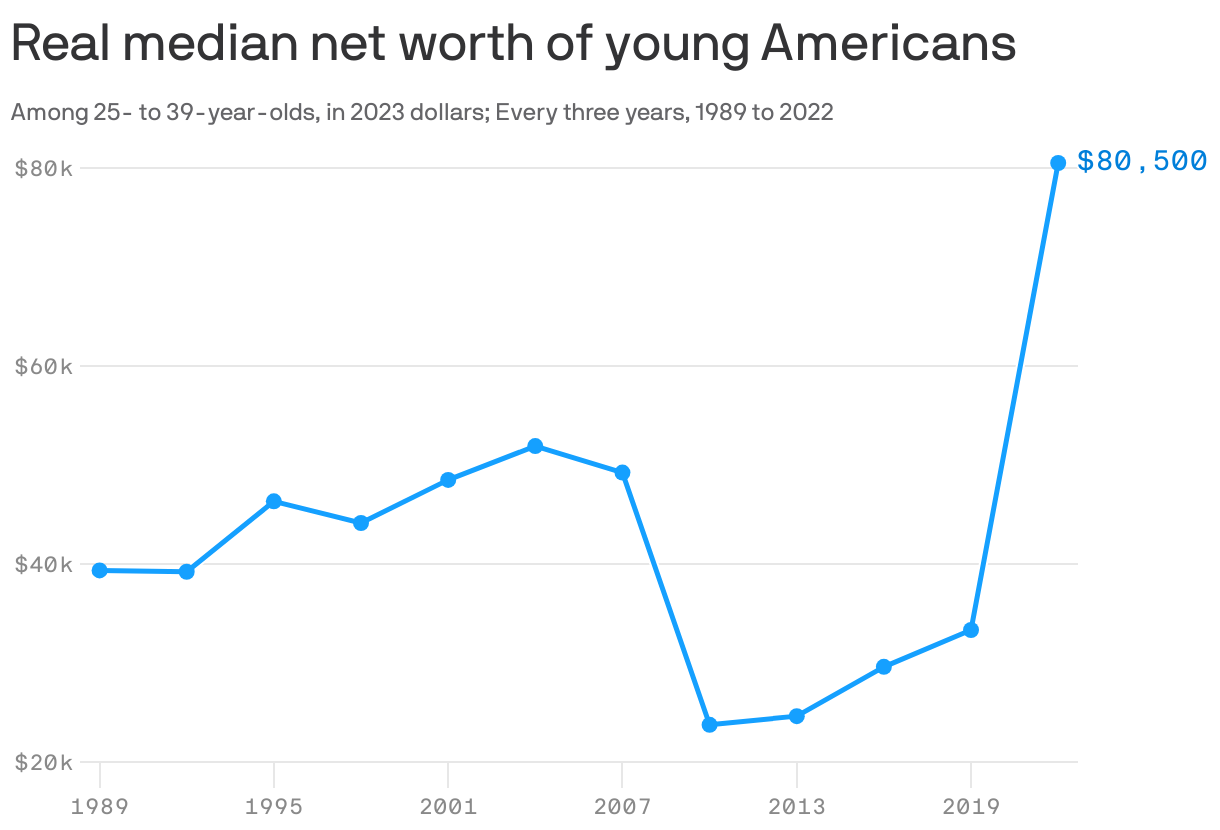
Americans under the age of 40 are richer than ever — but they still feel "an increasing sense of economic fragility," per detailed new research released by the Treasury Department this morning.
Why it matters: Disaffection and despair, especially among young men, are on the rise, and economic factors play an important role in that phenomenon.
What they're saying: Treasury Secretary Janet Yellen spoke in October about "a sense of alienation" and "very deep dysfunction in people's lives" — as evidenced by the "deaths of despair" documented by Anne Case and Angus Deaton.
The big picture: We've known for a while that average wealth for younger Americans has been hitting record highs. More importantly, median wealth has been showing the same thing.
- For Americans between 25 and 39, median wealth hit $80,500 in 2022, Treasury calculates — up from just $23,750 in 2010. And that's in 2023 dollars, after accounting for inflation.
The other side: While wealth was turbocharged by the stimulus checks and roaring bull market following the 2020 pandemic, careers were not.
- Mentorship and on-the-job learning are much harder when working remotely, while demographic changes mean that younger workers are increasingly competing with their more experienced elders for desirable jobs.
- Meanwhile costs have been rising faster than young Americans' incomes not only for education but also for child care, health care, and — most pressingly — shelter.
By the numbers: Treasury notes that 61% of men haven't graduated from college — and their earnings have been declining, in real terms, for 30 years.
- To add insult to injury, some 42% of Americans with student loans between ages 25 and 39 don't even have a bachelor's degree.
- It's not just college, either. The proportion of men between 25 and 39 with any job has been falling steadily for more than 30 years. It was almost 95% in 1990. It's now been below 90% for over a decade.
The bottom line: The report points to "expanded education, less discriminatory workplaces, cheaper goods, and more household wealth" as examples of how the lives of young Americans are improving.
- The other side of the ledger, however, seems to be dominating much of the generational psyche — as is evidenced by the enormous sums of money they say they need to be successful.
