Europe's new era of turmoil

Add Axios as your preferred source to
see more of our stories on Google.
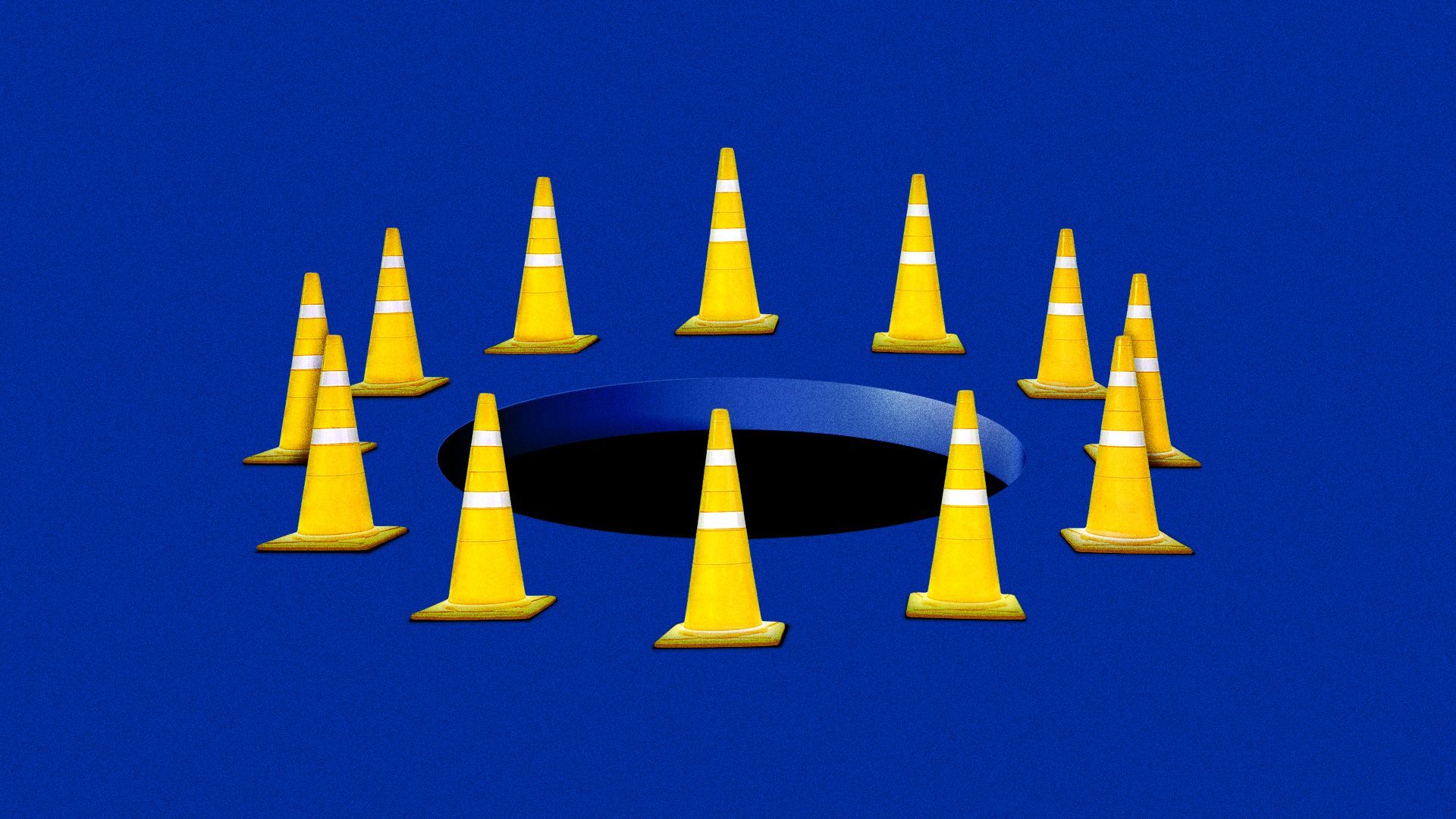
Illustration: Maura Losch/Axios
Historic political chaos and economic stagnation leave Europe in a weaker position to handle the expected fallout from President-elect Trump's looming tariffs.
Why it matters: Europe's economic powerhouses, Germany and France, no longer look like the reliable centers of political and economic stability of years past.
- That has halted efforts to address the continent's fiscal and economic challenges, ones set to deepen if Trump's trade agenda becomes a reality.
The big picture: These near-term crises will collide with Europe's structural problems — a lack of innovation amid tight regulation; slow productivity growth; and an aging population.
- "This is an existential challenge," Mario Draghi, one of Europe's most respected technocrats, wrote earlier this year in a report.
- "World trade is slowing, geopolitics is fracturing and technological change is accelerating," Draghi said in a separate address to parliament. "Of all the major economies, Europe is the most exposed to these shifts."
Between the lines: Far-right populists have gained more political power in Germany and France as part of a global anti-incumbency backlash stirred by the inflation crisis.
- Political gridlock over fiscal issues and starkly different economic visions make addressing economic shortcomings that much harder.
- "Skill mismatches and weak innovation performance weigh on productivity and result in higher unemployment," ratings agency Moody's said of France, adding that the cost of its aging population "remains high."
- "Germany's potential growth is likely to decline significantly, primarily due to an aging population and, to a lesser extent, the recent energy crisis," Fitch Ratings said in a recent report.
Catch up quick: At the heart of Europe's political dramas are feuds over each government's financial leeway. In France, the influence of the far-right has never been more on display.
France's government was dissolved for the first time in more than 60 years. The far-right faction, led by firebrand Marine Le Pen, joined with a left-wing coalition to oust the prime minister.
- Neither faction supported the proposed budget that aggressively tried to slash the nation's deficit. But investors were dumping French government debt in the event such deficit reduction would not happen.
Germany faces the opposite issue: Chancellor Olaf Scholz wants to relax the 2009 "debt brake" — a rule that caps fiscal deficits and limits how much the government can borrow — to invest in efforts to jumpstart the economy.
- Scholz sacked his finance minister for opposing the idea, triggering the collapse of the three-party governing coalition last month.
- For the first time, Germany's far-right party, Alternative for Germany (or AfD), put forth its own nominee for chancellor in the coming election.
The intrigue: The next governments will have to break those impasses against a perilous economic backdrop, threatened by tariffs.
- In France, economic growth is lackluster; the energy crisis, rising interest rates, and higher prices have weighed on demand.
- In Germany, the economy has shrunk in four of the last eight quarters. The European Commission predicts negative growth for the second year in a row.
- Germany and France are the center of the manufacturing slowdown in Europe. "It's like the eurozone's manufacturing recession is never going to end," one Hamburg-based economist said in a data release.
What to watch: Roughly 10% of German exports go to the U.S., with autos making up the largest share.
- "Any U.S. tariffs would hit an already suffering sector," Carsten Brzeski, an economist at ING, wrote in a client note.
- Adding to the pain: German companies might instead opt to invest in the U.S., lured by cheaper energy, tax cuts and deregulation anticipated under Trump.
- But all that will come at the expense of Germany's competitiveness on the global stage, Brzeski added.
The impact: Europe's political dysfunction, high debts and looming tariffs make it hard to prioritize and spend to fix its structural problems — possibly putting its economy in a low-growth trap.
- That could have spillover effects for the U.S., with less demand for domestic exports that would weigh on Trump's economy.
