What to know about ghost guns

Add Axios as your preferred source to
see more of our stories on Google.
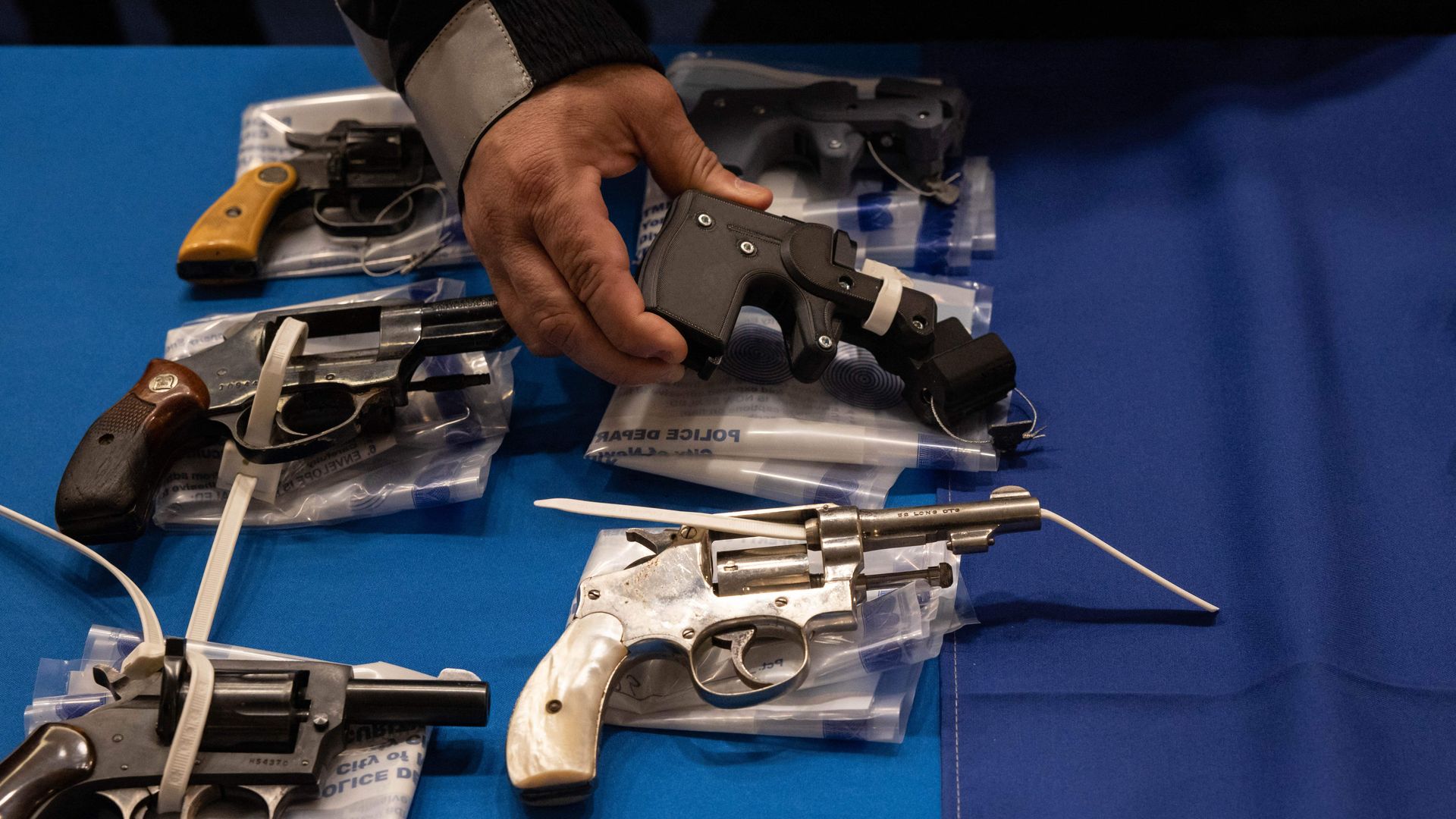
Kings County District Attorney Eric Gonzalez holds a 3D printed ghost gun during a statewide gun buyback event held by the office of the New York State Attorney General, in the Brooklyn borough of New York in April 2023. Photo: Yuki Iwamura/AFP via Getty Images
Luigi Mangione, the person of interest in the killing of UnitedHealthcare CEO Brian Thompson, was carrying a so-called "ghost gun" when he was arrested in Pennsylvania on Monday, law enforcement said.
The big picture: The privately made firearms have become increasingly popular among criminals. They are untraceable by law enforcement as they lack the serial numbers found on other guns.
What are ghost guns?
Ghost guns are bought and assembled by the owner, Axios' Bryan McBournie previously reported.
- Individuals purchase the parts to assemble the gun, either piece by piece or in assembly kits. The parts aren't usually considered firearms, allowing purchases to bypass the background check that is required for serialized firearms.
- Ghost guns are often marketed as untraceable and unregulated by the government.
Yes, but: President Biden proposed a rule change in April 2022 requiring that ghost guns be placed under the same regulations as commercial firearm sales, including the use of serial numbers and background checks for buyers.
- The legal challenge to the rule was taken up by the Supreme Court, which heard oral arguments on the case in October. A ruling has not been issued.
What threat do ghost guns pose?
Threat level: Ghost guns are considered the "fastest-growing gun safety problem" in the U.S. by Everytown for Gun Safety, an advocacy organization.
- "They are extremely dangerous and we must do more on the federal level to clap down on the availability of ghost guns," New York City Mayor Eric Adams said in a news conference on Monday afternoon.
By the numbers: The number of ghost guns traced and recovered by the federal government more than doubled in 2021 from the year before, per the Bureau of Alcohol, Tobacco, Firearms and Explosives.
- According to the Department of Justice, over 25,000 ghost guns were recovered by law enforcement in 2022, marking a 1300% increase from 2016.
- Just 15 states have laws on ghost guns. Most require background checks on purchasers and serialization of parts and components.
Zoom in: Mangione's gun may have been made using a 3D printer, NYPD Chief of Detectives Joe Kenny said during Monday's press briefing.
- "The capability of firing a 9 millimeter round, obviously that will come out during our ballistics testing," he said.
- 3D-printing technology has yielded increasingly reliable firearms, per The Trace, a news organization that reports on gun violence. Models can vary widely.
How are ghost guns legal?
The Gun Control Act of 1968 allows private citizens to build guns for personal use. There are few regulations requiring them to be registered or traceable so long as they're not sold by the owner.
- Commercial firearms are required to be federally licensed.
Go deeper:
