Trump's currency cakeism

Add Axios as your preferred source to
see more of our stories on Google.
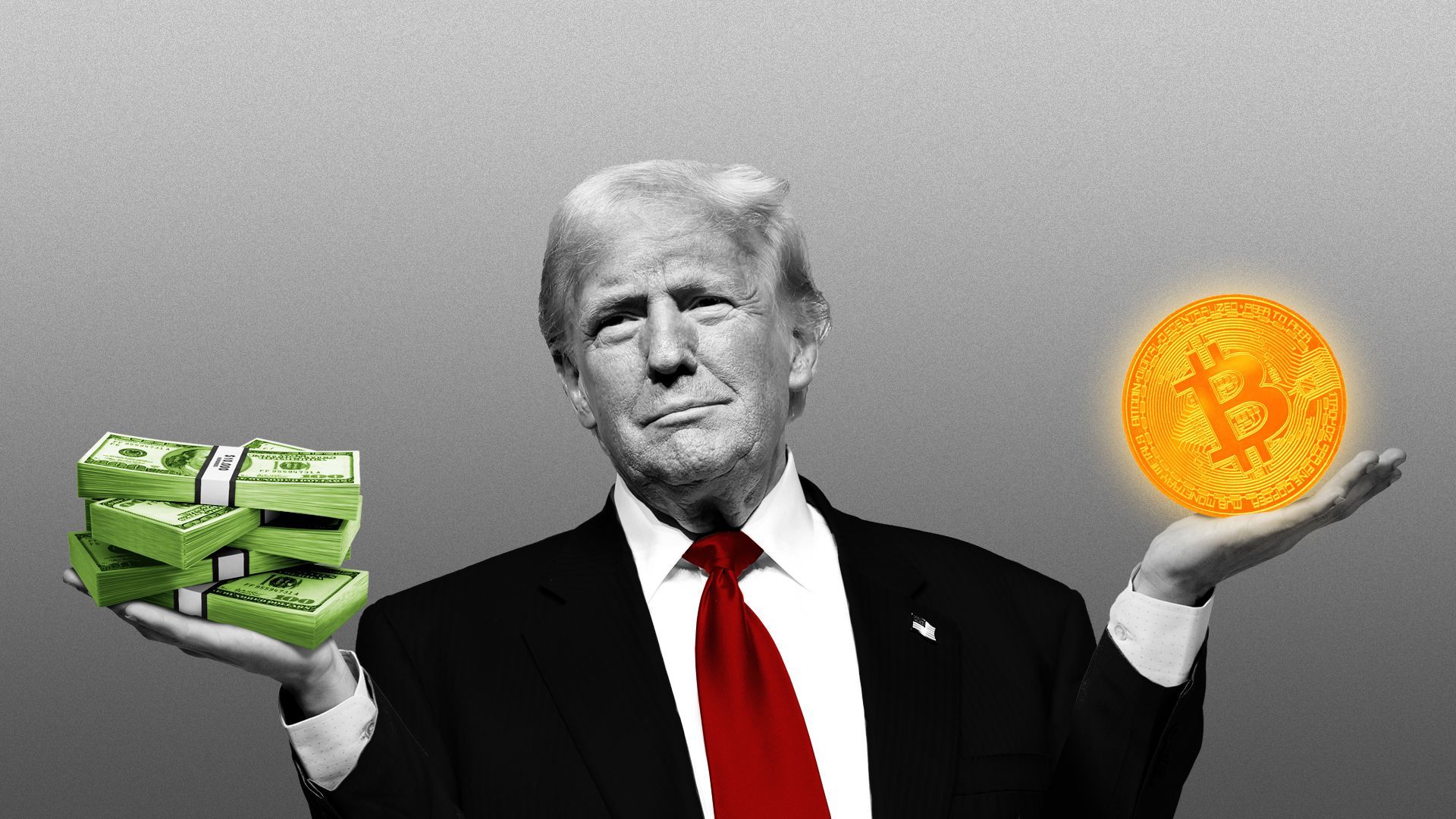
Illustration: Sarah Grillo/Axios. Photo: Anna Moneymaker/Getty Images
Should the U.S. government be worried about a potential threat to the dollar's status as the dominant global reserve currency? President-elect Donald Trump thinks so — but then again, he also thinks it shouldn't.
Why it matters: Trump feels so threatened by the risk posed by a rival to the dollar that he's willing to impose 100% tariffs on countries considering such a move.
- On the other hand, he has warmly embraced bitcoin, which was...created to be a rival to the dollar.
- It's another thorny internal contradiction of Trumponomics, as our colleague Neil Irwin has written, which will have to be sorted out sooner than later.
What he's saying: "Those who say that bitcoin is a threat to the dollar have the story exactly backwards," Trump said in a speech to a bitcoin conference in Nashville in July.
- "Bitcoin is not threatening the dollar," he explained. "The behavior of the current U.S. government is really threatening the dollar."
Between the lines: It's an article of faith among bitcoiners that fiat currencies in general, and the U.S. dollar in particular, make for terrible reserve currencies because of the way that governments can print them at will.
- The argument goes that because there will never be more than 21 million bitcoins, the digital token is a stronger and more useful currency, which should and will supplant the dollar.
- Trump's counterargument, as limned in his Nashville speech, is that the determination whether the dollar retains its global reserve status lies entirely in the hands of the U.S. government itself. So long as the U.S. remains fiscally prudent, the dollar will remain dominant.
Where it stands: The BRICS — Brazil, Russia, India, China, and South Africa — have joined with Saudi Arabia, Iran, Ethiopia, Egypt, and the United Arab Emirates to declare their opposition to a unipolar world where the U.S. can wield economic power far beyond its own shores.
- The dollar will remain the dominant global reserve currency for the foreseeable future, though, whatever the BRICS decide to do.
- That said, one of the most effective ways to reduce dollar dominance would be for the U.S. to impose punitive tariffs on the world's most populous countries, thereby forcing them to trade more with each other and less with the global hegemon.
Zoom out: Trump's stated arguments for the imposition of tariffs — whether it's fentanyl crossing the border or counteracting dollar dominance — are not being taken particularly seriously by the market, which sees such rhetoric as just the way Trump likes to conduct trade negotiations.
- That said, Trump would clearly like higher tariffs, mainly because he thinks they will bring in enough revenue to be able to cut taxes and bring the budget deficit down to a reasonable 3% of GDP.
The bottom line: If the BRICS want to unite behind a dollar rival that Trump has endorsed but can't control, perhaps they should start thinking about bitcoin.
