Trump's dollar dominance push is at odds with his agenda

Add Axios as your preferred source to
see more of our stories on Google.
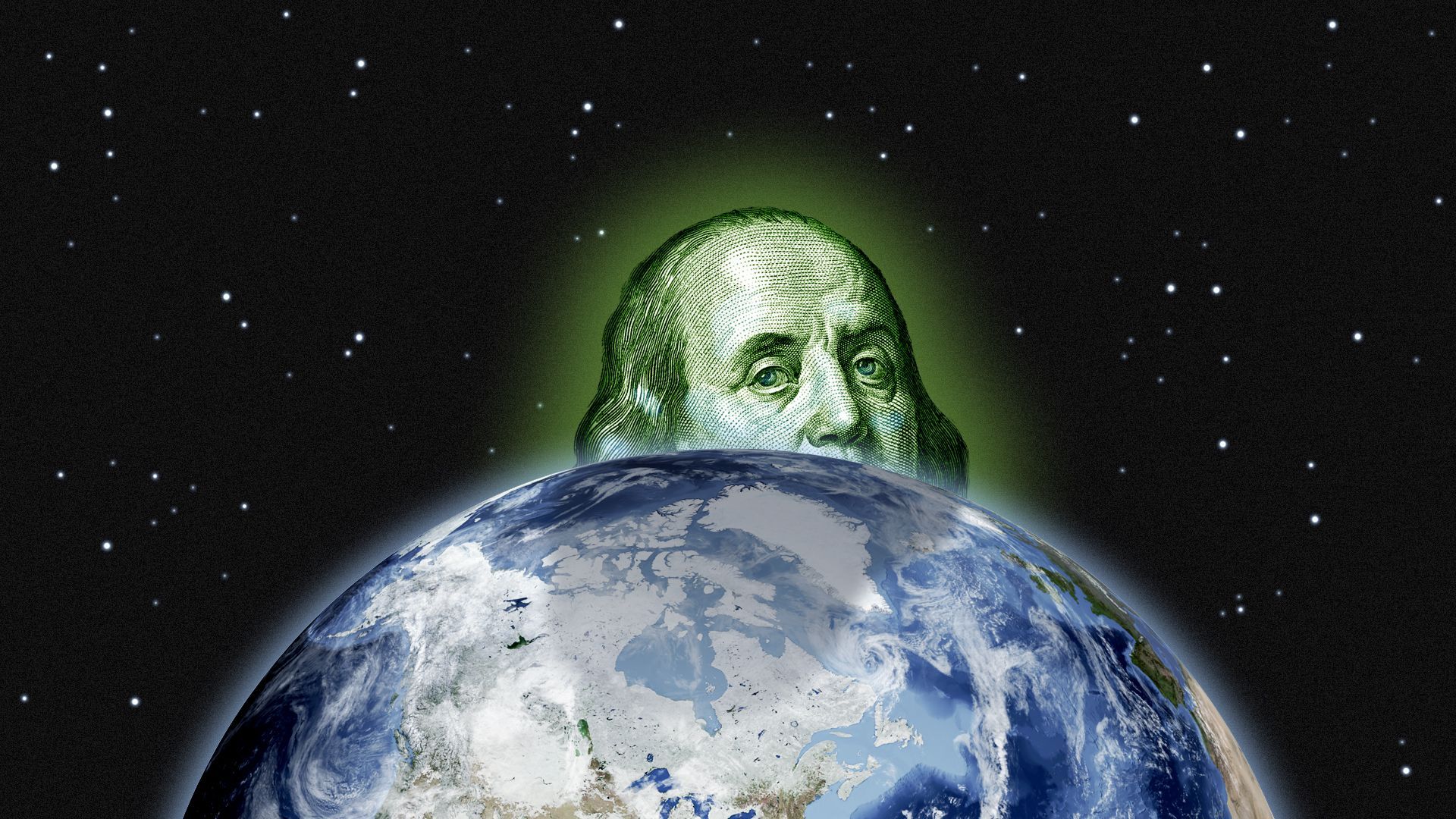
Illustration: Sarah Grillo/Axios
President-elect Trump had a blunt warning Saturday to countries looking to shift away from the U.S. dollar as the dominant global currency — but his threats are in tension with his broader economic agenda.
Why it matters: The dollar's international role is one of several areas in which different aspects of Trump's agenda involve internal contradictions.
- Trump's planned use of tariffs to try to bolster U.S. manufacturing and reduce the trade deficit would likely lessen the global role of the dollar, not increase it.
Catch up quick: On Truth Social, Trump lobbed a message at the BRICS nations — Brazil, Russia, India, China and South Africa — that have sought an alternative to the dollar for use in trade and capital flows.
- "We require a commitment from these Countries that they will neither create a new BRICS Currency," Trump wrote, "nor back any other Currency to replace the mighty U.S. Dollar," and threatened to retaliate with a 100% tariff.
The big picture: When countries sell more goods and services in the United States than they buy, they are left with dollars that must be invested somewhere — and that somewhere includes U.S. Treasury bonds and other dollar assets.
- That, in turn, is part of the reason the dollar is the bedrock of the global financial system. The dollar's role as the global reserve currency has benefits for the U.S. — great geopolitical power and cheaper borrowing — but also costs.
- It means a persistently strong dollar that disadvantages U.S. exporters, a factor in the relatively small U.S. manufacturing sector.
What they're saying: Michael Pettis, an advocate of rebalancing global trade, wrote Sunday on Bluesky that "if the US really wants to reduce its trade deficits in order to revive domestic manufacturing and reduce the economy's reliance on household debt and fiscal deficits, by definition this means that foreigners will acquire fewer US assets."
- "The US cannot both reduce its trade deficit and increase the global dominance of [the U.S. dollar] because these impose diametrically opposed conditions," Pettis, a senior fellow at Carnegie China, wrote.
Flashback: At least one senior member of the incoming administration is well-versed in this trade-off.
- "Americans have enjoyed one of the greatest privileges of the international economy for the last nearly eight decades, a strong dollar that acts, of course, as the world reserve currency," Vice President-elect JD Vance said in a Senate Banking Committee hearing last year.
- "I think, in some ways you can argue that the reserve currency status is a massive subsidy to American consumers but a massive tax on American producers," he said.
The bottom line: You can ignore these tensions in a social media post, but once back in the White House, Trump will face the arithmetic of global trade and capital flows. The open question is how he resolves them.
