Last conversations with former Sen. Fred Harris

Add Axios as your preferred source to
see more of our stories on Google.
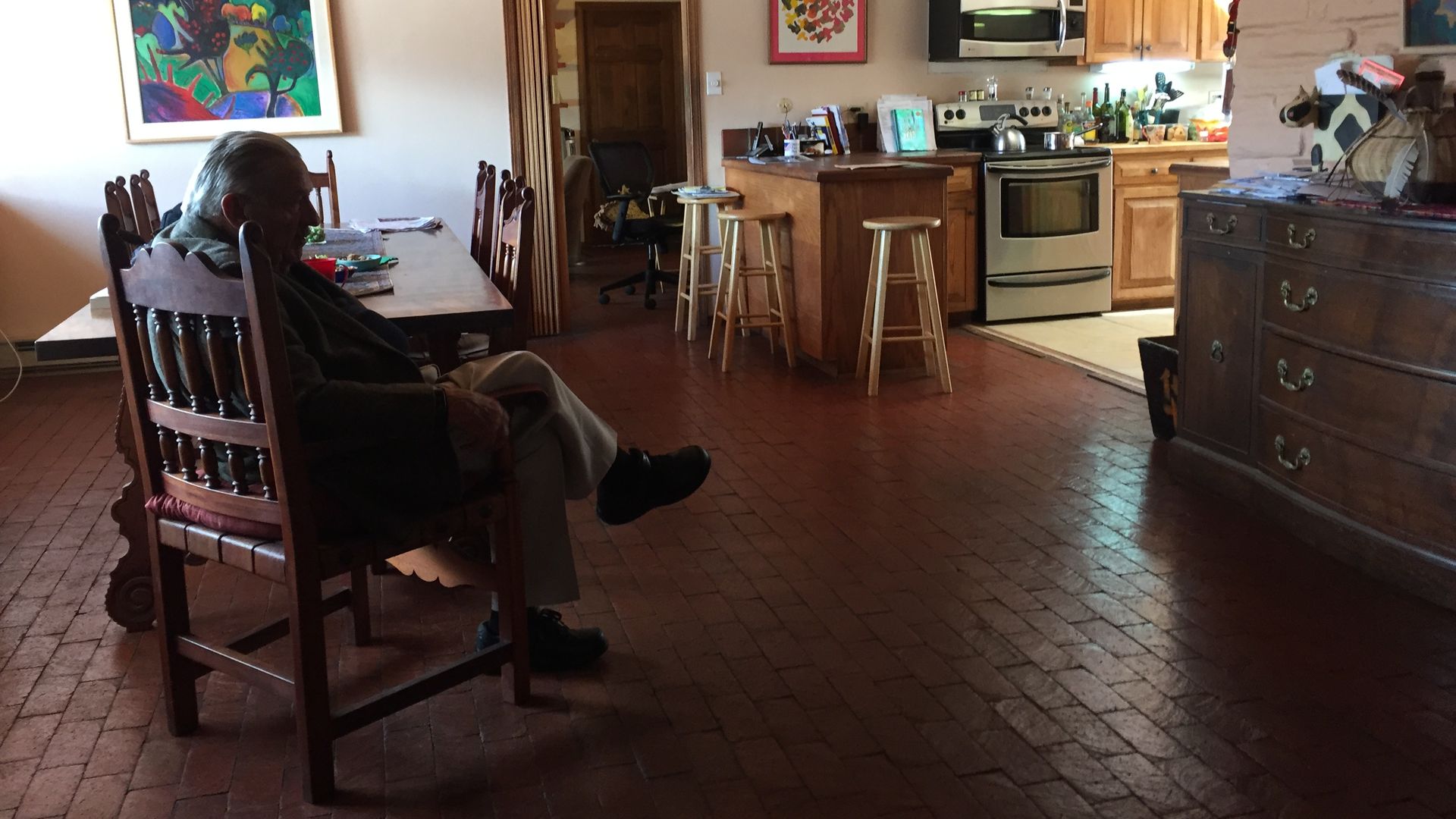
Former Sen. Fred Harris sits in his Corrales, New Mexico home in 2018. Photo: Russell Contreras/Axios
Former Sen. Fred Harris (D-Okla.) stayed out of the national spotlight after leaving Congress, but over the years, he still had plenty to say about the nation's future to young leaders, students — and me.
The big picture: Harris, the last surviving member of the Kerner Commission, a panel appointed by President Lyndon Johnson in 1967 to examine the causes of the 1960s riots, died Saturday at 94.
- Over seven years, I held several sit-down interviews and private conversations with him about the Democratic Party, President Lyndon Johnson and feeling guilty about mistakes he made in fighting poverty.
The intrigue: He's talked to me about his disappointment with the modern Democratic Party, the time President Johnson threatened to castrate him and how he convinced President Richard Nixon to give land back to Native Americans.
Zoom in: The former chair of the Democratic National Committee (1969-1970) was frustrated that Democrats didn't discuss poverty as much as they should.
- From his perspective, the party had a moral obligation to address poverty since more people are live in poverty now than in the 1960s.
- "It's harder to get out of poverty today than it was back then," he repeatedly told me.
- He also felt that discussing poverty, rather than just focusing on how Democrats could help the middle class, would motivate low-wage voters in Appalachia, the Mississippi Delta, Central California and Native American reservations.
Donald Trump: Harris saw comparisons between Trump's rise with disaffected working-class Americans to that of Nixon in 1968.
- What he learned from his time as DNC chair in Nixon's first years was to find a reason for voters to turn to the opposition and not just attack the other side.
Lyndon Johnson: No president did more to fight poverty and racism than LBJ, Harris told me.
- But the Vietnam War and his ego were Johnson's downfall, Harris said.
- Harris was sad that the pair could never reconcile their disagreement over the Vietnam War and recommendations from the Kerner Commission.
Richard Nixon: One of his greatest accomplishments was convincing a skeptical Nixon to give sacred land back to Taos Pueblo and the Hopi Nation.
- Nixon became a hero among some tribes in signing the law to return the land, and today they hold events honoring the former president's birthday.
Background: Harris also reflected on his time on the Kerner Commission when he toured urban cities hit by riots and heard Black residents tell him, "we need jobs, baby."
- During the summer of 1967, more than 150 cases of civil unrest erupted across the United States, and Harris felt the commission was on the edge of a breakthrough.
- Those riots were not a conspiracy sparked by Black militant leaders like H. Rap Brown or Stokely Carmichael, as President Johnson suspected, "but thousands of H. Rap Browns who we don't know and who just need a little spark."
- The commission shouldn't have kept hearings closed and should have invited reporters along on tours, he said. Instead, the report was leaked and white journalists dismissed it as another liberal plan to blame white Americans.
Harris told me multiple times that mistake haunted him for the rest of his life.
