What banana art says about Federal Reserve policy

Add Axios as your preferred source to
see more of our stories on Google.
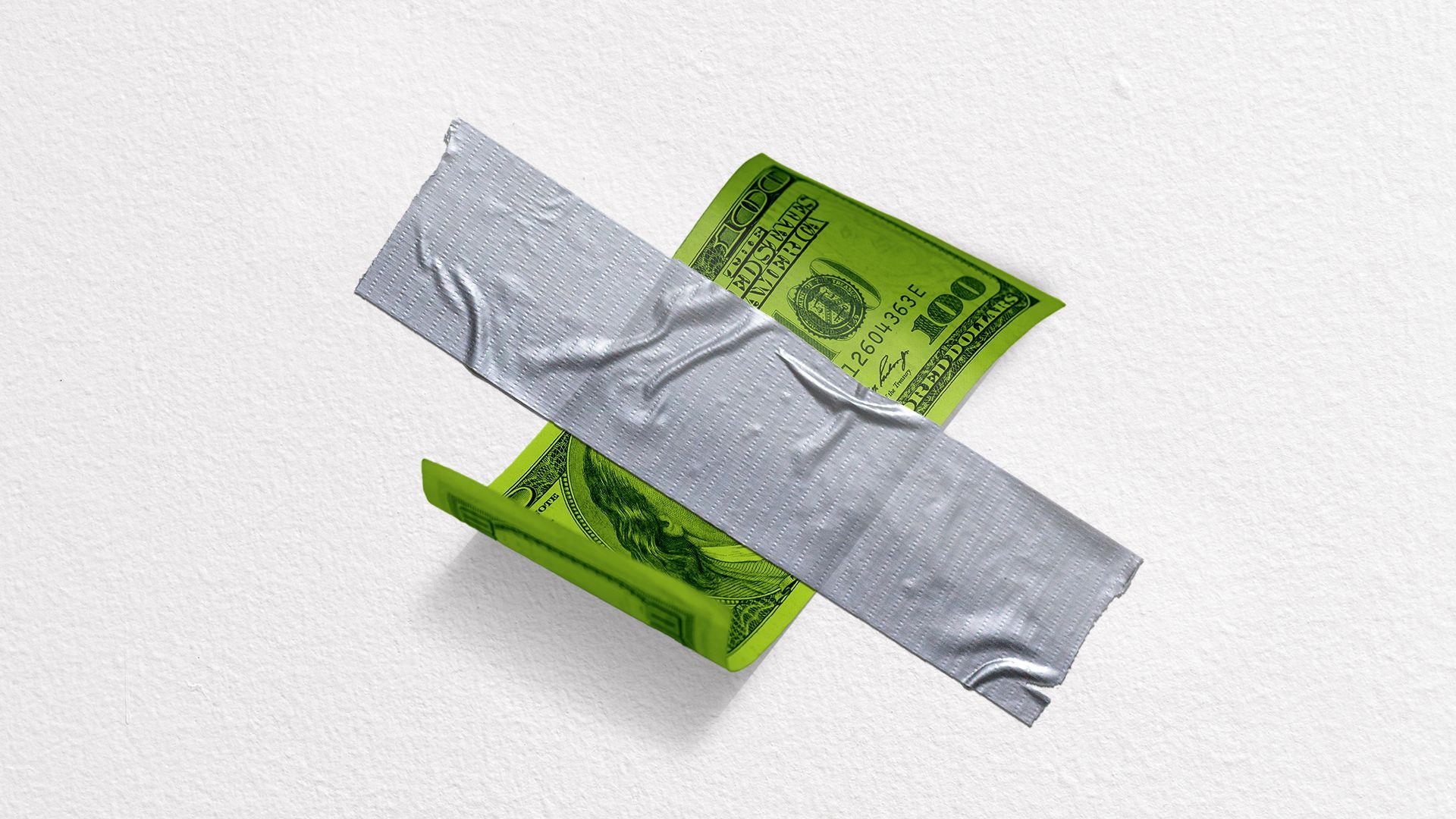
Illustration: Aïda Amer/Axios
Did you hear the one about the $6.2 million banana? That's the price a piece of art consisting of a banana duct-taped to a wall fetched this week, up from a "mere" $120,000 it sold for five years ago.
Why it matters: It is a fitting metaphor for an exuberant, and frothy, moment in financial markets of all types, one that raises uncomfortable questions about whether Federal Reserve policy is really restraining the economy as much as its leaders believe.
- Financial markets are, in theory, a major way that interest rate policy shapes economic results. But financial conditions right now — as opposed to economic data — make it hard to argue rates are too high.
The big picture: It's not just that the stock market has been notching new highs all year. It's that this valuation looks highly stretched.
- The S&P 500's earnings yield — the inverse of the more widely cited price-to-earnings ratio — is only 3.9%, half a percentage point below the yield on a 10-year Treasury note. The gap is even wider for the 10 most valuable companies in the index — a situation Goldman Sachs chief U.S. equity strategist David Kostin said this week hasn't happened since the dot-com bubble.
- By contrast, when the stock market reached a previous peak at the end of 2021 — before the onset of the Fed's tightening campaign — not only was the S&P earnings yield higher at 4.2%, but that represented a 2.7 percentage point premium to rock-bottom Treasury yields at the time.
- It's not just stocks — bitcoin is up 121% for the year, now approaching $100,000.
State of play: There are plausible narratives behind these valuations. For large-company tech stocks, the AI gold rush may well pay off in just the way investors are betting.
- The Trump 2.0 administration may bring a golden era of deregulation and lower taxes. It will certainly apply a lighter touch to crypto regulation.
Yes, but: Markets are priced for perfection, essentially assuming those outcomes are preordained, not one of multiple possibilities.
- Just maybe, billions in capital investment in AI won't pay off as quickly or as handsomely as current valuations imply.
- What Trump administration deregulation giveth, tariffs could taketh away.
- And how much further can crypto assets really climb unless and until they offer more concrete use cases in the real economy?
Between the lines: The Fed, as chair Jerome Powell has said many times, does not target asset prices. It makes its interest rate decisions aiming to achieve its mandate of maximum employment and stable prices.
- Inflation has come mostly back toward the Fed's target and the job market has flashed warning signs of weakness, hence two rate cuts since September and potentially another one on the way next month.
Financial market channels are historically the most direct and measurable way that monetary policy shapes the economy, as seen in 2022 when rate hikes caused a market plunge.
- If we can experience this kind of froth even with the Fed's interest rate target in the 4.5% ballpark, it raises uncomfortable questions about whether interest rate policy really shapes the economy the way the textbooks say.
The bottom line: If people want to pay $100,000 for bitcoin or assign a $3.6 trillion valuation to Nvidia or pay $6.2 million for a piece of banana art, it's not the Fed's job to stop them.
- But it probably does tell us something about the limits of the central bank's ability to shape economic results.
The other side: Our colleague and resident art aficionado Felix Salmon argues here that the banana art in question is reasonable and not really a sign of unreasonable froth.
