Biden says Ukraine can use anti-personnel mines to slow Russian advances

Add Axios as your preferred source to
see more of our stories on Google.
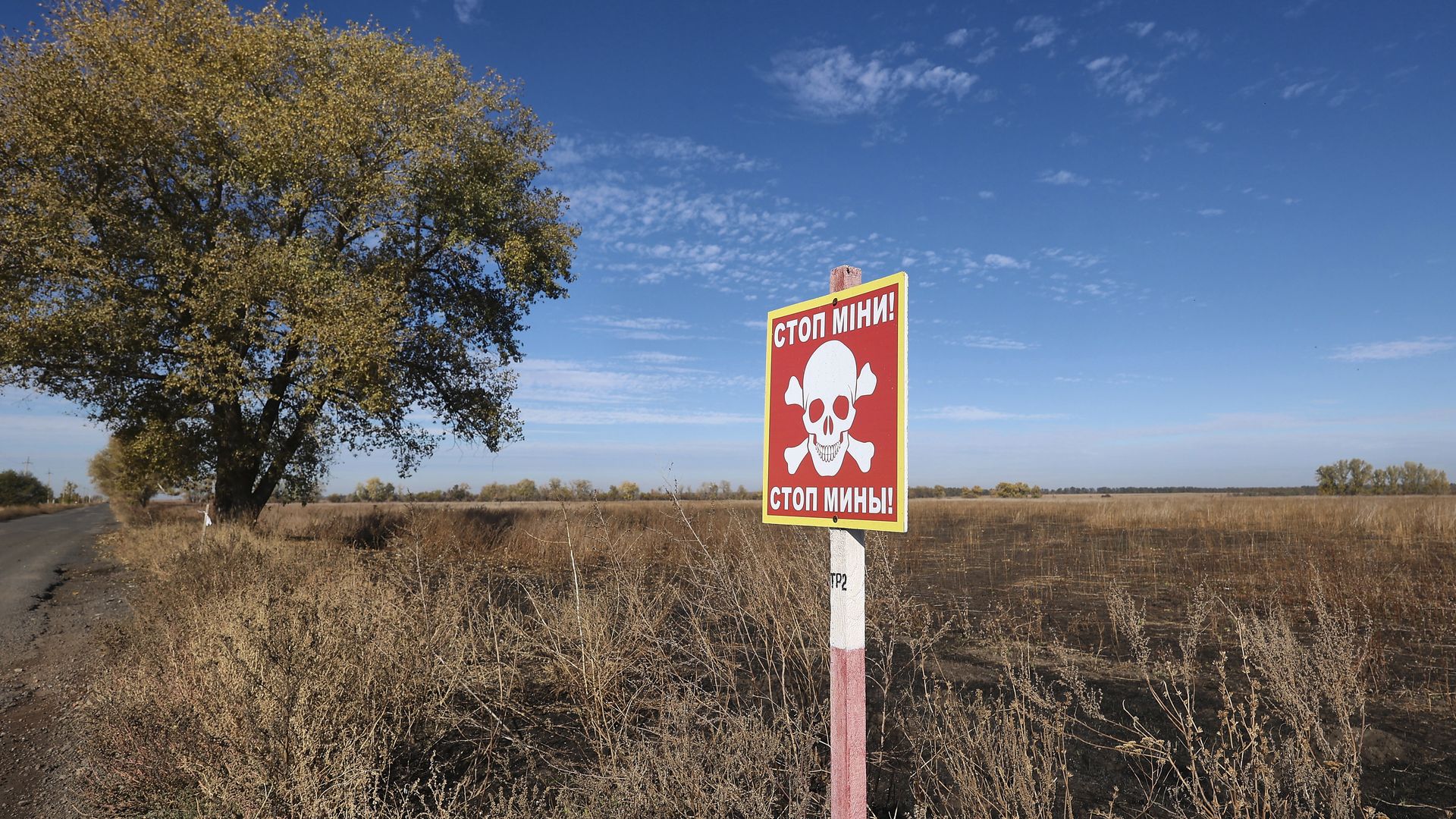
The warning sign "Stop! Mines" is seen in Kharkiv region, eastern Ukraine. Photo: Viacheslav Madiievskyi/Ukrinform/Future Publishing via Getty Images
President Biden has authorized the provision of anti-personnel mines to Ukraine for the first time, a defense official confirmed to Axios Wednesday.
Why it matters: It's the second major U.S. policy shift in a matter of days aimed at strengthening Ukraine's defenses against Russian forces, and comes on the heels of the Kremlin ramping up its nuclear threats.
- The U.S. also authorized Ukraine on Sunday to use U.S.-provided long-range missiles to strike targets inside Russia.
- The policy shift comes as the Biden administration seeks to bolster its support for Ukraine before President-elect Trump takes office and likely reduces U.S. support for Kyiv's defense.
Driving the news: Russia has long used anti-personnel land mines in its war in Ukraine, which Ukraine has warned pose a threat to Ukrainian civilians.
- Ukraine has agreed to not deploy the U.S.-provided mines in areas populated by civilians, the defense official told Axios.
- Until now, the U.S. had only provided Ukraine with anti-tank mines, per Reuters.
Flashback: More than two years ago, the Biden administration pledged to limit the use of anti-personnel mines around the world due to their "disproportionate impact on civilians."
- The White House did not immediately respond to Axios' request for comment on Wednesday.
Between the lines: The Biden administration's decision could prove controversial. Advocacy groups have long warned about the weapons' danger to civilians.
- 164 parties around the world have signed the 1997 Ottawa Convention, which requires states parties to stop the production, use and transfer of anti-personnel land mines.
- Neither the U.S. nor Russia signed the treaty.
- The mines the U.S. is now providing Ukraine are "non-persistent," according to the defense official, meaning they become inert after a certain period of time rather than remaining potentially detonable for years.
The big picture: The war, which passed the 1,000-day mark this week, has seen several shifts in recent weeks with North Korean troops arriving to aid Russian forces and the U.S. granting Kyiv permission to use new weaponry.
- Russian President Vladimir Putin signed a new nuclear doctrine Tuesday lowering the threshold of use for nuclear weapons, days after the U.S. authorized Ukraine's use of the long-range missiles.
- The shift indicated that Russia could use nuclear weapons to respond to Ukrainian attacks using conventional weapons that are backed by the U.S.
Zoom in: Citing security risks, The U.S. and other Western embassies in Kyiv closed Wednesday, AP reported.
- The U.S. Embassy Kyiv said in a statement Wednesday that it had "received specific information of a potential significant air attack" and that it was closed "out of an abundance of caution."
Go deeper: Mapped: Russia's war in Ukraine hits 1,000-day mark
