Axios Explains: Roadblocks to Trump's mass deportations

Add Axios as your preferred source to
see more of our stories on Google.
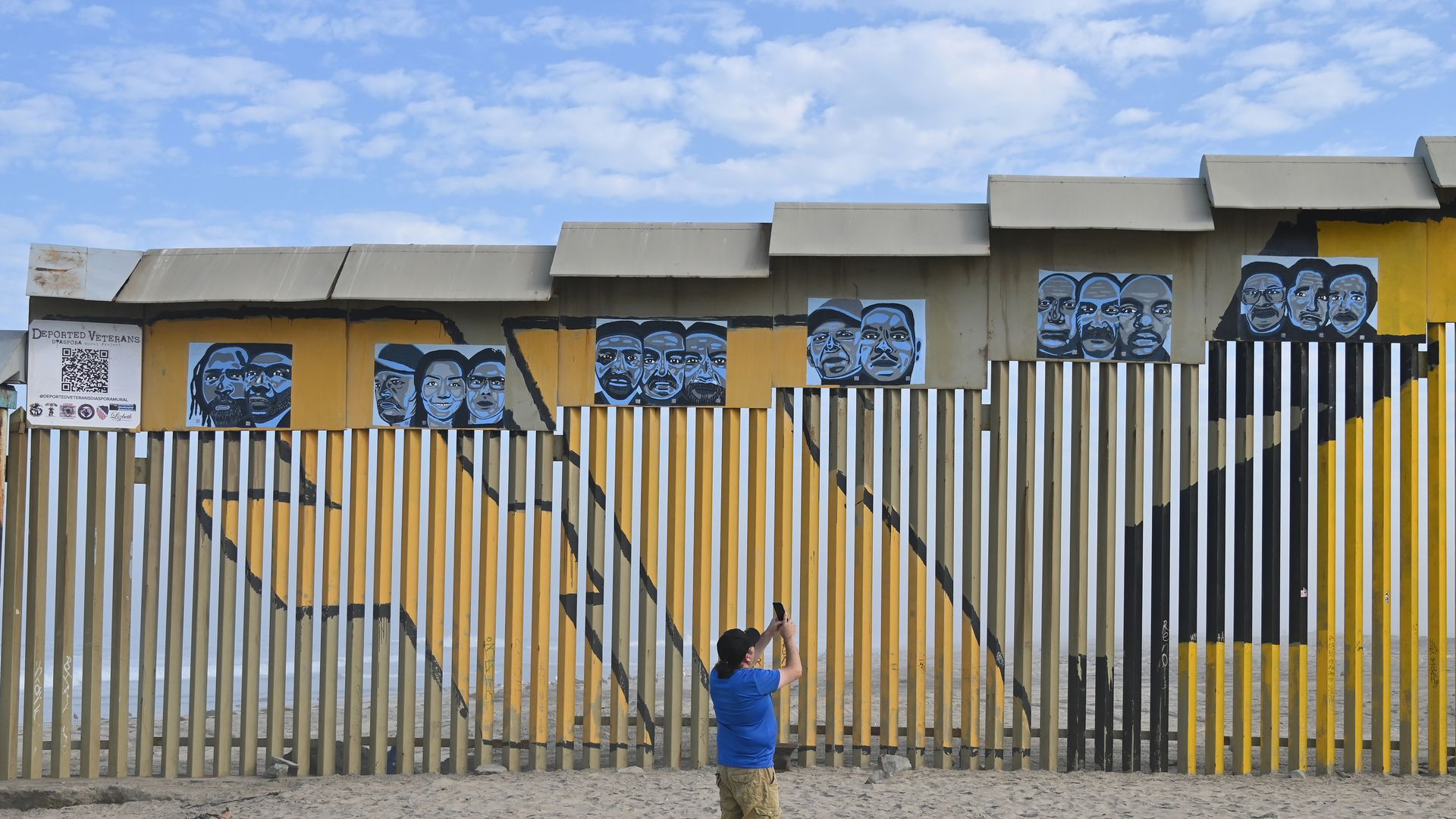
A man in Tijuana, Mexico, takes pictures of ''The Deported Veterans Diaspora,''a new interactive mural at the Playas de Tijuana beach border wall on Sept. 6. Photo: Carlos Moreno/NurPhoto via Getty Images
President-elect Trump has vowed to crack down on immigration and start mass deportations on Day 1 of his presidency, but the operation will be difficult to pull off without major structural overhauls.
Why it matters: A backlog of nearly 4 million immigration cases and a shortage of immigration judges and detention centers can hinder quick deportation.
The mass deportations outlined by Trump could cost $150 billion to $350 billion, immigration experts say.
Catch up quick: Trump shared a social media post yesterday suggesting his new administration will declare a national emergency and use the military for mass deportations, and he labeled the claim, "TRUE!!!"
- Trump has said he wants to remove all undocumented immigrants from the country, though his campaign and surrogates said he wanted to focus on immigrants who have committed crimes.
- He's promised to use local law enforcement, the military, the FBI and other federal agencies to carry out mass deportations.
- He also vowed to end birthright citizenship.
State of play: An estimated 11 million undocumented immigrants live across the country, working in the agriculture, oil and gas, construction, health care and service industries.
- Here is how mass deportations could shake out under the current immigration system:
Raids
Immigration attorney David Leopold tells Axios that the administration will likely order high-profile immigration raids of sites to create a flashy image that Trump is being tough.
- Leopold says those early actions will generate fear, forcing some workers not to show up for jobs anymore and creating a worker shortage while driving up inflation.
Yes, but: Jaclyn Kelley-Widmer, immigration law scholar and professor at Cornell Law School, tells Axios it's unlikely that a coordinated effort across all federal and local agencies for deportations would be possible.
- Turf wars, pressure from local residents to resist and logical staffing realities would make it impossible, Kelley-Widmer says.
- Jennie Murray, president & CEO of the National Immigration Forum, tells Axios that mobilizing the military to help prioritize deportations is "worrisome."
- For example, some members of the National Guard and reserves who are also police officers may feel conflicted about participating in deportations because they also want to work with undocumented immigrants to solve crimes, Murray says.
Detentions
Currently, the U.S. does not have enough holding cells to house millions of people placed in deportation proceedings.
- That means the Trump administration will have to erect new "soft detention centers," or temporary camps across the country (though Trump officials strongly dispute calling them camps).
- Kelley-Widmer says that Trump's promise to use the 1798 Alien Enemies Act to detain migrants is more "showy" and aimed to instill fear.
- The president already has the authority to detain immigrants, but currently, the country only holds 38,000 in immigrant detention a day, Kelley-Widmer says.
Maribel Hernández Rivera, director of policy and government affairs for border and immigration at the American Civil Liberties Union (ACLU), tells Axios she expects the temporary holding centers to be inhumane and poorly built.
- The ACLU has sued and criticized the federal government numerous times over allegations of poor conditions and treatment in detention centers.
- "We intend to stop them."
Immigration hearings
Detainees still have a right to due process before removal, but 3.7 million people are already waiting for hearings right now.
- Leopold says the Trump administration could opt for more expedited removals, yet those are reserved for dangerous criminals.
- "At this moment, there's a lack of resources to be able to process people and allow them their due process. Imagine when funding is redirected to his deportation machinery," Hernández Rivera says.
- Experts say adding millions more to the backlog means the speed of deportations will slow — and maybe crawl to a standstill amid larger court challenges.
Subscribe to Axios Latino to get vital news about U.S. Latinos and Latin America.
