Prediction markets victorious

Add Axios as your preferred source to
see more of our stories on Google.
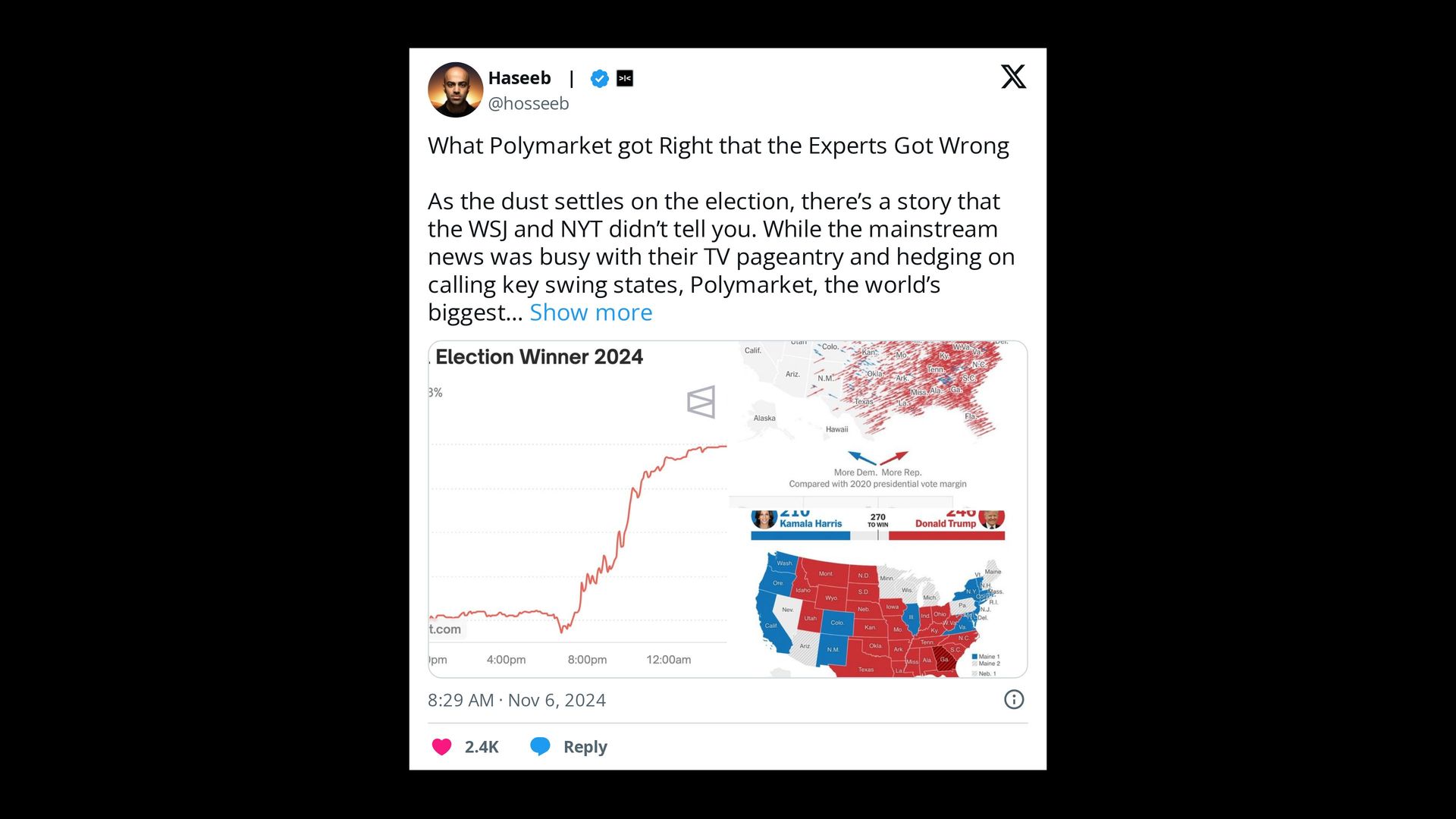
The future looks bright this week for prediction markets.
What they're saying: "While the mainstream news was busy with their TV pageantry and hedging on calling key swing states, Polymarket, the world's biggest prediction market, had already delivered its verdict by midnight EST, declaring Trump was 97% likely to win," Haseeb Qureshi, managing partner at VC firm Dragonfly, wrote in an essay on social media.
- "This was before the media called even a single swing state."
- Here inside Axios' Slack channels on election night, we were watching that line on Polymarket spike — dumbstruck by its definitiveness.
💭 My thought bubble: Here's the difference between polls and prediction markets.
- With polls, teams call people and ask questions. Then they take those answers and analyze them in a centralized way — one approach from one organization.
- The two problems here are, first, the bias of that analysis and, second, the possibility that respondents just lie — why shouldn't they?
With a prediction market, thousands (millions?) of pieces of information and analysis get ingested without necessarily being shared. All that must be shared is a price signal. That way, it is decentralized.
- As the argument goes, everyone who shares a price signal does it with money on the line. They could still do it maliciously, but they have a reason not to.
The big picture: There's room — and a case — for both. Just as the news influencers of social media would have little to pontificate about without the information gathering of proper news organizations, bettors probably need traditional polling, too.
The bottom line: Two weeks ago, we wrote: "If the prediction markets don't favor the winner in 2024's most high-profile race, perhaps the public will be less apt to look there for answers in the future."
- Well. They did.
