Channeling climate anxiety into action


Add Axios as your preferred source to
see more of our stories on Google.

Illustration: Aïda Amer/Axios
Devastating hurricanes, severe drought, wildfires, extreme heat and other consequences of human-caused climate change are a growing source of anxiety for many Americans.
Why it matters: Climate groups are trying to turn that anxiety into action to help people combat — and cope with — climate change.
- A slate of programs around the country are offering volunteering and job opportunities oriented toward helping to address climate change, including the fledgling American Climate Corps (ACC), an interagency group led by AmeriCorps and created by the Biden administration.
- "This is something that you could do to make a real, tangible, meaningful difference right now, and also to create a pathway for your future," AmeriCorps CEO Michael Smith says.
The big picture: Climate anxiety rises in America
A new study of 16,000 young Americans found that 85% of respondents are at least moderately worried, with over half "very or extremely worried" about climate change and its impacts.
- 38% of respondents stated their feelings about climate change were interfering with their daily lives.
- The findings echo earlier reports finding widespread worry in the U.S. about global warming.
"I have no doubt that on some level, whether we like it or not, whether we know it or not, whether we admit it or not, everyone is suffering from climate anxiety," says Lise Van Susteren, an expert on the mental health implications of climate change and co-author of the large study on American youth.
What they're saying: Climate anxiety "can range from a clinical diagnosis, all the way up to just a general populist feeling that we are worried about the environment," says Leah McCord, the Tennessee projects and coalition coordinator for Appalachian Voices.
- Eco-guilt, pre-traumatic stress condition, eco-grief, solastalgia, apocalypse grief and other terms are becoming vital to understanding the burgeoning mental health crisis tied to climate change.
- There are now climate-aware therapists who specialize in working with people suffering from climate anxiety.
- But a "shared vocabulary is lacking" among people experiencing climate anxiety, says Martin Lemke, a graduate student at Naropa University who studies how climate-related emotions can lead to pro-environmental behavior.
- "People think 'Ah, I can't do anything.' So they just shut down right away."
Between the lines: 62% of Americans say they feel a personal sense of responsibility to help reduce human-caused global warming, according to a study of 1,031 people taken in the spring.
- But, 66% of Americans say they "rarely" or "never" discuss global warming with family and friends.
- "Because people don't talk a lot about it, or because they're afraid to talk about it, it reinforces the belief that they're the only ones worried about it," says Rebecca Weston, co-president of the Climate Psychology Alliance of North America.
- Research by Lemke and others found that being part of a group of people working to address climate change can help mitigate the anxiety.
- That group support can come in the form of community meetings, more traditional group therapy sessions, or climate-focused volunteering and jobs.
"When we do community meetings, people find connection with each other and shared experiences," says McCord of AppVoices, which also offers local volunteering opportunities.
- "When people start to get together and compare these stories, that is where a lot of generative action starts to take place."
- It's "not just young people demanding this," she says. "We are people from all backgrounds, all age groups, and we cross rural and urban lines."
Behind the scenes: Harnessing anxiety into action
A handful of groups are offering hands-on training, volunteering, and paid job opportunities in climate-related industries. These range from community outreach on recycling and compost initiatives, to forestry management and fighting wildfires.
- These experiences can prepare members for the litany of climate-related jobs needed in today's economy.
The California Climate Action Corps (CCAC) is trying to help address climate change and "allows Californians to be part of something bigger than themselves, and allows them to work in the community, together with each other, to help solve this crisis," says Josh Fryday, chief service officer of California.
- Last season, the CCAC "recruited more than six applicants for every available slot" for member positions, according to Katie Vavao, communications director of California Volunteers.
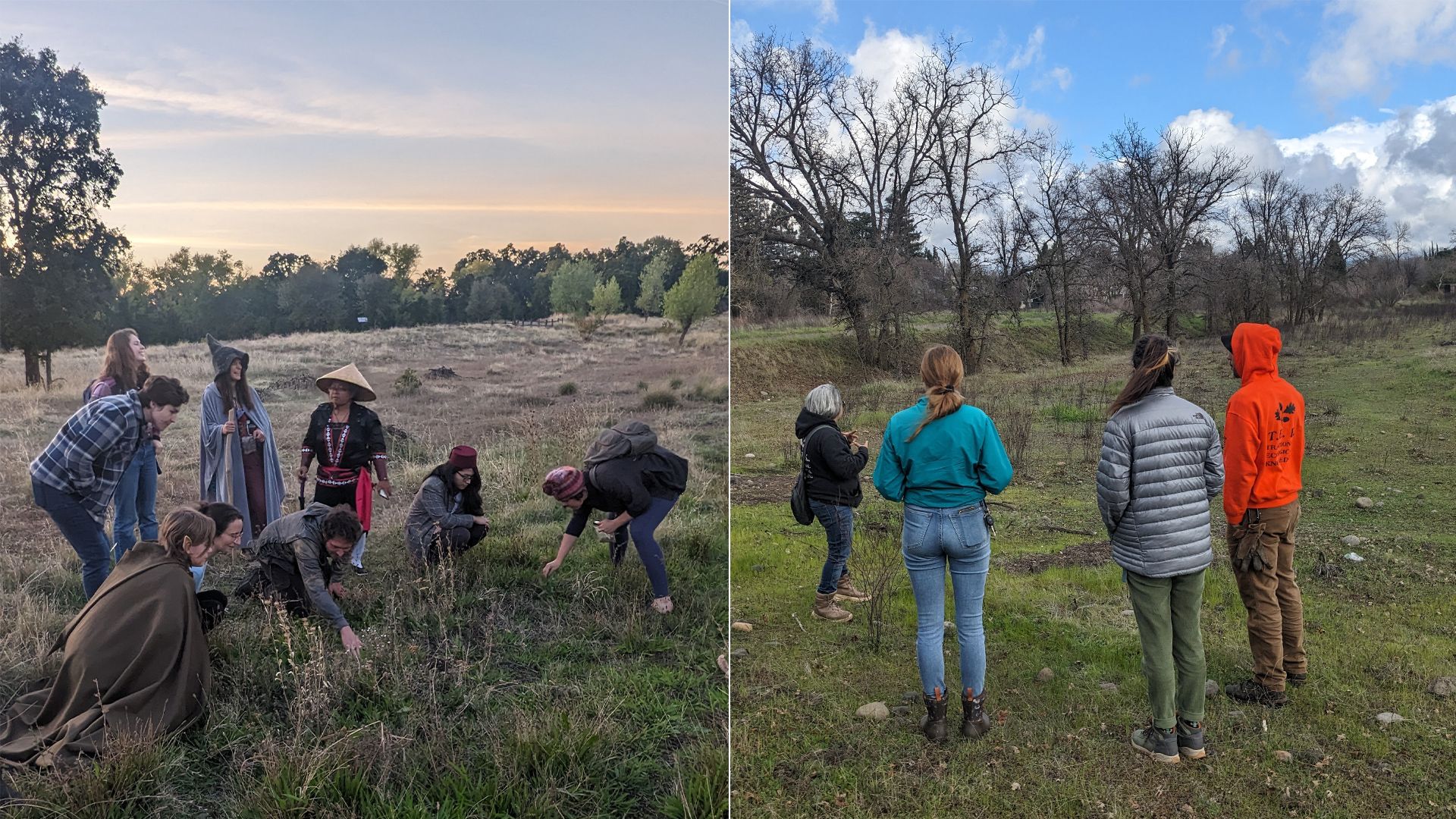
Zoom in: Chelsea "Chella" Barron volunteers with the CCAC at Verbena Fields, a 17-acre park and nursery for restoring native plants in Chico, which also helps educate the community about the rich ecological heritage of the Mechoopda people.
- Verbena Fields was established by Ali Meders-Knight, the executive director of California Open Lands and a Mechoopda tribal member. She leads weekly workshops about applying Indigenous knowledge to climate adaptive management, including selecting plants that can cope with certain conditions.
- Barron says it meant a lot to meet people who had similar feelings of anger and anxiety about climate change. "You just don't feel crazy anymore."
Zoom out: AmeriCorps launched the ACC in 2023 and hopes to initially recruit 20,000 corps members. The program offers members full-time paid employment with benefits for various term lengths, with the option to focus on areas like reforestation, restoration work, urban agriculture, clean energy efficiency, and coastal climate resistance.
- AmeriCorps' Smith says it's "an opportunity to give young people not only the chance to make a difference on urgent climate issues and to address this existential threat of climate change, but also to provide the potential for a job for people who could end up staying in this green job space."
Yes, but: Climate work can come with its own set of challenges, including burnout.
- Research "suggests that the mental health of all the climate workers out there is going to wind up being important for actually saving the planet," Laurie Santos, a cognitive scientist and psychology professor at Yale University, said during a recent webinar.
- "If you're not protecting your mental health, your performance is going to decrease," she said, adding that cynicism and a feeling of ineffective hard work in the face of this monumental challenge are two precursors for burnout.
Climate anxiety in Indigenous and rural communities
Climate anxiety isn't new for Indigenous communities, whose observations of the changing environment are passed from one generation to the next.
Zoom in: Angela Noah grew up on the Fort Apache Indian Reservation in Arizona, but was living in the Northwest when they first experienced the devastation of wildfires.
- "I remember taping my windows to keep out the ash," Noah, a member of the White Mountain Apache and Oklahoma Choctaw nations, recalls. "After the fire there was an elder [who] said, 'All of the ash that you see on your windowsill, those were animals and people's belongings.'"
- The experience compelled Noah, a University of Oregon student and the host and creator of the "Young Elders" podcast, to become part of the first Native American young adult crew of the Northwest Youth Corps' tribal stewards program.
- The program combines education and job training for conservation, reforestation and recreation projects.
- "The whole reason why I'm here is for my siblings, for my family," Noah says. "I think about my brother who just turned five ... and what it's going to be like when he's my age."
Friction point: Climate advocacy groups often aim to partner with the 500-plus Indigenous communities in the U.S., but sometimes face a strong distrust of non-Native groups due to a long, troubled history with the U.S. government.
- Resistance to climate groups can also be financial. Some tribes receive a large portion of their revenue from energy sources like oil, and cannot receive the same profit by transitioning to renewable energies.
Communities have been "trampled on" in the past, so climate work requires "a lot of trust building," says Erika Symmonds, vice president of equity and workforce development at Solar Energy Industries Association and a past AmeriCorps member.
- The groups that spoke with Axios say there's a concerted effort to move away from a policy of "parachuting" into a place and instead encouraging local communities and governments to lead their climate-related efforts.
The bottom line: Action leads to hope
When it comes to facing climate anxiety, giving people agency can counterbalance the stress and worry, several people interviewed by Axios said.
- "The heart of [CCAC] and the heart of this issue, is if we're actually going to tackle this, people need to have hope that we can," Fryday said.
- "Hope is not about having blind faith, hope is about having a plan."
