Pre-election silence periods are common around the world, but not in U.S.

Add Axios as your preferred source to
see more of our stories on Google.
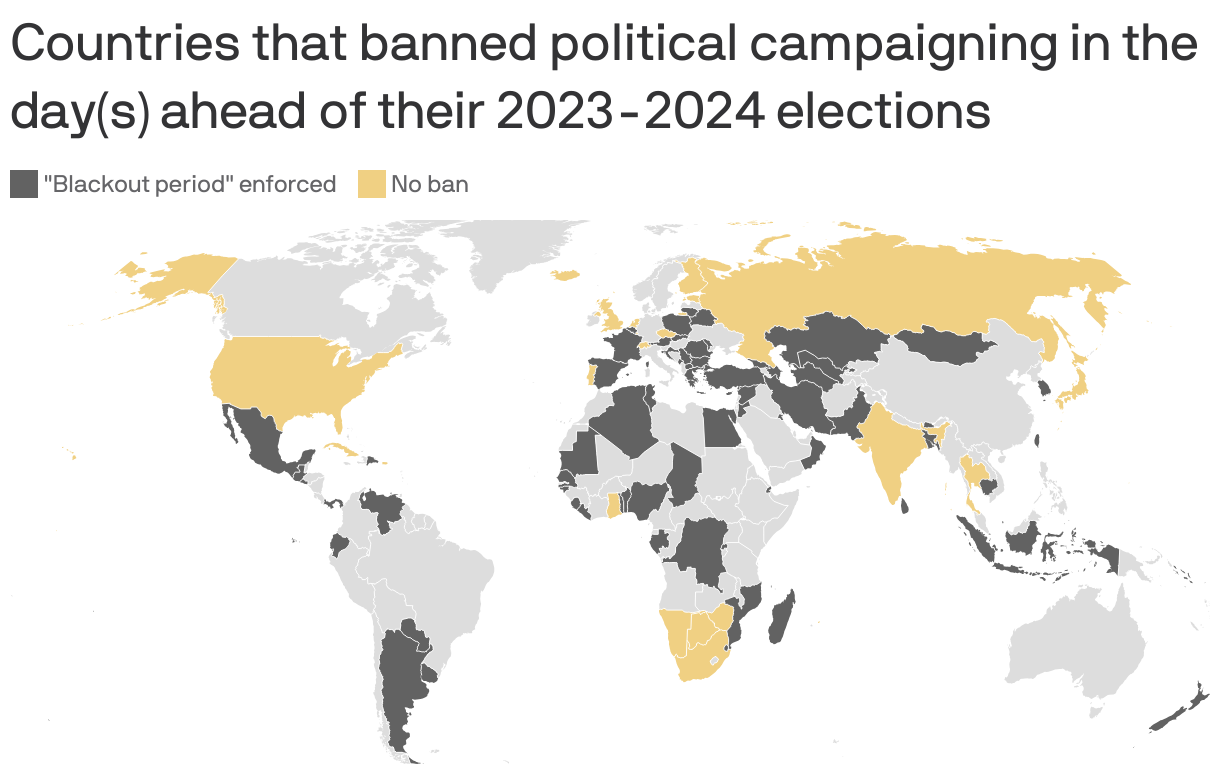
U.S. political candidates can appeal to prospective voters until polls close, but that wasn't the case in most recent elections worldwide.
Why it matters: Swaying voters in the election's final homestretch could be crucial in the razor-thin race between former President Trump and Vice President Harris.
- In many democracies, a "pre-election silence period" bars political advertising, rallies, media appearances or polling in the final stretch before an election.
State of play: 79 of about 119 countries or territories with elections in 2023 and 2024 had pre-election silence periods, per Staffan Darnolf, a senior global adviser at the International Foundation for Electoral Systems.
- The amount of silent time varies per country, but typically is between 24 to 48 hours for voters to reflect on the candidates without intense external influence or pressure, Darnolf said.
- In some cases, public opinion polls cannot be released during that final stretch either.
Between the lines: This period also serves to quell some security concerns by tamping down on the sharing of potentially hostile information, said Darnolf, whose work focuses on electoral operations and administration.
- "They want to cool down the temperature of the country," he said.
- Non-election movement, including public transportation, is sometimes limited too, especially in post-conflict settings.
Reality check: The internet "poses an extra challenge" to pre-election silence, as social media users can keep circulating information even if campaigning stops, said David Carroll, democracy program director at the Carter Center.
- "Everything with how the online environment relates to elections is a fast-moving, changing set of issues," he said.
The intrigue: "Late-deciders" are a minority in this year's U.S. presidential election, per PBS News/NPR/Marist polling released this month. But they hold weight in deciding the outcome when the margins are so tight.
- Late-deciders were also a minority in Europe this year. 5% of voters in 2024 European elections said they decided the political party or candidate they'd vote for on the day of the election, per a European Parliament survey.
- 11% said they decided a few days before the election.
Zoom out: Pre-election blackouts exist mostly in countries with one day dedicated to voting.
- Only 16 countries, including the U.S., allow early voting for all voters, per a September report from the International Institute for Democracy and Electoral Assistance.
Since 2020, Meta has instituted its own version of a pre-election blackout on Facebook by restricting new ads about social issues, elections or politics the week before Election Day.
- "In the final days of an election, we recognize there may not be enough time to contest new claims made in ads," the company said in a September statement.
- However, pre-existing ads continue to circulate on the social media platform.
Go deeper: Why Election Day has irreversibly changed
