Why one measure of consumer sentiment looks lower than the others

Add Axios as your preferred source to
see more of our stories on Google.
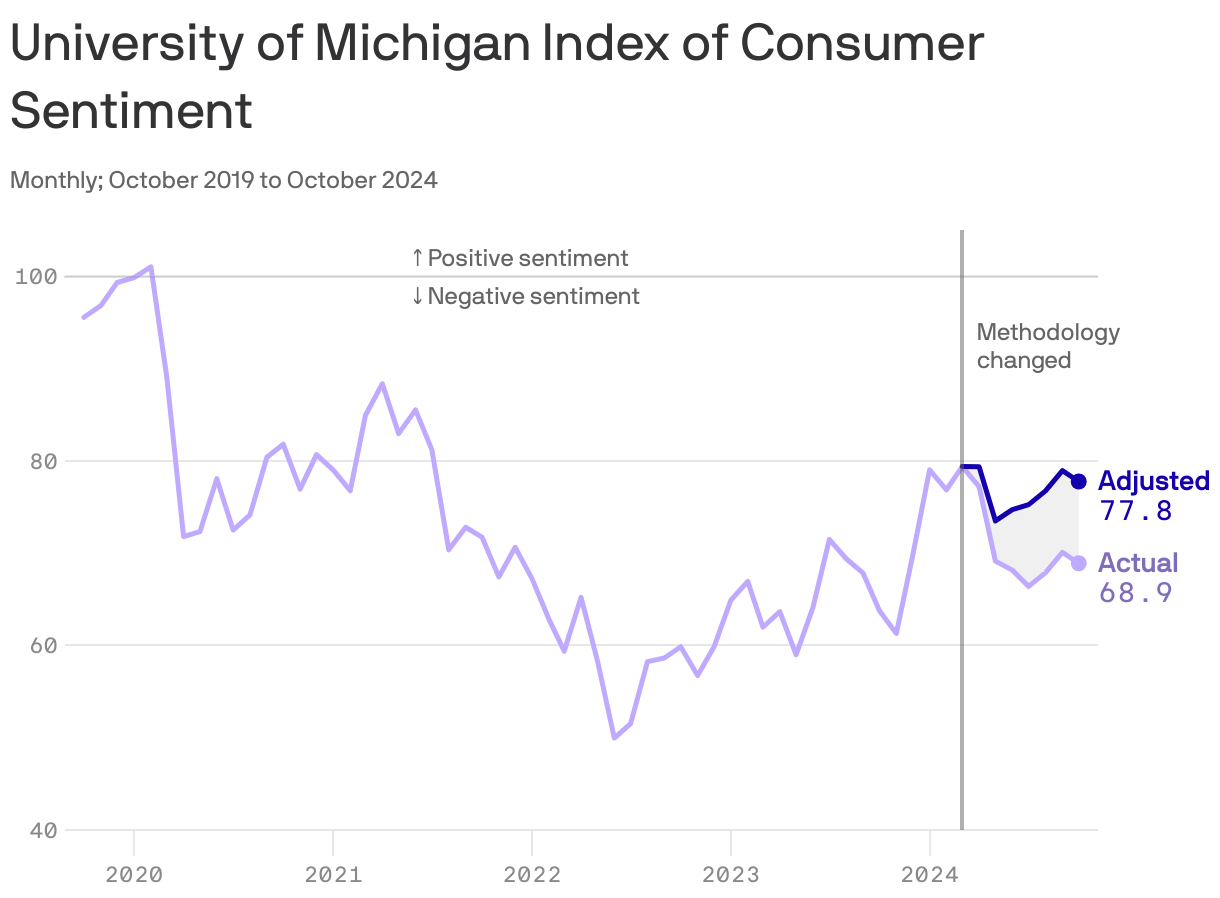
The Index of Consumer Sentiment has been meaningfully lower since the spring because of a change in survey methodology, finds a new analysis.
Why it matters: One of the most closely watched measures of consumer sentiment — aka the vibes — would seem a little less terrible if not for this change.
- That's a big deal in an election year that hinges on voters' perceptions of the economy.
Catch up fast: In April, the University of Michigan began moving from surveying respondents by phone to an online method. By July, it was fully online.
- "After this change, there was a bit of a drop in University of Michigan sentiment, something that we didn't see in other consumer attitude surveys," says Ernie Tedeschi, director of economics at the Yale Budget Lab.
- He wrote the analysis with Ryan Cummings, an economist at the Stanford Institute for Economic Policy Research.
By the numbers: The switch led to a nearly 9-point decline in sentiment, even after adjusting for differences in the demographics of phone and online respondents.
- They recommend that Michigan adjust its measures to account for this, but the school doesn't plan on it.
Zoom in: The university's analysis produced similar findings: a 6.6-point difference.
- "We wanted to be as transparent as possible," says Michigan's survey director Joanne Hsu. The university has no objection if users want to make their own adjustments, she says. They don't feel it's necessary.
Between the lines: In an election year, making further adjustments to how the index is measured in order to account for the online shift could've driven a lot of attention and controversy — especially since that could be viewed as favoring one side.
- It's possible that Michigan didn't want to step into that thicket. Hsu declined to comment.
- You don't need to look hard for an example. There was a recent spate of conspiracy theorizing after the Bureau of Labor Statistics made some standard revisions to past jobs reports, as Axios' Courtenay Brown reported earlier this month.
The big picture: Before the pandemic, consumer sentiment roughly tracked economic indicators like the unemployment rate, GDP and inflation.
- That link is broken now.
The new analysis of Michigan data doesn't much change that broader story, both Hsu and Tedeschi point out.
- Even with their adjustment, Michigan's sentiment index is tracking lower than you'd expect given current economic conditions.
Yes, but: The switch-up means that you shouldn't use Michigan data — it goes back to 1978 — if you're looking at sentiment over time, writes John Leer, chief economist at Morning Consult, in a piece published Tuesday morning.
- Morning Consult has a competing online sentiment index that up until the change tracked pretty close with Michigan's. "Our questions are identical," Leer tells Axios.
- "The trend is really, really important, and this is a break in the trend. So that creates a whole boatload of problems," he says, acknowledging that his criticism might be slightly "self-serving."
