These are the swing states facing legal challenges to mail-in voting

Add Axios as your preferred source to
see more of our stories on Google.
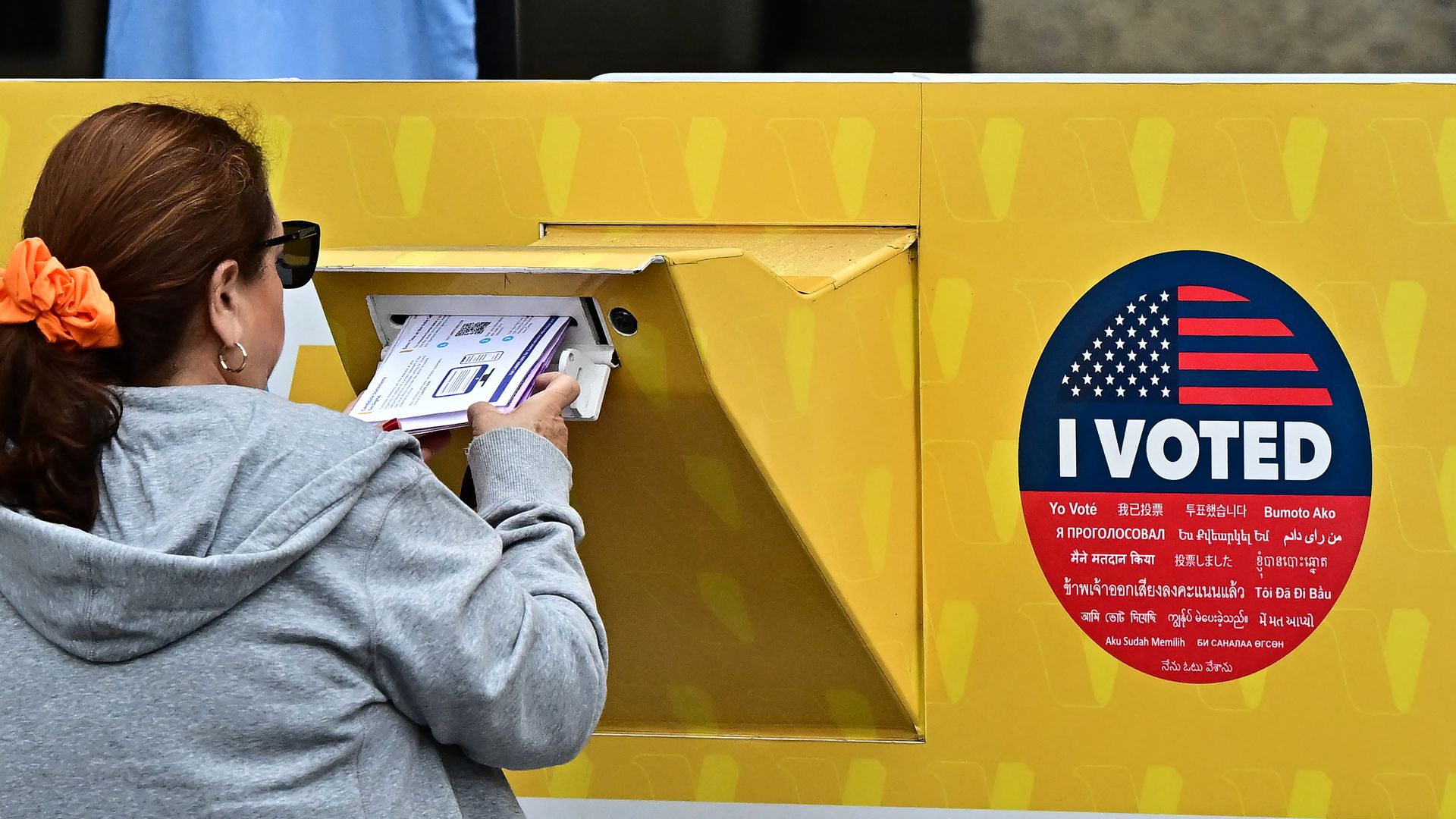
People drop off their ballots at the Los Angeles County Registrar on Oct. 28, in Norwalk, California, two days after early voting in Los Angeles County began. Photo by FREDERIC J. BROWN/AFP via Getty Images
As Election Day nears, several critical decisions over challenges to swing-state mail-in voting laws have been handed down across the country.
Why it matters: While mail-in and absentee voting have become popular alternatives to in-person, Election Day voting, nontraditional voting methods have been the target of partisan legal challenges and election misinformation.
- Over 24 million mail-in ballots have already been returned across the country, according to the University of Florida's early vote tracker.
The big picture: Some recent rulings have set the stage for further legal battles, with the possibility that they could reach the Supreme Court.
- See the latest updates in legal challenges to mail-in voting in swing states below.
Pennsylvania
The Pennsylvania Supreme Court ruled on Oct. 24 that citizens can vote using provisional ballots if their mail-in ballot is disqualified for certain procedural reasons.
- The court ruled in a 4-3 decision that Butler County's Republican-majority election board has to count ballots that arrived without mandatory secrecy envelopes, or "naked ballots."
- The Republican National Committee requested on Oct. 28 that the U.S. Supreme Court intervene.
In a separate lawsuit filed by Republicans over the Uniformed and Overseas Citizens Absentee Voting Act (UOCAVA), six House members challenged the state's guidance exempting overseas voters from ID requirements.
- U.S. District Judge Christopher Conner tossed the challenge on Oct. 29, writing that "an injunction at this late hour would upend the Commonwealth's carefully laid election administration procedures to the detriment of untold thousands of voters."
- Conner characterized the request as a "creative" case before making a ruling, per the Associated Press, and questioned why the plaintiffs "took so long" to file a complaint.
Michigan
Michigan Republicans and the RNC also sued state officials over the UOCAVA, arguing that allowing non-Michigander dependents and spouses of residents to register and cast absentee ballots violates state provisions.
- Michigan Court of Appeals Judge Sima Patel rejected the suit, which she characterized as an "11th hour attempt to disenfranchise these electors."
North Carolina
A third UOCAVA suit was brought in North Carolina and was also struck down by a state court judge, who ruled Republican plaintiffs "presented no substantial evidence of any instance where the harm that plaintiffs seek to prevent has ever 'fraudulently' occurred."
- The RNC and other plaintiffs appealed the decision to the North Carolina Court of Appeals.
State of play: All three UOCAVA cases have several stops to navigate before reaching the Supreme Court.
Nevada
Nevada's Supreme Court sided with a lower court on Oct. 28, ruling that mail-in ballots can be counted without a postmark up to three days after the election.
- The decision was a blow to Republicans, who argued the state law allowing mail-in ballots to be counted when the "postmarked cannot be determined" should only apply to illegible postmarks, not ballots without any postmark.
- "There is no principled distinction between mail ballots where the postmark is 'illegible' or 'smudged' and those with no postmark," the court ruled.
Zoom out: A similar case in Mississippi tipped the other way when a federal appeals court struck down a state law allowing mail-in ballots with appropriate postmarks to arrive after Election Day.
- Over a dozen states and Washington, D.C., have similar allowances, according to the National Conference of State Legislatures.
Beyond mail-in voting, a number of other Republican-led suits targeting voting laws in critical battlegrounds have been filed.
- Trump-aligned groups have filed lawsuits focusing on state laws surrounding signature verification, voter registration and drop boxes.
- Several suits have also zeroed in on state voter rolls, claiming they should be purged of alleged non-citizens or are otherwise inflated.
Go deeper: State and election officials issue warning over potential voting disruptions
