Why the GOP is challenging overseas and military voting

Add Axios as your preferred source to
see more of our stories on Google.
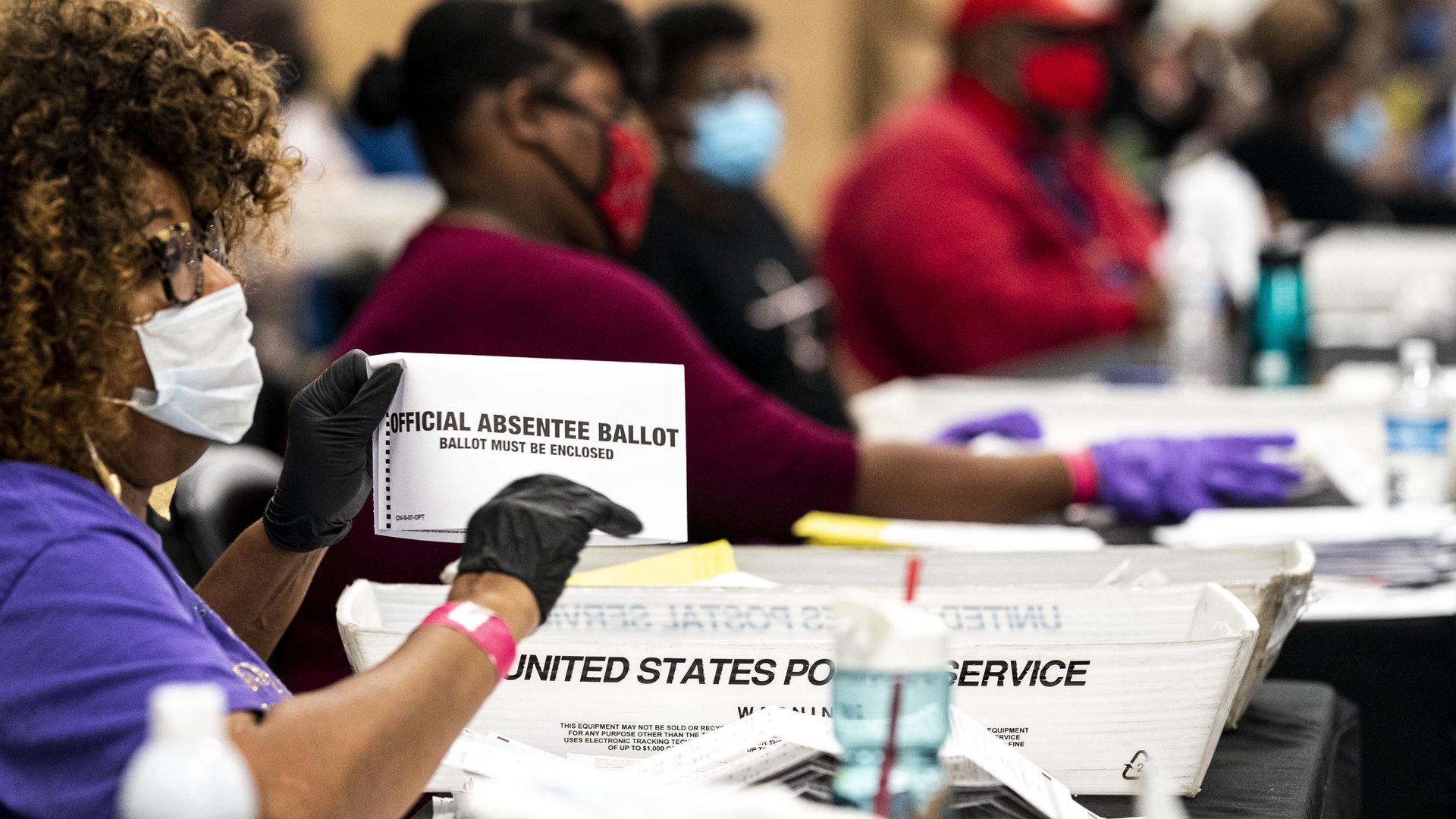
Absentee ballots and overseas ballots are processed in Atlanta, Georgia in Nov. 2020. Photo: Melina Mara/The Washington Post via Getty Images
With less than two weeks left in the presidential race, Republicans have stepped up attacks on overseas and military voters looking to cast ballots from abroad in critical swing states.
Why it matters: The challenges are the latest in a spate of efforts to sow doubt about the election results if former President Trump loses.
- Targeting overseas and military ballots is a new frontier for Trump, who frequently railed against domestic absentee voting during the previous election but did not dispute the validity of overseas ballots.
- The attacks have "had a chilling effect" and have "complicated an already complicated voting process for a lot of our voters," Kate Marsh Lord, communications director of Secure Families Initiative, a nonpartisan nonprofit that advocates for military families, told Axios.
Catch up quick: Over the past few weeks, Republicans in the battleground states of Pennsylvania, North Carolina and Michigan have filed lawsuits challenging the validity of ballots cast abroad.
- The challenges revolve around the Uniformed and Overseas Citizens Absentee Voting Act (UOCAVA), a federal law allowing military members and citizens living abroad to cast absentee ballots in federal elections.
- A Michigan judge on Monday dismissed the RNC's lawsuit, calling it an "11th hour attempt to disenfranchise" voters.
- In another blow to GOP efforts, a North Carolina judge on Monday rejected the RNC's effort to have overseas voters' ballots set aside and not counted until their eligibility could be confirmed.
- The Pennsylvania Department of State said that the lawsuit — which remains pending — "is nothing more than an attempt to confuse and frighten people ahead of an important election.
State of play: Nearly 3 million Americans live overseas and are eligible to vote absentee, according to the Federal Voting Assistance Program. These include active duty military members and their families, State Department employees abroad, and other Americans working and living abroad.
- UOCAVA is intended to simplify the voting process for overseas and military voters. It has never been challenged before, Marsh Lord said, noting that states still have guard rails to protect against any cases of fraud.
- "If any of these lawsuits are successful, they could create significant barriers to voting for our men and women in uniform protecting this country. At the very least, they introduce unnecessary uncertainty into voting for men and women serving our country," David Becker, executive director of the Center for Election Innovation & Research, told Axios.
What they're saying: Marsh Lord said she feels the suits are part of "a pattern that is trying to sow distrust in our elections" and pointed to the lawsuits being filed so close to Election Day. In many states, early and absentee voting is already underway.
- "If this is a true concern about, you know, protecting the election system….Why did they wait so long to file it?" she asked.
- Becker voiced a similar sentiment, saying it was "disturbing to see Republicans wait until just weeks before the election" to challenge such a longstanding law.
The big picture: Cleta Mitchell, a Republican lawyer who helped Trump challenge his 2020 defeat and helped prepare the Pennsylvania lawsuit, told the Washington Post that many Republicans previously assumed that overseas voters were primarily affiliated with the military, before learning that the majority were not.
- The Republican National Committee, which helped file the North Carolina and Michigan lawsuits, did not immediately respond to Axios' request for comment.
- Military members and veterans tend to lean more conservative, though a 2021 analysis by The Economist found that Trump got less support from the military in 2020 than in 2016.
Zoom out: Trump has led the push to paint overseas ballots as evidence of election fraud.
- "The Democrats are talking about how they're working so hard to get millions of votes from Americans living overseas. Actually, they are getting ready to CHEAT!" he wrote in a Truth Social post last month.
- More than 100 lawsuits against various 2024 election procedures have been filed by Republicans nationwide.
The bottom line: "U.S. troops have and deserve the right to vote, and this is just a blatant attack on that," Marsh Lord said.
Go deeper: House Dems and GOP wage bitter fight over military voting
