How on-device AI could shake up the phone app business

Add Axios as your preferred source to
see more of our stories on Google.
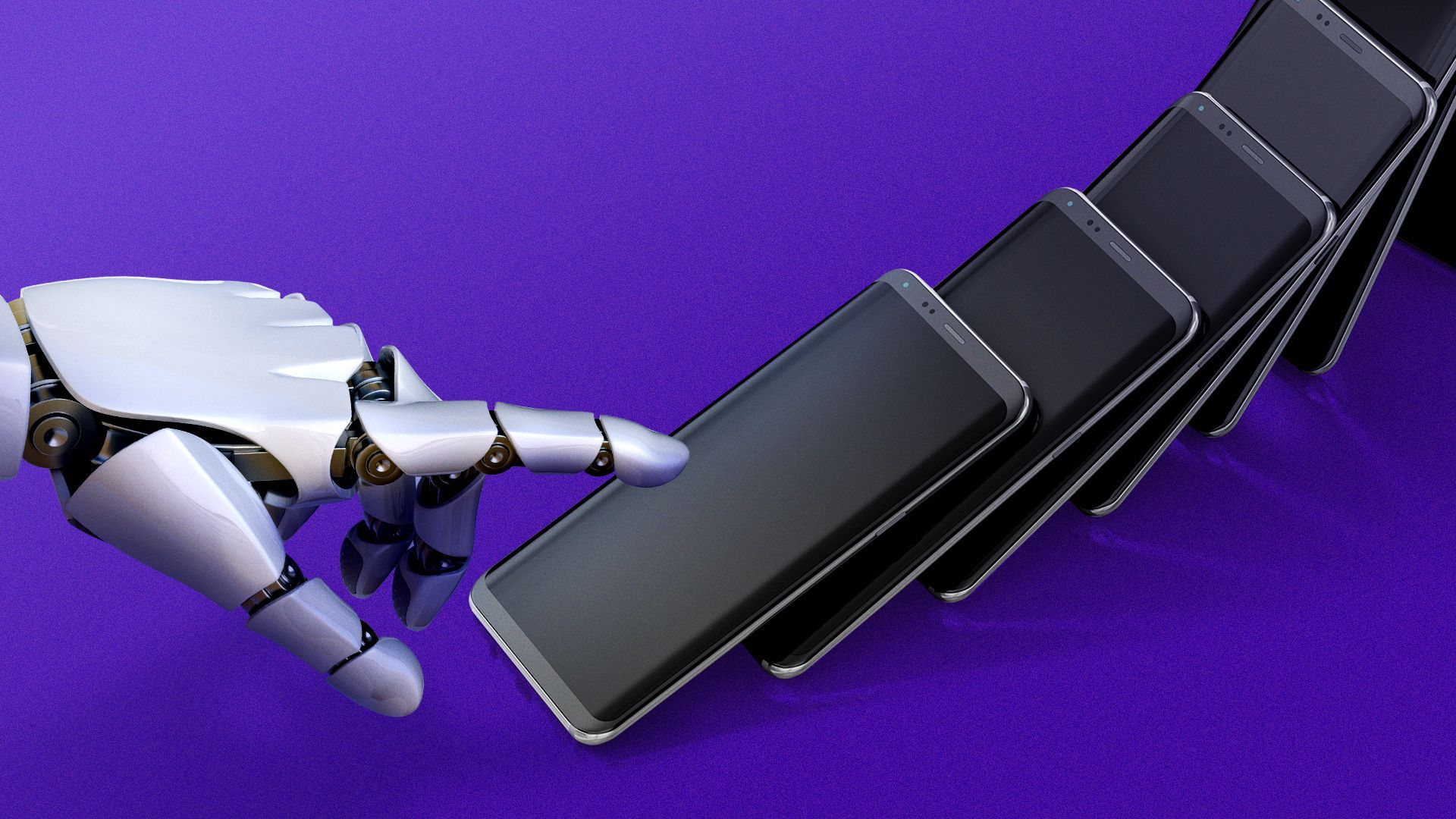
Illustration: Allie Carl/Axios
The arrival of on-device AI could radically reshape the app/app-store model that has ruled the tech industry in the smartphone era.
Why it matters: Apple and Google have dominated the mobile era by controlling the two major smartphone ecosystems and their associated app stores.
Driving the news: Qualcomm on Monday announced it is bringing the next generation of its Oryon chip to the smartphone — basically, putting the full power of a PC processor inside a phone.
- That, combined with improved companion processors, provides a lot of horsepower as Qualcomm looks to enable phone users to run AI models that previously had to operate via a data center.
At the same time, AI companies like Meta, OpenAI, Mistral and others have shown they can improve performance while decreasing the size of their models.
- Today, for example, models with only a few billion parameters can outperform the 175 billion parameter GPT 3.5, which powered the original ChatGPT.
The big picture: Qualcomm CEO Cristiano Amon told Axios that he sees on-device AI fundamentally reshaping tech's competitive landscape.
- "It could change some of the established constructs that we have built in our heads about OSes and app stores," Amon said in an interview on Sunday ahead of the company's Snapdragon Summit this week in Maui.
- "You may pick the agents of your choice, and once the agents understand what you want, the agent is free and not bounded by the OS, an app store or anything like that."
Zoom in: The on-stage demos Qualcomm showed Monday hinted at what that future could look like.
- Honor, a Chinese device maker, showed how an AI agent could be used to take complex actions that would now require human intervention along with the use of several apps.
- In one example, an Honor executive used the agent to cancel online subscriptions, with the AI system looking across AliPay and WeChat and finding a music and cloud service that could be canceled.
- Qualcomm and its partners showed a host of other ways that on-device AI could be used, from improving pet photos to automatically checking one's bank balance before making a purchase.
Between the lines: A video appearance from OpenAI CEO Sam Altman at Qualcomm's event was an indication of this moment's fluidity.
- The two companies did not announce any collaborations, nor do their current areas overlap.
- Qualcomm makes chips for devices that sit at the edge of a network — PCs, phones, cars, wearables — while nearly all of OpenAI's most important technologies run from the cloud.
But Altman's presence in the mix at Qualcomm's conference makes sense in light of comments he made at a different event last week.
- There, Altman spoke about the power of on-device AI to complement what can be done in the cloud — while also noting that cloud-based AI will always be a step ahead of what can be done on an individual device.
- "I am optimistic that we will make progress towards enormously capable models that can run locally," Altman said. "Long term, we will all have huge and powerful models we can run on our own devices, and I think that's great."
The other side: Apple and Google are unlikely to easily cede control of the lucrative smartphone ecosystems they created. Both are putting renewed effort into improving their own ubiquitous assistants, Siri and Gemini, which could be deployed in ways that further entrench their power.
- Apple, for example, has talked about the opportunity for developers to highlight "app intents" that a more powerful Siri could access. But the company will still want to take its cut of digital transactions — and to maintain its present control over content.
What to watch: Amon said apps won't necessarily go away, but they could fade more into the background as AI assistants take center stage.
- As for timing, Amon said he is sure that the transformation will happen over the next five years. "Will it happen in one year, two years, three years, four years? I don't know," he said.
Disclosure: Reporting for this event took place at the Snapdragon Summit in Maui, where I am moderating an AI-related panel on Wednesday. Qualcomm paid for my travel-related costs.
