Behind the Curtain — Election scenario 4: Harris with handcuffs


Add Axios as your preferred source to
see more of our stories on Google.
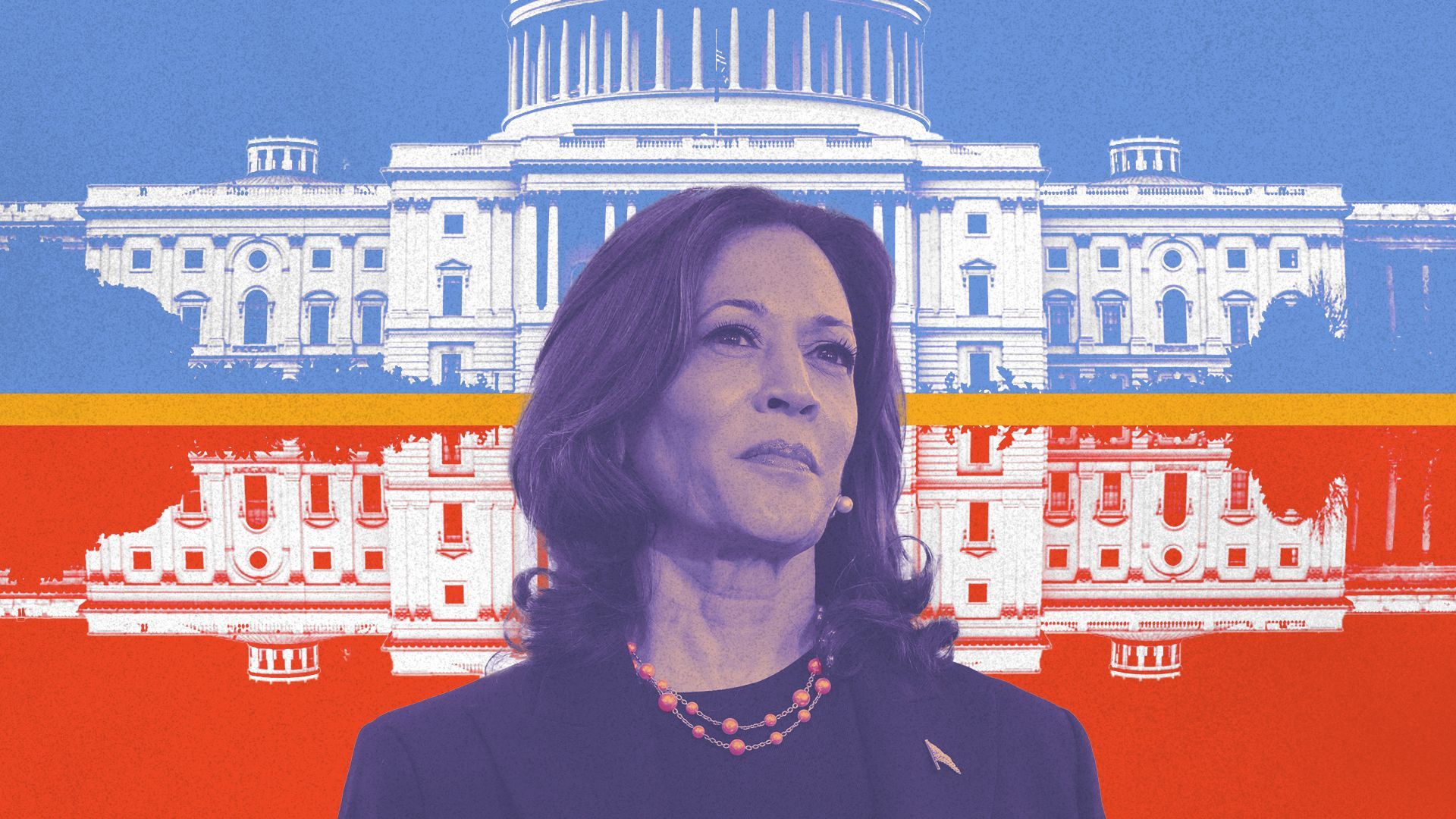
Photo illustration: Sarah Grillo/Axios. Photo: Andrew Harnik/Getty Images
Fourth in a series
If Vice President Kamala Harris takes the White House but not Congress, Washington would face much of the same gridlock and dysfunction it does today — except with an ambitious new president facing off against an oppositional but decapitated GOP.
Why it matters: Harris, handcuffed by Republicans in Congress, would be forced to govern like a more moderate version of President Biden.
There's little appetite, or money, for massive new programs like Biden's green energy and infrastructure plans. Her term would be consumed by finding a middle ground on the Trump tax cuts that expire in 2025, and fighting for smaller wins like subsidies for buying a new home.
- Republicans in Congress would prioritize blocking Harris' more progressive initiatives, particularly on climate, health care and taxes.
The big picture: A private presentation by FGS Global — a worldwide communications and public affairs consultancy advising huge clients on election outcomes — outlines potential policy shifts under a Harris administration that are constrained by a Republican majority in at least one chamber on Capitol Hill.
- This is the final of four columns, combining our reporting with the FGS "Alternative Futures" analysis.
What to watch in a "stalemate" scenario, with a President Harris + GOP control of one or both chambers of Congress:
1. Climate, environmental policy
Harris' climate agenda, which would focus on aggressive emissions reductions and expanding green energy, would face significant opposition in a Republican-controlled Congress. Major legislation to combat climate change would be unlikely to pass, but Harris could pursue regulatory changes through executive agencies.
- Expect Harris to use the EPA and other federal agencies to regulate carbon emissions and push for clean energy infrastructure, including electric vehicles and solar energy.
- Republicans in Congress might try to defund key climate initiatives or pass bills that weaken environmental regulations. But these would likely face a veto from Harris.
- Harris' ability to advance large-scale climate reforms would be limited, resulting in slower progress on green energy and emissions reductions.
- The regulatory push could face legal challenges from industries and Republican-led states, creating a fragmented approach to climate policy.
2. Health care, social spending
- Expanding health care access, a cornerstone of Harris' platform, would be a major point of contention. Republicans would likely block efforts to expand the Affordable Care Act (ACA). But Harris could focus on maintaining existing health care programs and making incremental changes.
- Harris might rely on executive actions to strengthen ACA provisions, including expanding subsidies and enforcing protections for preexisting conditions.
- Social programs — child care, paid family leave and affordable housing — might be scaled back due to budget constraints imposed by a Republican-controlled Congress.
- Republican opposition would block any sweeping changes to health care, preventing Harris from enacting the broader social safety net expansions that progressives want.
3. Tax, economic policy
Economic policy would become a major battleground: Harris would push for tax increases on corporations and the wealthy, while Republicans would work to maintain tax cuts enacted under Trump. Look for major standoffs over the budget and tax policy.
- Harris would likely propose reversing the Trump-era tax cuts for those earning over $400,000, and increasing taxes on corporations to pay for social programs. But Republicans in Congress would block any significant tax hikes.
- Budget negotiations would be contentious: Republicans would aim to reduce federal spending, particularly on social programs and green energy initiatives. There's a high likelihood of government shutdown threats over budget disagreements.
- Harris might use executive actions to address income inequality, by expanding wage protections and encouraging federal contractors to raise wages.
- With no room for compromise on taxes, the wealth gap may remain unchanged, and any significant redistribution of wealth would stall.
- Budget fights could lead to instability in government operations, with periodic threats of shutdowns and delays in funding for key programs.
4. Judicial appointments, courts
If Republicans control the Senate, Harris' ability to appoint judges would be severely limited. GOP senators would likely block or delay the confirmation of progressive judges, particularly for appellate courts and potential Supreme Court nominations.
- Harris could still make appointments to lower courts. But higher-profile judicial appointments, especially to the Supreme Court, would face significant roadblocks.
- A Republican Senate could block judicial nominations. That would maintain the conservative balance in the courts, limiting Harris' ability to influence long-term legal outcomes on reproductive rights, health care and immigration.
- Conservative control over the courts would likely remain intact, preserving Republican gains on abortion, voting rights and executive power.
5. Immigration, border control
- A Republican Congress would force Harris to maintain the more hawkish posture on border security that she's projected on the campaign trail.
- Comprehensive immigration reform would likely be off the table. But Harris could push Congress to take up the bipartisan border deal former President Trump helped kill earlier this year. That could mean more funding for border agents and an overhaul of the asylum process.
- Republicans may use their control over the budget to block funding for sanctuary cities and other humanitarian support for migrants.
- Without support from Congress, Harris' ability to make meaningful reforms to immigration law would be limited, leading to continued legal battles over immigration policy.
6. Foreign policy, global relations
On the international stage, Harris would likely continue President Biden's foreign policy of strengthening alliances and reengaging with multilateral institutions.
- She'd likely prioritize deepening relationships with NATO allies, maintaining a tough stance on China and Russia, and focusing on global cooperation on climate change, cybersecurity and human rights.
- Republicans in Congress would challenge aspects of her foreign policy, particularly around defense spending and trade.
- Harris would focus on diplomacy, rejoining global climate initiatives, and leading efforts to strengthen international coalitions on issues from pandemics to cybersecurity to nuclear disarmament.
- Republicans might push for a more hawkish approach — insisting on higher defense spending, particularly in response to tensions with China and Russia. They may also resist Harris' efforts to scale back military involvement in the Middle East.
- Trade policies could become a point of friction, with Harris seeking to rebuild trade relationships and promote environmental standards. Republicans may push for a more protectionist approach.
Post-election risks: A Harris presidency facing a divided Congress would create a volatile and uncertain political environment.
- This scenario could lead to a series of legal challenges, budget fights and political stalemates — increasing the likelihood of government shutdowns and partisan confrontations.
- A Republican-controlled House could launch investigations into Harris' administration, focusing on alleged mismanagement, ethics violations or unpopular executive actions, while slowing legislation.
- Harris' executive actions could face lawsuits from Republican-led states and industries, particularly around environmental regulations, health care and immigration.
The bottom line: Frequent political battles and legal challenges could create instability — making it difficult for Harris to achieve lasting reforms, and increasing partisan tensions across America.
- Axios' Zachary Basu contributed reporting.
- Go deeper: Read the three previous columns in this series — Trump sweep ... Harris sweep ... Tempered Trump.
🗓️ Join Jim VandeHei, Mike Allen, and Eleanor Hawkins TODAY (Oct. 17) for an Axios Communicators Pro virtual conversation about this series. You'll hear how potential election outcomes will affect business — and what it means for communications leaders. Become a Comms Pro member to attend.
