Nebraska's Supreme Court upholds felon voting rights

Add Axios as your preferred source to
see more of our stories on Google.
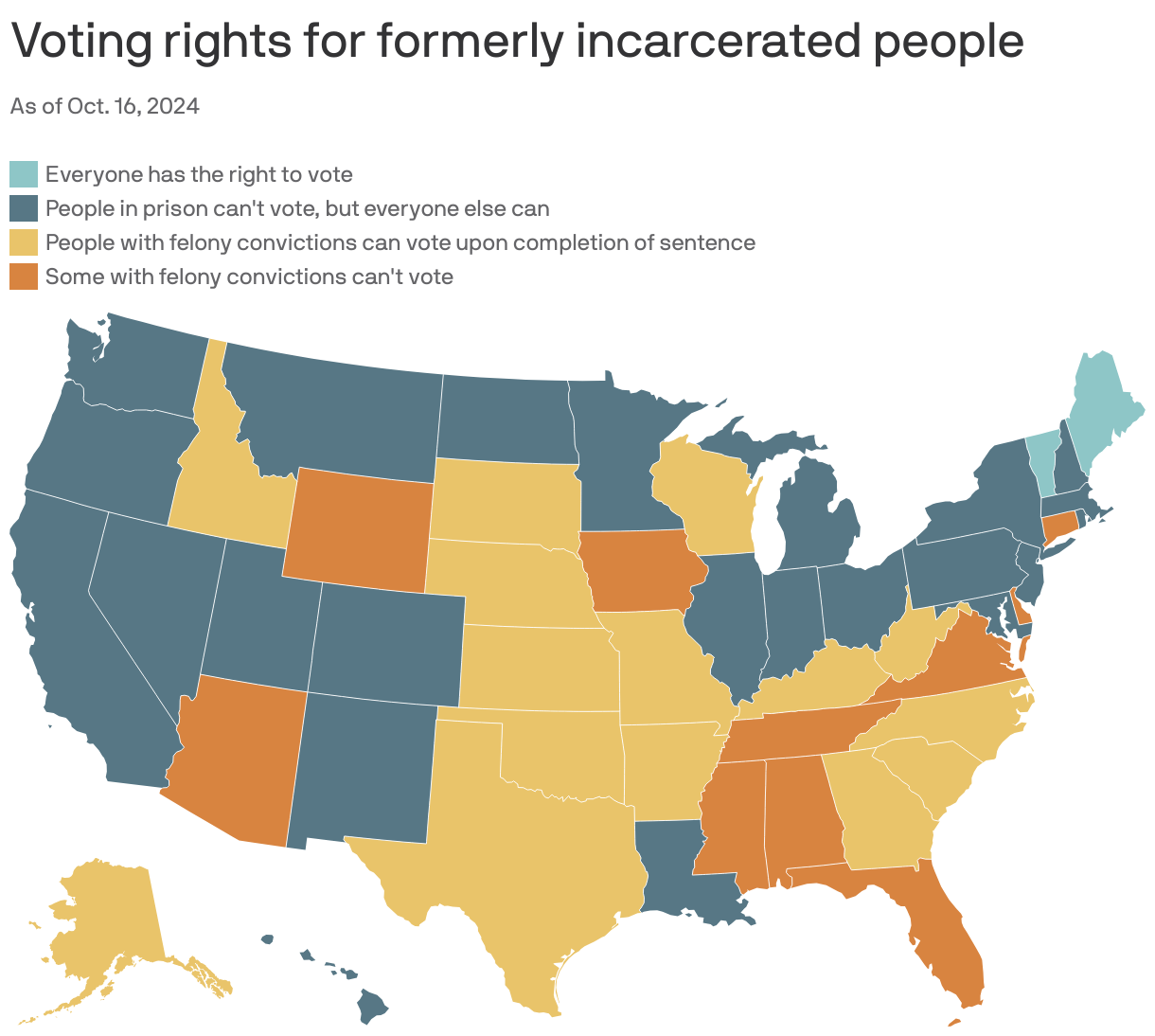
With Election Day just 20 days away, Nebraska's Supreme Court ruled Wednesday that the state's top election official can't bar people with felony convictions from voting after they complete their sentences.
The big picture: The complex — and highly partisan — battle over felons' voting rights has played out in courts and state legislatures across the country, as millions of Americans' suffrage hangs in the balance.
- The state Supreme Court's decision affects an estimated 7,000 felons who are now eligible to cast ballots, according to the state's Voting Rights Coalition.
Catch up quick: The decision from the Cornhusker state's top court resolves confusion surrounding Secretary of State Robert Evnen's order to county officials to stop registering to vote Nebraskans with past felony convictions who had not been pardoned.
- Historically, Nebraska had restored voting rights of former felons two years after they completed the terms of their sentences, but the state legislature passed a bipartisan effort to eliminate the two-year waiting period earlier this year.
- Evnen based his directive on an opinion he sought from Attorney General Mike Hilgers, who contended that the law to immediately restore the voting rights of people who've finished serving is a violation of the state constitution's separation of powers.
- Hilgers argued only the state's board of pardons — which consists of Evnen, Hilgers and Gov. Jim Pillen (all three of whom are Republicans) — could restore voting rights.
What they're saying: "The Secretary is ordered to remove any disqualification on registration he has imposed that is not contained within L.B. 20 and to comply in all respects with the provisions of L.B. 20," the Nebraska Supreme Court ruled.
- In a statement celebrating the directive, the ACLU of Nebraska noted that while felons who have completed the terms of their sentences can now vote, they must do so on a tight deadline.
- Online voter registration in the state is available through Oct. 18, and the last day to register in person is Oct. 25.
Between the lines: The decision comes amid an increasingly tight election.
- A 2019 study found that felons are four times as likely as non-felons to be Democrats or politically unaffiliated.
- Though Nebraska is a ruby red state, the competitive second congressional district often flips blue, as it did for President Biden in 2020.
Zoom out: Democrats in Congress have called for a national law to standardize restoring felons' voting rights, but conservatives in Washington have pushed back on the efforts on a states-rights basis.
- According to the National Conference of State Legislatures, 48 states have some form of restriction on felon voting rights.
- Only in the District of Columbia, Maine and Vermont do felons never lose their right to vote.
Go deeper: Where people with felony convictions can vote in the U.S.
