SAIC's Knausenberger: Mind the "rise of asymmetrical, AI-augmented warfare"

Add Axios as your preferred source to
see more of our stories on Google.
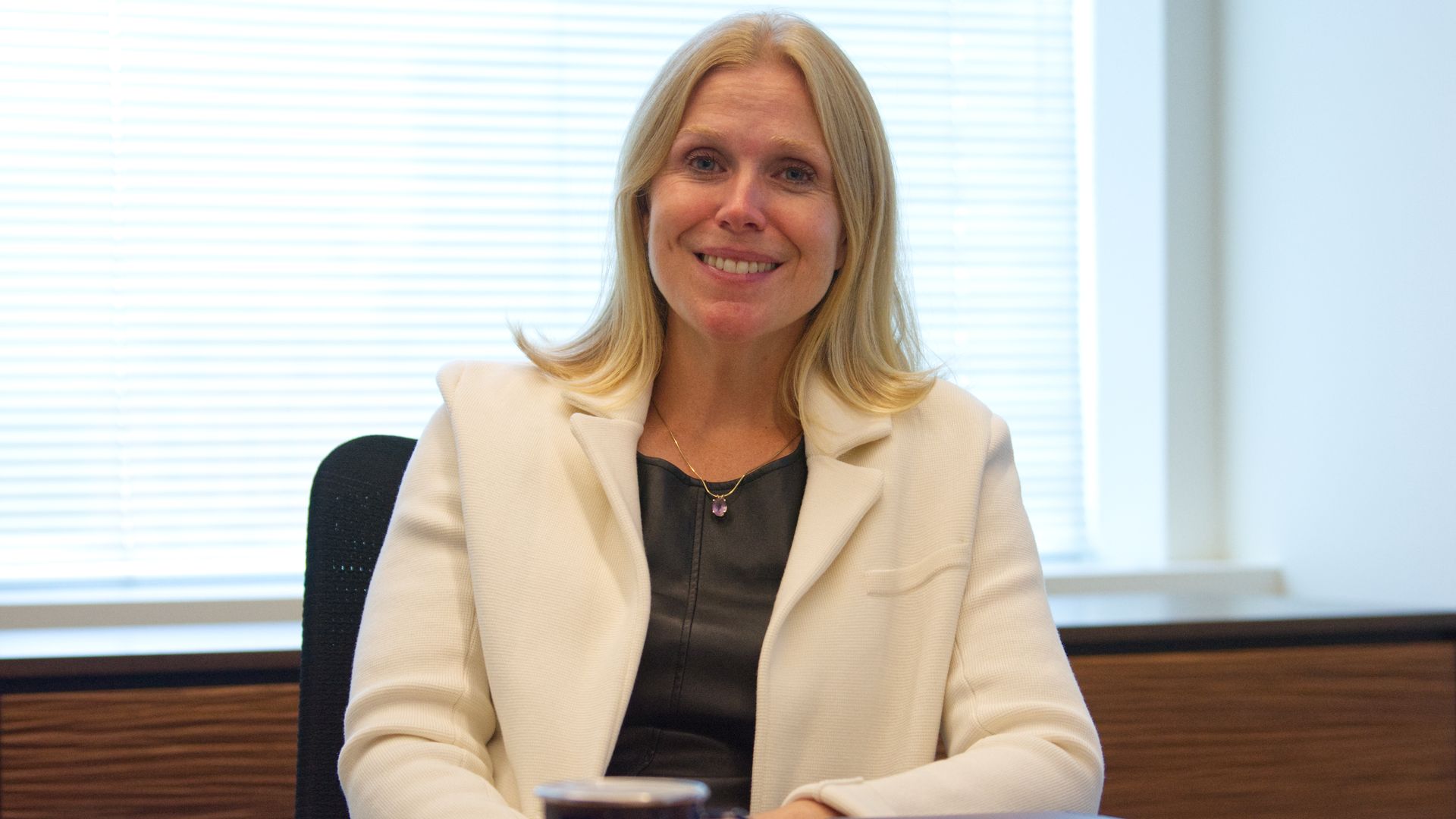
Lauren Knausenberger, at SAIC's corporate headquarters in Reston, Virginia. Photo: Colin Demarest/Axios
One year after joining SAIC, Lauren Knausenberger has thoughts — about artificial intelligence, information warfare, critical infrastructure, commercial innovation and, maybe most importantly, instantly hot water.
- Axios interviewed her at the company's corporate headquarters in Reston, Virginia.
Why it matters: Knausenberger previously served as the chief information officer at the Department of the Air Force, where she oversaw a portfolio totaling $17 billion. She is now the executive vice president and chief innovation officer at SAIC.
Q: When you hear "future of defense," what comes to mind?
A: Really, the general trend of moving more toward automated warfare, asymmetrical warfare, AI-based infiltration of networks and systems, and definitely autonomous systems.
- Another thing that that comes to mind with future of defense is: I think our national defense strategy really has it right with "integrated deterrence."
Q: When will wars be waged solely by robots?
A: Now, for the simple "can you use robots." But if we're talking about "solely waged," then probably we're talking end of days. If we're talking "solely," we've gone completely outside of human accountability.
- I think and hope that, as humans, we will want to keep hold of what are our ideals and what are our objectives, and, at the very least, be giving strategic intent to robots that may fight more and more for us, but that we would continue to stay on top of the accountability and intent for what those robots are doing while waging the war.
Q: What's a national security trend we aren't paying enough attention to?
A: A few on this one.
- There's the rise of asymmetrical, AI-augmented warfare and a world where, increasingly, you have very cheap autonomous systems that can inflict major damage against billion-dollar platforms.
- The vulnerability of critical infrastructure. I think we've gotten lucky that we haven't had more major, catastrophic attacks — but you see things like Colonial Pipeline, vulnerabilities in power grids, any of those types of things.
- Finally, just the ability to drive hearts and minds using social media.
Q: What region of the world should we be watching? Why?
A: Unfortunately, we are beyond the time when we have the luxury of looking at only one region of the world. Even if I just pick one competitor, let's say China, or even two, Russia, we can't just look at Ukraine or Taiwan.
Q: How many emails do you get a day, and how do you deal with them?
A: Too many. And not well.
Q: What's a piece of gear or tech you can't go without?
A: The less-traditional gadget that I have to share is my insta-hot water on my sink at home.
- It's so easy for coffee or tea or oatmeal, or if I'm having people over for cocktails, I can whip up a simple syrup.
Q: What advice would you give your younger self?
A: Just be you. It's going to be OK.
- There's many other pieces of advice I could give my younger self, but I think it all ended up the way it was supposed to be.
