DOJ launches first federal probe of 1921 Tulsa Race Massacre


Add Axios as your preferred source to
see more of our stories on Google.
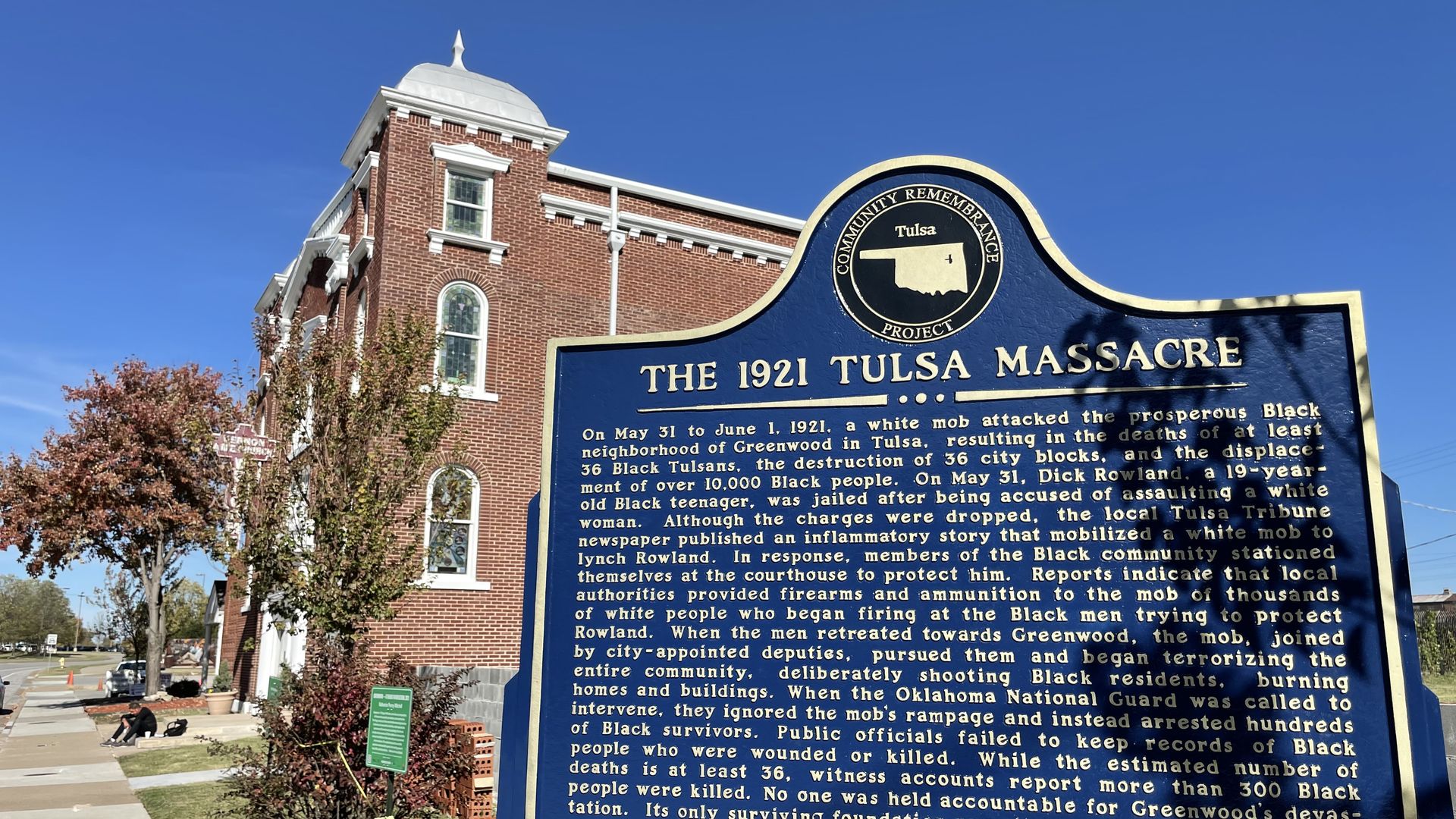
A sign marks the site of the Tulsa Massacre in this November 2021 photo. Photo: Russell Contreras/Axios
The U.S. Department of Justice (DOJ) has opened its first-ever probe into one of the deadliest race massacres in the nation's history more than a century later.
The big picture: A commission, historians, lawyers, and others have investigated the 1921 Tulsa Massacre, but the DOJ never has, leaving Black victims and later their descendants with little acknowledgment from the federal government or compensation for generations of trauma.
Driving the news: Assistant Attorney General Kristen Clarke on Monday announced the DOJ review under the Emmett Till Unsolved Civil Rights Crime Act.
- That law allows the federal government to investigate civil rights crimes that resulted in death and occurred on or before Dec. 31, 1979.
- In recent years, the DOJ's Civil Rights Division has taken the lead in investigating civil rights cold cases that rarely, if ever, saw prosecution from local authorities or the federal government.
What they're saying: "We have no expectation that there are living perpetrators who could be criminally prosecuted by us or by the state," Clarke said Monday.
- "Federal prosecution is often legally impossible because no federal hate crime laws existed at the time of the crime that would have given the federal government jurisdiction over these racial atrocities."
- However, Clarke said the department will issue a report analyzing the massacre in light of both modern and then-existing civil rights laws.
Background: On May 31, 1921, a white mob descended on Greenwood, a thriving Black economic hub in Tulsa, Oklahoma, after unsubstantiated rumors that a Black teen assaulted a white woman.
- City officials deputized members of a white mob who randomly shot and killed innocent Black residents.
- In 24 hours, the mob torched 35 blocks of Black-owned businesses, churches, homes, a library, a school, and a hospital.
- The vigilantes wiped out Greenwood's vibrant Black economic hub, known as "Black Wall Street."
Zoom in: No one was charged in the mass killing of some 300 Black residents.
- The city later prevented many Black residents from rebuilding by refusing to sell them construction materials. Many moved into makeshift tents.
- Researchers recently found a mass grave at Oaklawn Cemetery that some believe are victims of the race riot.
Zoom out: Suzette Malveaux, a law professor at Washington and Lee University who has advocated for justice on behalf of the survivors of the massacre, told Axios she applauded the DOJ's decision.
- "They will be able to unearth information that wasn't retrieved before. These cold cases are important in understanding what is possible in our history so we don't repeat it," she said.
- "This was literally erased from the history books, so many people had no idea that this had taken place."
Between the lines: The Tulsa Race Massacre generated more interest in recent years after it was depicted in two HBO series, "Watchmen" and "Lovecraft Country."
- The U.S. in 2019 marked the 100th anniversary of Red Summer — a series of similar race massacres where white mobs across the country destroyed Black communities from Chicago to Elaine, Arkansas.
- Earlier this year, an Oklahoma judge dismissed a lawsuit from three survivors of the massacre who were seeking reparations. A lawyer for the survivors said at the time they would appeal the decision.
Go deeper: Uncovering the Tulsa Race Massacre after 100 years
Editor's note: This story has been updated to include comments from Suzette Malveaux.
