Air Force's next-gen fighter faces "another question mark"

Add Axios as your preferred source to
see more of our stories on Google.
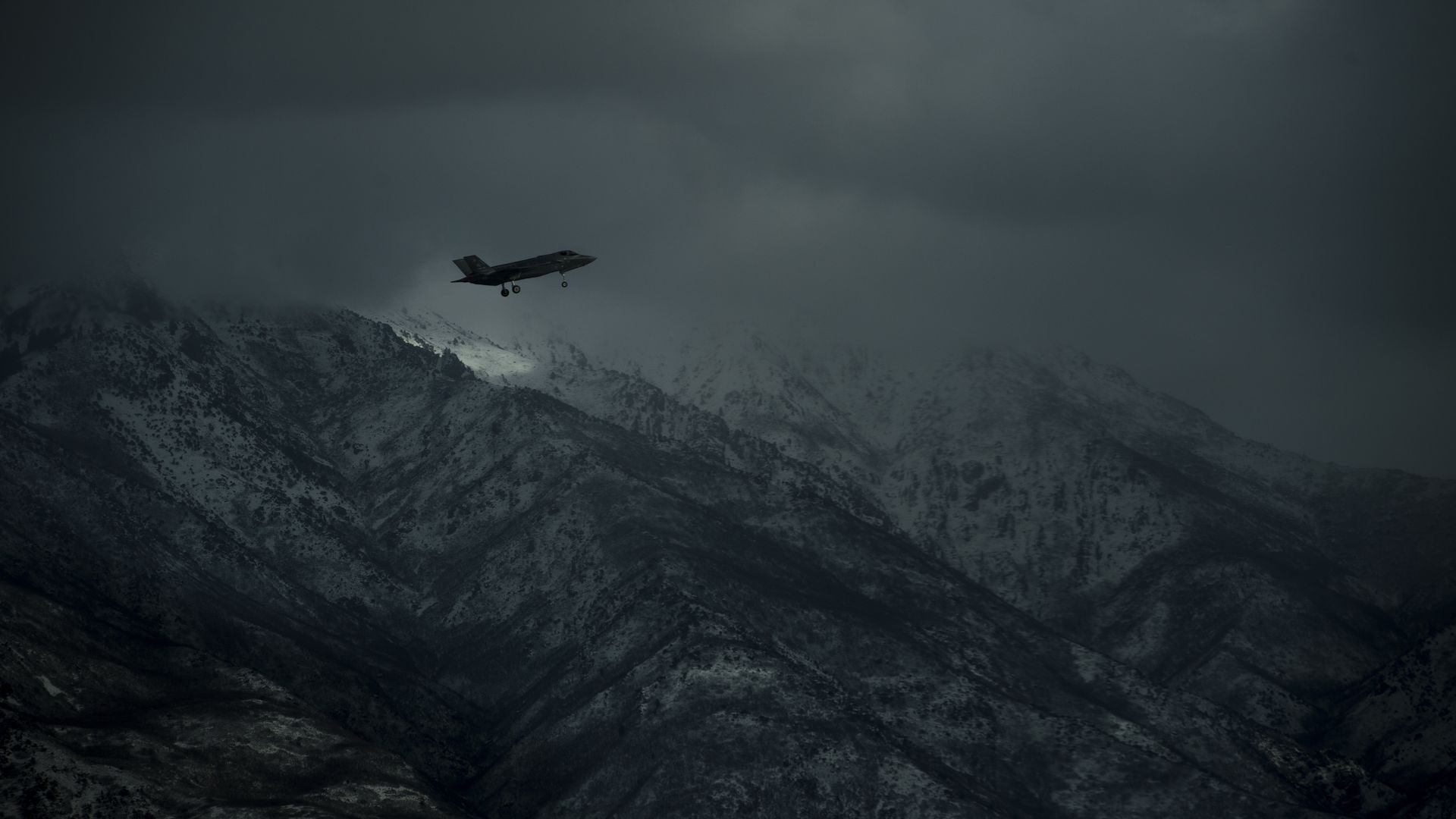
An F-35 zips past the Wasatch Mountains near Hill Air Force Base, Utah. Photo: Andrew Lee/DVIDS
It's back to the drawing board for the U.S. Air Force as air superiority is shaken by sophisticated drones, budget pressures back home and a growing appetite for mass, not rarity.
Why it matters: Fights abroad and industry's technological leaps are forcing militaries to rethink their biggest investments, including heavy armor and aircraft.
Driving the news: Months after the Air Force paused its Next Generation Air Dominance program, or NGAD, Secretary Frank Kendall told reporters the service is "taking a very hard look at whether we've got the right design concept."
- "The requirements are several years old now," Kendall said on the sidelines of the Air, Space and Cyber Conference in Maryland. "The concept, if you will, was an F-22 replacement designed very much for a specific mission under a specific set of circumstances."
- Robo-wingmen and other flying, armed computers have since come a long way.
Cost projections for an NGAD fighter at one point sat around $300 million. That's now too rich, according to Kendall, whose current preference is closer to the price tag of an F-35, or $80-100 million.
- "There's a real range in there," he said. "We need a unit cost that's affordable in significant numbers."
Between the lines: Such a gulf implies a major redesign.
- Cutting costs could mean sacrificing range and payload, going from two engines to one, and other "large-scale changes," according to Air and Space Forces Magazine and Aviation Week.
- "Whether there'll be variants that might be crewed or uncrewed is another question mark," Kendall said.
What they're saying: Vice Chief of Staff Gen. James Slife at another event said he "wouldn't rule anything out" but also "wouldn't rule anything back in."
- While lack of specificity can be blamed on the program's secretive nature, the public messaging feels like indecision.
- "How do we achieve air superiority in a contested environment? That would be one way to frame the question," Slife said. "A different way to frame the question would be: How do we build a sixth-generation manned fighter platform?"
Flashback: The Air Force intended to pick a contractor this year.
- Lockheed Martin and Boeing were considered top dogs. But Northrop Grumman CEO Kathy Warden this month suggested the company would play ball.
- Defense-contracting behemoths and smaller, specialized firms will chip into "whatever NGAD turns into," according to Slife.
What's next: A decision is due in the next few months. Industry and Congress are applying pressure.
