Deadly African floods stem from unusual atmospheric ingredients

Add Axios as your preferred source to
see more of our stories on Google.
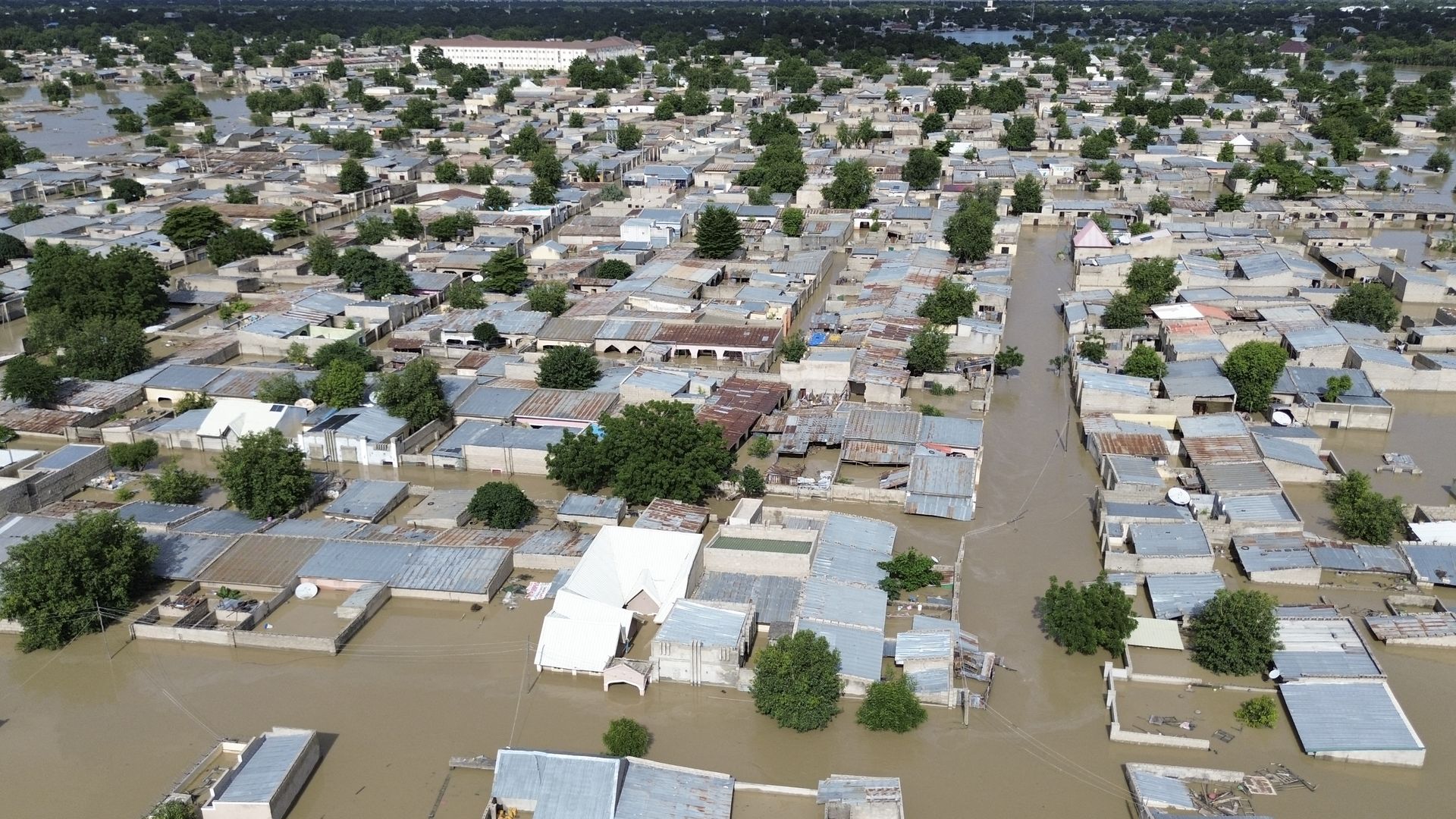
Houses are submerged in Maiduguri, Nigeria, on Sept. 10. Photo: Audu Marte/AFP via Getty Images
At least 1,000 people have been killed and millions more displaced, by floods across Central and Western Africa. Parts of Nigeria, Mali, and Niger have been particularly hard hit by some of the heaviest rains in decades.
Threat level: The flooding, which has hit some of the driest places in the world, has displaced large groups of people and drowned many who could not escape swiftly-moving water in time.
- In Nigeria, floodwaters collapsed a wall at a correctional facility and reportedly freed more than 200 inmates.
- In recent weeks, flooding has hit many other areas that typically see an inch or less of rainfall in September, including Chad, Morocco and Algeria.
- The threat for additional flooding rains continues in the semi-arid Sahel region.
The big picture: There are clear climate change ties to the extreme rains, but formal studies will have to be done to tease out the climate signals from the background noise of natural climate variability. Those studies will not be an easy task in Africa, where long-term weather observing stations — along with early warning systems — are especially lacking.
- Particularly, there is the trend toward more frequent and intense heavy precipitation extremes, which is occurring globally as air and ocean temperatures warm. This sends more moisture into the atmosphere, which storms can tap into to deliver punishing downpours.
The intrigue: There is another factor at work, though, that is unique to this moment in time and is determining the countries that are most greatly impacted by the flooding.
- A key climate feature known as the Inter-Tropical Convergence Zone has been displaced northward by hundreds of miles in recent months.
- This explanation ties directly into the lack of Atlantic hurricanes developing in the so-called "Main Development Region" off the west coast of Africa and the absence of hurricane threats across parts of the Caribbean and East Coast so far.
- The northerly displacement of this climate staple has brought repeated bouts of rainfall to the heart of the Sahara Desert, where such rains are rare, and the land is unable to absorb large amounts of moisture.
- Instead, heavy rain runs off the surface and into communities.
Between the lines: Some climate studies have shown the potential for a northward movement of the ITCZ due to human-caused climate change.
- This occurs in part because of the unequal warming rates of the Northern and Southern hemispheres.
- Because it has a greater land area, the Northern Hemisphere is heating up faster than the ocean-dominated Southern Hemisphere. This may, in turn, be affecting the location of atmospheric features that help drive the ITCZ.
- Studies also show that in some regions, such as the tropics of South America, the ITCZ could become more prone to significant swings from season to season as the climate warms.
Yes, but: It is not yet clear if a climate change-driven, long-lasting northward seasonal shift of the ITCZ is taking place, or if this season is an aberration, driven more by natural climate variability.
- The fact that 2024 is likely to beat 2023 as Earth's hottest year in modern record-keeping, however, lends some suspicion to it being at least partly climate change-driven.
What they're saying: Hurricane researcher Jim Kossin told Axios the ITCZ has continued to be displaced to the north, leading to the rainfall that has exacted such a heavy humanitarian toll.
- Philip Klotzbach, a hurricane expert at Colorado State University who tracks developments across Africa due to its hurricane season influence, says the displaced ITCZ has placed an active West African monsoon in an unusual region.
- These rains have resulted in striking precipitation departures from average throughout the Sahara region and in normally dry areas of some of these countries, like northeastern Nigeria, where rain is typically scarce at this time of year.
- Some of the tropical waves that would typically move from east to west over the Atlantic have curled northwest, then northward across Morocco, dumping hefty amounts of rain in the process.
The bottom line: Anomalous background conditions can lead to unusual, and unfortunately deadly, outcomes when it comes to extreme weather and climate change.
