Data centers set to spike U.S. electricity demand

Add Axios as your preferred source to
see more of our stories on Google.
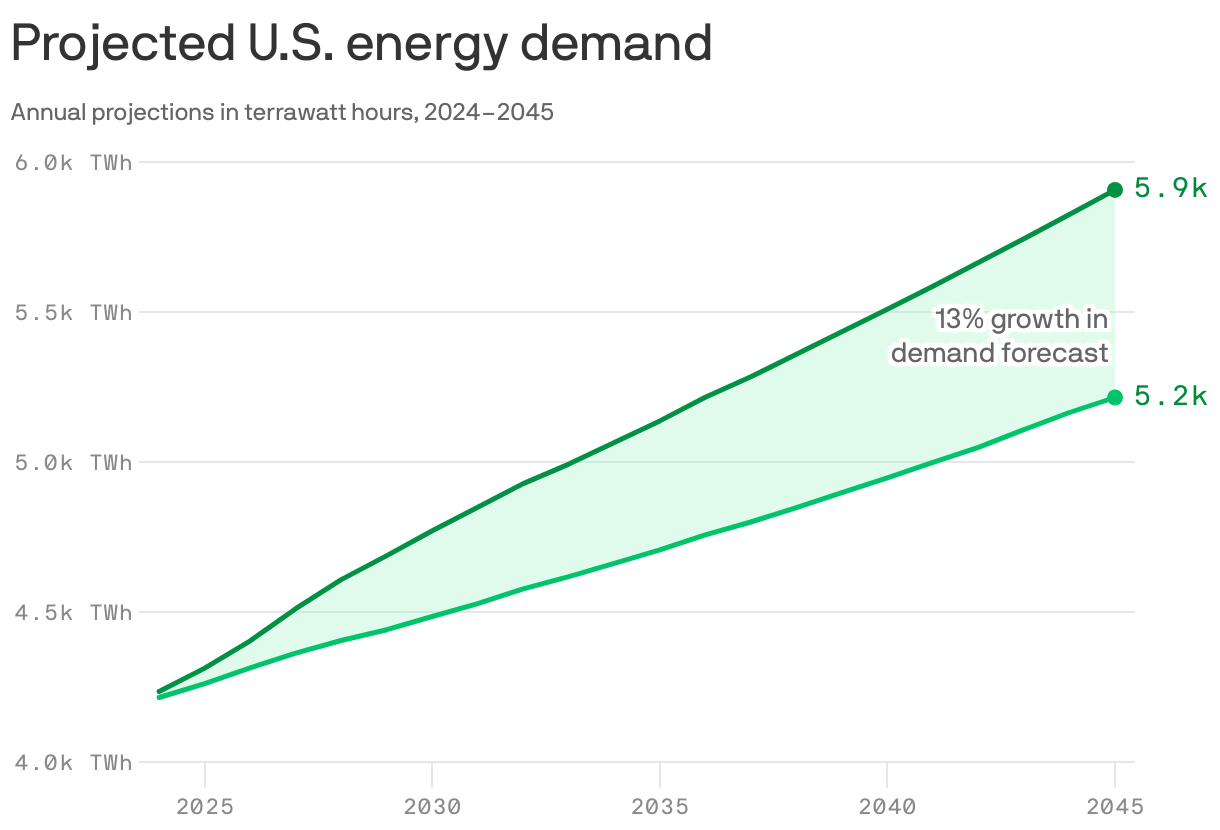
The rise of artificial intelligence, as well as building and vehicle electrification trends tied to cutting greenhouse gas emissions, are poised to drive a rapid growth in U.S. electricity demand, according to a new report.
Why it matters: The research released Thursday from the consulting firm ICF adds to the signs pointing to the increasing thirst for electrons in the U.S.
- It also shows some of the ramifications this could have for utilities and energy companies trying to meet demand while hitting emissions reduction targets.
Between the lines: Consumers could end up paying the price of poor planning.
- Amid the mismatch between supply and demand, the cost of electricity could spike by a national average of 19% by 2028, the report finds, adding that much of the increase would be passed on to customers.
- But a combination of demand side management, such as virtual power plants and incentives to consumers for reducing their electricity use at peak load times, could ease the strain on utilities.
- So, too, could measures that slash the backlog in approvals for connecting new solar, wind and energy storage facilities to the grid.
Zoom in: The report shows that the decades-long era of flat electricity demand nationwide is ending.
- The ICF research team concluded that demand could increase by an average of 9% by 2028, while peak demand for electricity could jump by an average of 5% during the same timeframe.
- ICF found that while electricity demand is likely to climb across the country, the rates of increase won't be uniform.
- The biggest increase is projected to be in the mid-Atlantic region, home to data center alley in Northern Virginia, due to data center demand coupled with growing use of EVs and building electrification.
- The numbers for this area are enough to make a utility leader's head spin: A demand increase of 68% by 2050, compared to the national average increase of 57%.
Reality check: These numbers are likely to change further, potentially even increasing more, depending on how many data center applications are approved and where, among other factors.
The intrigue: ICF's analysis comes as other research groups, industry officials and organizations and the Department of Energy are trying to determine how to meet the increasing electricity needs.
- The power demand increase wasn't high on DOE's radar until recently, since the latest projections in energy demand, including peak demand, are far higher than they were just last year.
- The report emphasizes the difficulties ahead for bringing new "clean" energy resources online, including electric grid upgrades, and the backlog in approvals for building new transmission lines and connecting them to the grid.
- Some utilities are likely to turn to natural gas plants in the near-term to bring on reliable power sources with a proven record of approval and transmission, despite the fact that it is a planet-warming fossil fuel.
- "The rise in electricity demand combined with the nexus of generation, transmission, distribution, regulatory, and policy constraints could slow the transition to clean, reliable, and affordable electricity," the report states.
What they're saying: ICF report coauthor Patty Cook said utilities are facing a "trifecta of challenges."
- "They're trying to deal with addressing demand growth, many utilities are trying to achieve net zero goals, and they're trying to integrate more renewables, which are all intermittent, and they're trying to also deal with extreme weather events," she told Axios in an interview.
- She compared the conflict between decarbonization goals and demand growth as a new type of energy crisis but emphasized that utilities have flexibility in how they address it, both on the supply and demand sides.
One coming challenge that is going under the radar, Cook said, is affordability.
- "You have this desire to achieve decarbonization, and you have to manage the grid in a reliable way, and it has to be affordable. Those three things. You can't pick two," she said.
- "I think that's what people are really overlooking, is just how big an impact this is going to be on customers and in terms of affordability impacts, and what is the, what is the least cost, best fit way of addressing that?"
Go deeper:
Energy Department's advisers call for agency's own AI data center testbed
