

Illustration: Sarah Grillo/Axios
Where the world sees a growing problem with power-hungry AI data centers, entrepreneurs and investors see a major opportunity.
Why it matters: Data centers' unquenchable thirst for electricity has created an emerging sub-sector within the Big Tech space.
Driving the news: On Tuesday night at a buzzy party in Los Angeles, startup Exowatt unveiled details of its solar storage product dubbed the Exowatt P3, built to help power AI data centers.
- The company, backed by Sam Altman, Leonardo DiCaprio and a16z, among others, dramatically unveiled the solar thermal battery box on the back of a semitruck to a room full of investors, potential customers and the media. DiCaprio attended the event, sitting in the front.
- The Miami-based startup said that Switch, a data center operator in Las Vegas, would be a customer, and says it has further demand from data center companies for 1.2 GW worth of deployments.
- The company, which was incubated out of Miami VC Atomic, said it plans to sell each 25 kwh solar battery box for $7,500 and said the boxes can generate electricity at 4 cents per kwh before subsidies.
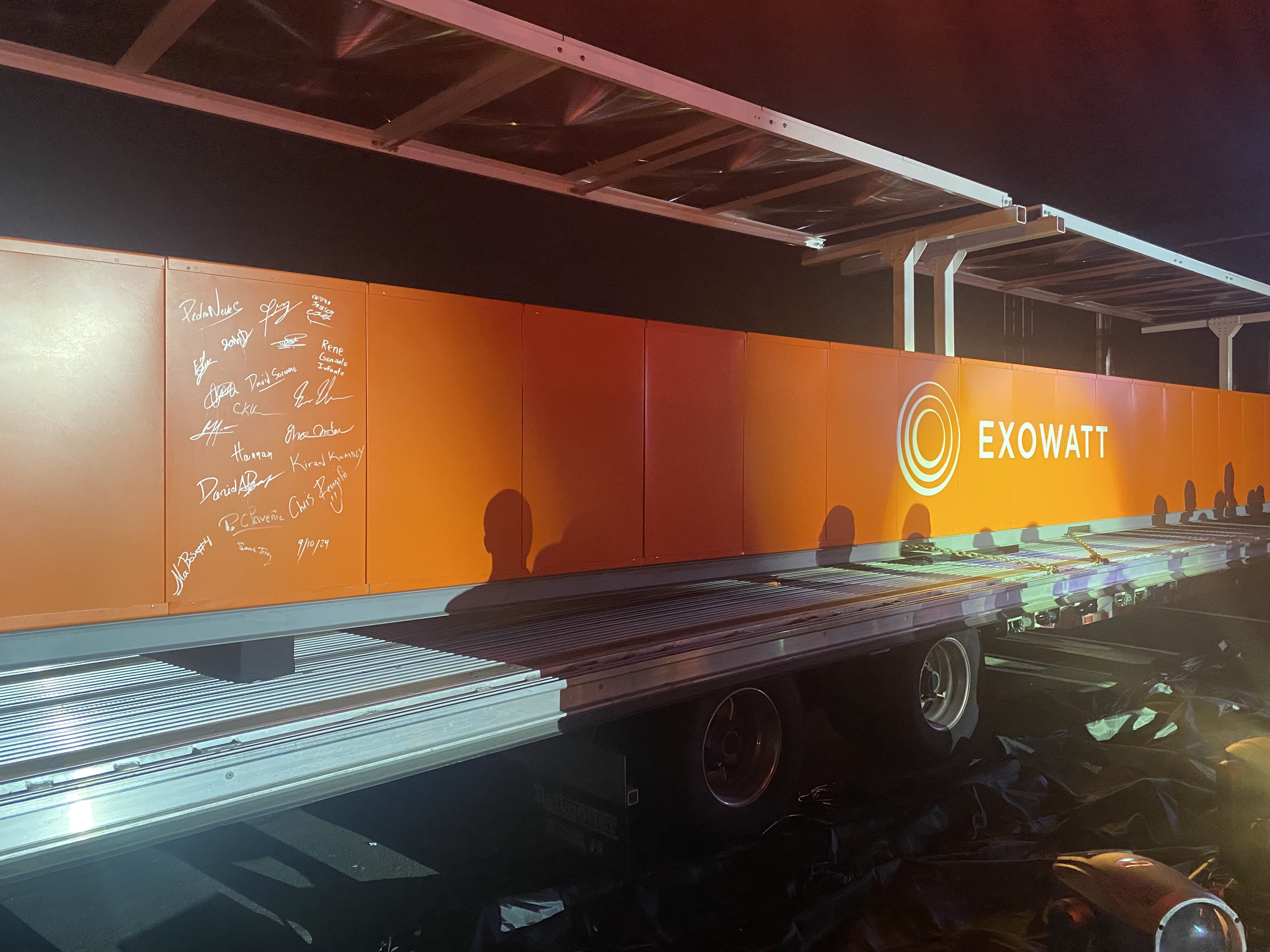
How it works: Exowatt's P3 uses solar lenses to concentrate the sun's light to create heat and stores that heat in a thermal battery made of a silicon-based composite material. An engine circulates the heat.
- The boxes can be deployed off grid or used to augment the grid.
Reality check: Years ago, investors blew millions of dollars backing startups that had developed different types of solar thermal, or concentrating, tech.
- As solar panels plummeted in cost and rose in efficiency, tapping solar heat for electricity didn't make much sense.
- Exowatt is a young company that plans to deploy its first tech later this year and relies on third-party contract manufacturers to make its boxes.
The big picture: Amazon, Google and Microsoft, as well as smaller data center companies, will be spending a massive amount of money building out data center infrastructure and procuring energy for them.
- In a year when climate tech financing has gotten more difficult, entrepreneurs are hoping this major spigot of money will flow their way.
- Companies that have targeted data center customers include geothermal players Sage Geosystems and Fervo Energy, project developers Crusoe and Cloverleaf Infrastructure, and carbon removal startups like Holocene.
The two paths for AI data center energy
There are diverging paths that Big Tech can choose to power up data centers for AI: a traditional gas-reliant grid, or more complicated clean energy options.
Why it matters: Billions of dollars are at stake when it comes to what path a company takes on this route.
Zoom in: Solar and wind will account for much of the new electricity needs.
- Amazon's 28 GW of clean energy capacity gives it the title of the largest corporate buyer of clean energy in the world.
Yes, but: There's a bottleneck when it comes to getting projects deployed.
- "The key gating item to get these projects built is connection to the grid," says Wyatt Hartley, managing partner, renewable power & transition for Brookfield, which is constructing 10.5 GW of clean energy (mostly wind and solar) for Microsoft.
- Data center operators also want more energy that runs 24/7, called baseload power, in contrast to solar and wind, which is variable unless paired with storage.
The intrigue: Some tech companies are turning to emerging climate technologies that are less mature and more expensive like next-gen geothermal, advanced nuclear, natural gas with carbon capture, and carbon removal.
- Google and Meta have been key partners for first-of-a-kind geothermal plants with young startups.
- Microsoft did the world's first corporate deal to buy fusion power from Helion, a startup funded by OpenAI CEO Sam Altman.
- Microsoft is also the largest purchaser of carbon removal credits in the world, and its investment grew by five times in 2023 compared to 2022.
Zoom out: Beyond the emerging tech, the so-called hyperscalers are trying to get creative with clean energy.
- Part of Microsoft's deal with Brookfield will include "repowering" of wind farms, which is upgrading older wind plants so they produce more power.
- Some companies are building naturally clean-powered data centers in cooler climates, such as Iceland.
Reality check: Other companies will build data centers in regions where utilities are expanding natural gas, like the South.
- "We will have to use gas, quite frankly, as a transition fuel. There's no getting around that," says Andrés Gluski, CEO of The AES Corporation, which is a major power provider for tech companies' data centers.
- To offset the emissions of natural gas, tech firms can buy renewable energy credits and try to maintain their sustainability goals. Some tech companies like Google are transitioning to tighter accounting.
- Data center operators could also become major buyers of carbon capture systems paired with natural gas.
The bottom line: Big Tech will likely opt for as much power as it can get to compete on AI, expanding with both clean, and dirty, electricity.
AI data centers could boost CCS
AI data center operators could become key customers for carbon capture and storage, an important climate tech that's been held back by high costs.
Why it matters: As more carbon capture projects are deployed, the more costs will drop, and the more the tech will spread.
Zoom in: Data center energy startup Crusoe says it has a pipeline of projects where it's developing natural gas plus carbon capture and storage that could operate without a grid connection.
- The idea is that these projects could be faster to build than powering a data center with grid-connected clean energy since they don't need to wait in a long interconnection queue.
- Data center workloads "catalyzing the CCS revolution and finally making it economic is a really powerful thing," said Cully Cavness, co-founder and president of Crusoe.
- Separately, fuel cell maker Bloom Energy said it's in active discussions with data center customers about pairing carbon capture tech with its systems that typically run on natural gas, says Bloom Energy CTO Ravi Prasher.
Reality check: Carbon capture and storage tech has long been technically viable but prohibitively expensive for most gas or coal plants.
- That's starting to change as supportive policies, like Canada's ITC and the U.S.'s IRA, are helping lower costs.
- Expect pushback from environmentalists on any tech companies' investments in gas plants with CCS.
- Microsoft considers natural gas with carbon capture and storage a form of renewable electricity, while Google defines "advanced clean energy technologies," as including "power generation with carbon capture and storage."
By the numbers: There are only a handful of carbon capture and storage projects actually operating but many more in development.
- Wood Mackenzie estimates that global carbon capture capacity will grow to 505 Mtpa by 2030, while the sector had 54 Mtpa in operation at the end of 2023.
- A report from Morgan Stanley says it sees a significant opportunity for carbon capture utilization and storage for data center operators but expects the demand for CCS projects for power for data centers to be far greater than actual projects planned.
1 fun thing: Landfill gas-powered AI data center
Smaller data centers built for AI could be powered by an unexpected bit of energy: biogas from landfills.
Why it matters: Data center operators could emerge as major customers of renewable natural gas, some of it from landfills, to meet their growing electricity needs.
Zoom in: Data center energy startup Crusoe has a data center project that's under development that will tap landfill biogas, says Crusoe president and co-founder Cully Cavness.
- The data center will be smaller in scale, requiring tens of megawatts instead of hundreds for power, and is planned to be built near a city.
- The facility will be used for AI interference, which is when an AI model draws conclusions from new data. Much of the data centers being built today are training AI, feeding models massive amounts of data.
- Microsoft is building a data center in San Jose that plans to use biogas from food waste to power a microgrid as backup power.
Catch up quick: Biogas, or renewable natural gas, is methane captured off of systems at wastewater treatment plants, dairy farms, landfills or food waste reactors.
- The Inflation Reduction Act has helped to boost the number of systems deployed in the U.S.
The big picture: Companies are on track to funnel $1.5 billion into new biogas systems in the U.S. this year, according to the American Biogas Council, a trade group.
Yes, but: The size of the biogas market in the U.S. is a small fraction of the overall natural gas market and is limited by the number of locations where anaerobic digesters can be used to convert organic waste.
